




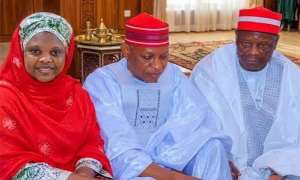
There is a serious fact about the way the reported marital crisis involving Zainab Kwankwaso and her husband, Abba Kabir Yusuf, Governor of Kano State, has captured public attention. Much of the discussion has continued to revolve around the political implications of the development, the relationship between the governor and his former political mentor, Senator Rabiu Musa Kwankwaso, and the possible consequences for the political fortunes of those involved. Yet, in all of the actors' political calculations, family disagreements and speculation, one group of people appears to have been almost completely forgotten: the six children born of the marriage. Who speaks for them? Who is asking how they feel about the possibility of their parents separating? Who is considering the emotional, psychological, social and material consequences of the situation for these young people? And, perhaps more importantly, who is ensuring that their interests are not sacrificed on the altar of parental disagreements, family loyalties and political rivalries?
These questions are not intended to prejudice the divorce proceedings reportedly initiated by Zainab. Neither are they an attempt to deny her the right to seek the dissolution of her marriage. Adults have the right to make decisions about their personal circumstances, including the decision to leave a marriage that they feel has become unbearable. No woman should be compelled to remain in a marriage simply because she has children. By the same token, no man should be forced to remain in a marriage against his will. Marriage is a relationship that requires the willingness, commitment and cooperation of both parties.
When a marriage has produced as many as six children, its possible dissolution raises considerations that go beyond the personal preferences of the two adults involved. It introduces responsibilities that neither husband nor wife can simply ignore. A marriage might end, but that doesn't in any way end parenthood. It does not. The children remain the children of both parents, irrespective of whatever disagreements may have made their continued life together no longer plausible.
According to newspaper reports, Zainab has approached an Upper Area Court in Gudu, Abuja, to seek a dissolution of her marriage to Governor Abba Yusuf under the Islamic legal principle of Khul'i. Her reported application cites the absence of mutual love and affection, a loss of emotional attachment and unsuccessful attempts at reconciliation. She is also reported to have offered to refund the bride price paid by her husband at the time of their marriage. These are matters for the court to examine in accordance with the applicable law and the evidence presented by the parties. The governor, too, is entitled to present his position and to be heard.
Nevertheless, the existence of six children makes it necessary to look beyond the legal contest between their parents. A court will eventually determine whether the marriage should be dissolved, but the consequences of whatever decision the court takes in the circumstance will definitely extend into the daily lives of these six young people who had no part in whatever disagreements brought their parents to this point.
Children do not necessarily understand marital disagreements in the same way adults do. To them, their parents are not political associates, members of influential families or public office holders. They are simply Mum and Dad. They are the people whose presence, affection, guidance and protection provide the foundation upon which childhood security is built. When that foundation is disturbed, children can experience confusion, anxiety, insecurity and even a sense of personal rejection. Some may begin to wonder whether they did something wrong. Others may feel compelled to choose between their parents, particularly where the separation is accompanied by hostility between the two families. Older children may understand more of what is happening, but understanding does not necessarily make the experience less painful.
The consequences can be especially complicated where the parents are prominent public figures. The children might find themselves exposed to newspaper reports, television discussions, social media commentary and conversations among people who know little or nothing about their private circumstances. Their parents' marital difficulties can become public entertainment in which their own emotional needs receive little consideration.
This is why this public conversation should be approached with restraint and responsibility. The six children should not be identified, photographed, questioned or subjected to unnecessary publicity. Their privacy deserves protection. They should not become instruments through which supporters of either parent attack the other. Nor should they be made to carry the burden of political disagreements between adults.
There is another dimension to this matter that deserves attention. The marriage reportedly dates back to 2006, when Abba Yusuf was an aide to Rabiu Musa Kwankwaso. The relationship between the two men subsequently developed into a close political association, with Kwankwaso providing considerable political support to Yusuf, who eventually became governor of Kano State in 2023. However, the political relationship reportedly deteriorated following Yusuf's defection from the New Nigeria Peoples Party to the All Progressives Congress in January 2026. The development created a serious disagreement between the governor and his former political mentor, who is also said to be Zainab's uncle.
The coincidence of this political disagreement with the reported marital crisis has inevitably attracted public attention. Some observers have wondered whether the political differences between the two men contributed to difficulties in the marriage. Others have suggested that the circumstances surrounding the separation may have wider family and political implications. But these will remain matters of speculation unless they are supported by credible evidence. So, it would be unfair to attribute Zainab's decision to seek a divorce to her uncle's political interests without establishing that connection. She is an adult with her own rights, feelings and reasons, and should not automatically be regarded as an instrument of another person's political calculations.
At the same time, it is reasonable to ask whether the wider family disagreements have been kept sufficiently separate from the children's welfare. If political differences between their father and their maternal uncle have created tension within the extended family, the children should not be made to suffer the consequences. They deserve to maintain meaningful relationships with both sides of their family, provided those relationships are safe and beneficial to them. Indeed, one of the greatest responsibilities confronting separated parents is ensuring that their children do not become victims of divided loyalties. A child should not be made to feel that loving one parent amounts to betraying the other. Neither should a child be encouraged to regard one side of the family as an enemy because of disagreements among adults.
The responsibility for achieving this rests primarily with the parents. Both must recognize that their children have interests independent of their own grievances. Whatever their differences, they must find ways to communicate constructively about the children's education, healthcare, accommodation, upbringing, emotional development and general welfare. The question of custody is particularly important. Where will the children live if the marriage is dissolved? How will they maintain contact with both parents? Who will make decisions about their education and healthcare? How will their financial needs be met? What arrangements will protect them from unnecessary disruption to their schooling and social lives? These questions should not be treated as secondary matters to be considered after the adults have settled their differences. They should be central to any responsible resolution of the marital crisis.
The court, in exercising its jurisdiction, might like to consider the relevant legal principles and the circumstances before it. In matters involving children, their welfare and best interests deserve serious consideration. The precise arrangements will depend on the applicable law, the children's circumstances and the evidence available to the court. Neither parent should assume that the mere fact of being the mother or father automatically settles every question concerning custody and upbringing. There is even a moral responsibility that goes beyond the formal requirements of the law. The parents should consider whether they can agree on arrangements that minimize disruption to the children's lives. If they cannot, they should be willing to use appropriate mediation or other lawful processes to resolve disagreements without exposing the children to unnecessary conflict. It is worth remembering that the children did not choose their parents' political affiliations, family relationships or marital circumstances. They did not participate in the political disagreements that may have strained relationships within the extended family. They did not ask to become the subject of public discussion. They simply came into the world through a marriage that is now reportedly facing the possibility of dissolution. It would, therefore, be deeply unfortunate if, in the process of resolving their parents' differences, their emotional needs were overlooked.
There is a tendency in Nigerian public life to become excessively interested in the fortunes and misfortunes of prominent personalities while we pay insufficient attention to the ordinary human consequences of their actions. A governor's marriage becomes a political story. A family disagreement becomes a subject of political speculation. The public debates who has gained or lost influence, which political camp has emerged stronger, and what the development means for future elections. Meanwhile, the children at the centre of the family crisis remain largely invisible. Perhaps this is because children have no political influence, command no political structures and cannot organize press conferences to express their concerns. They cannot defend themselves against public speculation. They cannot instruct lawyers to speak independently on their behalf unless appropriate arrangements are made for their representation. Their interests must, therefore, be protected by the adults and institutions entrusted with their welfare.
The public should resist the temptation to turn this matter into another opportunity for political name-calling. It should not become a contest between supporters of Kwankwaso and supporters of Yusuf. Neither should Zainab be condemned simply for exercising her right to seek a divorce, nor should the governor be presumed responsible for every allegation or interpretation circulating in the media. The facts must be established through appropriate legal processes.
But neutrality should not mean silence about the children. If the reported divorce application proceeds, the parties should demonstrate that, whatever happens to their marriage, they remain united in their responsibilities towards their six children. They should agree, or allow the court to determine where necessary, how those responsibilities will be discharged. They should protect the children from public hostility, avoid using them as messengers or bargaining instruments, and ensure that they continue to enjoy the love and support of both parents.
There is no reason why the dissolution of a marriage, if it eventually occurs, must automatically result in the emotional abandonment of children. Many separated parents successfully raise children who remain secure, well-adjusted and confident because their parents make a conscious effort to put their welfare first. The marriage may have ended, but the parenting partnership should continue.
That is the standard by which both Zainab and Abba Yusuf should be judged in the days ahead, not by the political fortunes of their extended families or the public relations consequences of their marital disagreement. At the end of the day, the most important question is not whether Kwankwaso lost a political ally, whether Yusuf strengthened his political position, or whether Zainab's decision will alter the political dynamics in Kano State. Those questions may interest political commentators, but they are not the most urgent human concerns arising from this development. The six children deserve to know that, whatever happens between their parents, they have not lost either of them. They deserve stability, affection, protection and the opportunity to grow up without being made to choose sides in disputes they neither created nor understand.
Zainab has the right to seek a divorce. Abba Yusuf has the right to respond through the appropriate legal process. The court has the responsibility to adjudicate on the matter according to law. But both parents have an enduring responsibility to their children. And that brings us back to the question that seems to have been overshadowed by all the political excitement: in the face of Zainab Kwankwaso's planned divorce, who speaks for her six children?
Their parents should. Their extended families should. The court should, within its proper jurisdiction. And a responsible society should insist that their welfare must never become collateral damage in a dispute between adults. A marriage can be dissolved by a court. The responsibility of bringing six children into the world, nurturing them and preparing them for adulthood cannot be dissolved by any court order. That responsibility is permanent. And so, it is high time the welfare of the six children became the centre of this national conversation.


 Nsuta Circuit Court remands Aduman SHS Chaplain, ICT teacher over alleged sodomy
 If NPP doesn’t win power in 2028, we have to find somewhere sleep and forget com...
 The Judge was defending her own judgement—Atta Akyea faults court after Wontumi ...
 Ato Forson met a ladder in 2025, NPP met a hole in 2017 – Gideon Boako on 2027 b...
 ‘Your cash is ready, come for it’ – Ato Forson announces GH¢29bn early payment t...
 Bawku oldest school still without roof after 10 years
 2027 Budget: NDC has habit of recycling projects without tangible results - PNP ...
 Court rejects Wontumi's bail application pending appeal in Samreboi mining case
 University students suffer skin irritation, itching as illegal mining activities...
 Boako questions Ato Forson's claim to Ghana's economic recovery, cites foundatio...


