




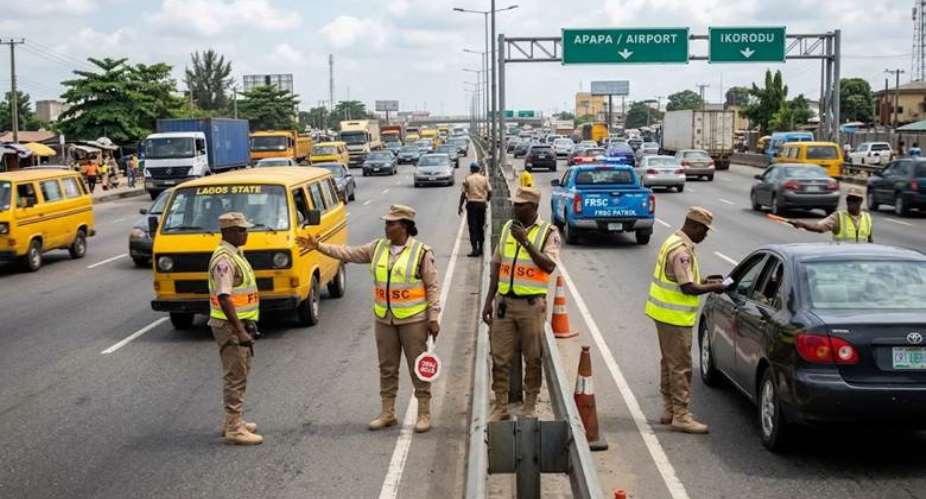
For a long time now, there has been a growing level of lawlessness on Nigerian roads that deserves far greater attention than it has received from the authorities. The lawlessness is particularly evident in rural communities, small towns and the outskirts of major cities, where commercial motorcyclists, popularly known as okada riders, increasingly conduct themselves as though traffic regulations were made for other road users and that they are less concerned about them. And so, they ride their motorcycles without driving and vehicle licenses and road worthiness documents. They disregard basic safety precautions, overload their motorcycles with passengers and, in some particularly disturbing cases, allow children who are barely old enough to understand the dangers of road traffic, not only to make use of motorcycles but to also convey passengers with them. It is difficult to understand how such a dangerous culture has been allowed to grow virtually unchecked over the years.
The Federal Road Safety Corps (FRSC) was established to promote safety on Nigerian roads and to ensure compliance with traffic regulations. Its responsibilities include road safety education, enforcement of traffic laws, the regulation of road users and the promotion of standards that reduce accidents and fatalities. Yet, in many communities across the country, the visible presence of the Corps appears insufficient to deter the excesses of commercial motorcyclists. One is left wondering whether the authorities are aware of the scale of the problem or have simply become accustomed to it.
Consider the question of motorcycle registration and licensing. It is not unusual to see commercial motorcycles operating without visible evidence of proper registration or licensing. Many riders appear to have no interest in obtaining the appropriate driving licences. They go about their business with little fear of being stopped, questioned or sanctioned. The problem is not necessarily that the law does not exist. It is that a law which is rarely enforced gradually loses its authority in the eyes of those expected to obey it.
A motorcycle is a motor vehicle, and the person operating it is a road user with legal obligations. Commercial use does not confer exemption from those obligations. A rider should possess the appropriate driving licence, while the motorcycle itself should have the required registration and documentation. It should also be mechanically fit for the road. These are not bureaucratic inconveniences invented to frustrate poor people trying to earn a living. They are basic safeguards intended to protect the rider, passengers and other road users.
The situation becomes even more disturbing when one considers their casual disregard for safeguards like crash helmets. In many communities, motorcyclists ride without helmets, while their passengers are equally exposed. Some riders appear to regard helmets as optional accessories rather than essential safety equipment. Yet, in a collision or a fall, the human head is particularly vulnerable. A helmet cannot prevent every injury, but it can significantly reduce the risk of serious head trauma and death. Why, then, should a rider be permitted to carry passengers without taking even this elementary precaution?
More alarming is the practice of overloading motorcycles. A motorcycle designed to carry one rider and one passenger is sometimes turned into a makeshift passenger bus. One sees riders conveying three or even four passengers, with adults, women and children squeezed into spaces never intended for such numbers. Sometimes an entire family is transported on a single motorcycle. Schoolchildren are also among those exposed to this reckless practice. The rider's desire to collect additional fares appears to outweigh every consideration of balance, control and human safety.
A motorcycle is not a commercial bus. Its design, stability and braking capacity impose obvious limitations on the number of people it can safely carry. Overloading compromises the rider's ability to manoeuvre, makes braking more difficult and increases the likelihood of losing control, particularly on uneven roads, at bends or when confronted by sudden obstacles. It also places every passenger at risk. The fact that such practices have become commonplace does not make them acceptable.
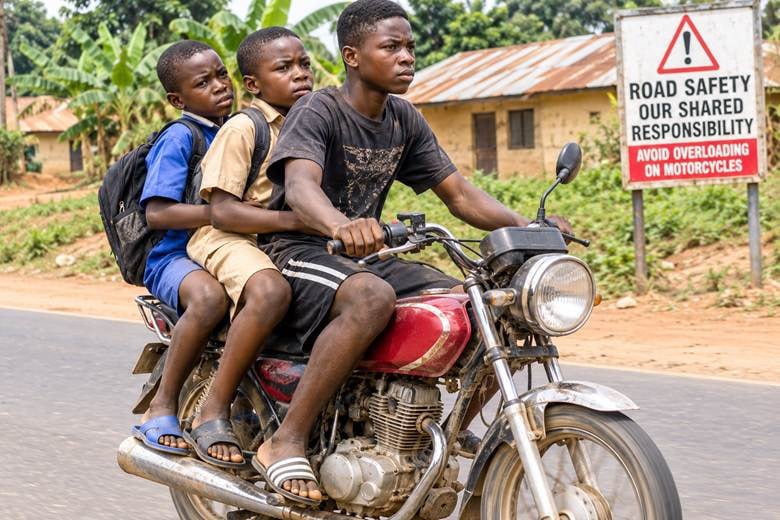
But perhaps the most troubling development is the increasing involvement of children in motorcycle operations. In some places, one encounters children who appear to be barely ten years old riding motorcycles, not merely for amusement within a family compound, but on public roads, carrying passengers and sometimes transporting other children. It is a frightening spectacle. A child who should be concentrating on schoolwork, play and the ordinary responsibilities of childhood is instead entrusted with a powerful machine capable of causing serious injury or death.
Under Nigeria's driver-licensing framework, an ordinary driving licence is not available to a ten-year-old. The minimum age for an ordinary driver's licence is 18. There can therefore be no reasonable argument for allowing a child of that age to operate a motorcycle on a public road. The child lacks the legal qualification and cannot reasonably be expected to possess the judgment, experience and maturity required to navigate unpredictable traffic conditions. Parents and guardians who permit this practice must also recognise that they are exposing their children and innocent members of the public to grave danger.
The issue is not simply one of children riding motorcycles. It is also one of adults willingly entrusting their safety to children. When a ten-year-old carries passengers, the danger extends beyond the young rider to every person sitting behind him or her. If an accident occurs, who accepts the responsibility? The parents? The passenger? The owner of the motorcycle? Or the authorities that allowed such conduct to flourish without effective intervention?
It is tempting to blame the motorcyclists alone, but that would be an incomplete assessment. Enforcement agencies have a responsibility to make it clear that no road user is above the law. When offenders repeatedly violate regulations without consequences, the impression is created that the law is negotiable. Eventually, people begin to behave as though their personal convenience or commercial interest takes precedence over public safety. That is precisely the attitude that effective road traffic enforcement is supposed to prevent.
The FRSC should therefore intensify its presence in communities where these violations are common. It should not concentrate its operations only on highways and major urban roads while it leaves rural communities to develop their own informal traffic rules. Road safety is not an urban privilege. A child knocked down by an overloaded motorcycle on a village road suffers the same injuries as a child involved in an accident on a metropolitan expressway.
Having said that, it is important to note that road traffic administration is shared among several authorities. The FRSC has a central role in road safety enforcement, but state Vehicle Inspection Services, motor vehicle licensing authorities, traffic management agencies and the police also have responsibilities here and that makes cooperation essential. The relevant agencies should undertake coordinated operations to identify unregistered motorcycles, riders without appropriate licences, mechanically defective vehicles, helmet violations and illegal passenger overloading. Such operations should be sustained, not staged occasionally for publicity before enforcement disappears again.
There is another road safety problem that deserves attention: the indiscriminate construction of speed breakers on public roads, particularly in rural communities. Individuals, families, community associations and social organisations sometimes take it upon themselves to construct raised obstacles across major roads, apparently believing that any obstruction capable of slowing vehicles is automatically a contribution to public safety. Their intentions may be understandable. A family living beside a busy road may fear that speeding vehicles would endanger children. A community may be concerned about motorists who drive recklessly through residential areas. A school or social organisation may wish to protect pedestrians. These are legitimate concerns. But good intentions do not confer the technical competence or legal authority required to alter a public road.
A speed breaker is not simply a heap of concrete or asphalt placed across a carriageway. Its height, width, gradient, visibility, positioning, drainage implications and approach markings must be properly considered. The speed environment, traffic volume, road classification, sight distance, proximity to junctions and pedestrian activity are among the factors that should inform the decision to install one. Poorly designed or unmarked speed breakers can cause accidents, damage vehicles, endanger motorcyclists and create hazards for emergency vehicles. At night, an unexpected raised obstruction can be particularly dangerous.
There is also the question of jurisdiction. Public roads are not private extensions of the properties adjoining them. Individuals and organisations should not assume that they can independently modify a public highway simply because they believe a particular intervention is necessary. The appropriate road authority should assess the location, determine whether traffic calming is justified and approve a design that meets recognised engineering and safety requirements. Where speeding is a genuine problem, properly designed speed humps, warning signs, road markings, pedestrian facilities and enforcement would provide a more effective solution than makeshift concrete barriers.
The FRSC should work with state and local road authorities to identify and assess these unauthorized obstructions. Those that are dangerous should be redesigned or removed through lawful procedures, while communities should be encouraged to report speeding problems and request professionally approved interventions. Public participation in road safety is welcome, but public enthusiasm must not become an excuse for amateur road engineering.
Ultimately, the issue is about the value Nigeria places on human life. A society cannot claim to take road safety seriously while it allows children to operate commercial motorcycles, adults to travel without crash helmets, riders to carry passengers beyond the capacity of their machines and unqualified individuals to alter major roads at will. These are not harmless local peculiarities. They are preventable dangers.
The FRSC must be more visible, more consistent and more assertive in carrying out its responsibilities. It should educate, inspect, enforce and, where necessary, prosecute. It should also make road safety education accessible to parents, motorcycle owners, commercial riders, school authorities and community leaders. State governments must support this effort by strengthening vehicle inspection and traffic enforcement services.
There is no justification for treating commercial motorcyclists as a privileged class of road users who can disregard regulations because their occupation provides an essential service. Their economic contribution is recognised, but the right to earn a living does not include the right to endanger other people's lives.
The law must be seen to operate on village roads as firmly as it does on urban highways. If motorcycle riders are allowed to become their own traffic regulators, and if communities are allowed to become their own road engineers, the consequences will eventually be paid for in human lives. The FRSC should sit up before an avoidable culture of recklessness becomes even more deeply entrenched in the Nigerian road system.

 Nsuta Circuit Court remands Aduman SHS Chaplain, ICT teacher over alleged sodomy
 If NPP doesn’t win power in 2028, we have to find somewhere sleep and forget com...
 The Judge was defending her own judgement—Atta Akyea faults court after Wontumi ...
 Ato Forson met a ladder in 2025, NPP met a hole in 2017 – Gideon Boako on 2027 b...
 ‘Your cash is ready, come for it’ – Ato Forson announces GH¢29bn early payment t...
 Bawku oldest school still without roof after 10 years
 2027 Budget: NDC has habit of recycling projects without tangible results - PNP ...
 Court rejects Wontumi's bail application pending appeal in Samreboi mining case
 University students suffer skin irritation, itching as illegal mining activities...
 Boako questions Ato Forson's claim to Ghana's economic recovery, cites foundatio...


