




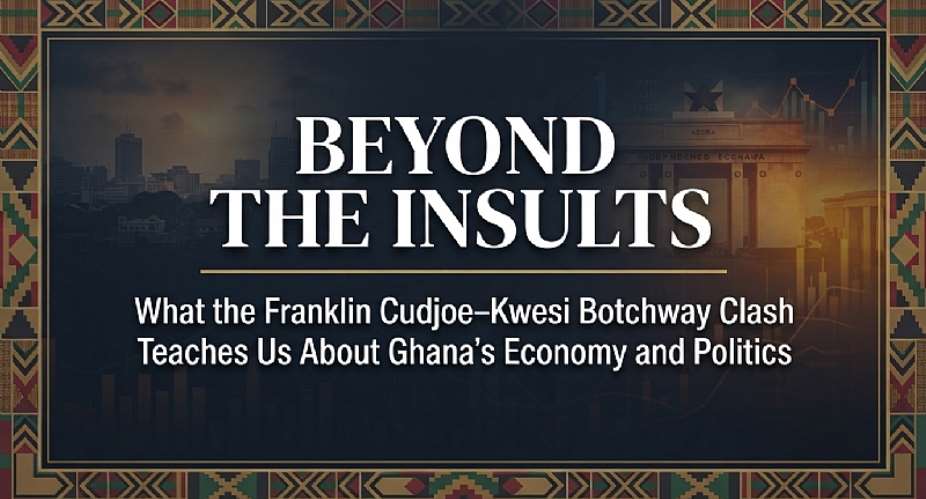
Every few months, Ghana’s digital public square erupts into a familiar storm. A political communicator makes a sweeping claim, a prominent policy analyst fires back with personal insults, and social media commentators quickly divide into partisan trenches. The November 2026 clash between IMANI Africa President Franklin Cudjoe and New Patriotic Party (NPP) Deputy Communications Director Kwesi Botchway Jr. over the performance of Finance Minister Dr. Cassiel Ato Forson—alongside viral open letters from writers like Akaneweo Kabiru Abdul and sharp rebuttals from skeptical readers—is more than just another online spat. Beneath the name-calling lies a golden opportunity to educate Ghanaians on how national economies work, how budgets should be judged, and how citizens can spot bias in public commentary.
The Anatomy of a Viral Debate
The controversy erupted after Kwesi Botchway Jr. labeled Dr. Cassiel Ato Forson the "worst Finance Minister" in Ghana’s history. In response, Franklin Cudjoe dismissed Botchway Jr. as an "illiterate clown," challenging him to compare economic indicators across administrations.
This exchange triggered an open letter from social media commentator Akaneweo Kabiru Abdul, who argued that:
- Personal insults cheapen public discourse. Public officials are not immune from criticism, and intellectuals should dismantle weak arguments with facts rather than attacking a critic's literacy.
- Flagship delivery matters. Abdul pointed out that former Finance Minister Ken Ofori-Atta rolled out the flagship Free Senior High School (SHS) policy in his maiden 2017 budget, whereas Dr. Ato Forson had presented multiple budgets without delivering the touted "one job, three shifts" 24-Hour Economy promise.
- Citizens do not eat statistics. Echoing a widespread sentiment on the streets of Accra and Kumasi, Abdul argued that macroeconomic jargon remains useless until it puts money directly into the pockets of ordinary Ghanaians.
Yet, just as quickly, a counter-commentator ("A critic") challenged Abdul’s own credibility, noting that his timeline disproportionately targeted one political party—exposing how selective outrage often masquerades as neutral civic concern.
1. Macroeconomic Indicators vs. "Pocketbook" Reality
To make sense of this clash, Ghanaians must understand the difference between macroeconomics (the big picture of the national economy) and microeconomics (the daily reality of households and market traders).
- Why Macroeconomic Numbers Matter: When analysts like Franklin Cudjoe cite macroeconomic figures, they are looking at the foundation of the economy. According to data highlighted by 3News, inflation dropped from 23.8% in December 2024 to 5.5% in October 2026 under Dr. Ato Forson, dipping below the Bank of Ghana's medium-term target band of 6% to 10%. Similarly, during the 2027 Budget presentation, the Finance Ministry reported that public debt had declined to 44.7% of GDP by the end of 2025, while gross international reserves climbed to 5.7 months of import cover. Without bringing inflation and debt down, prices spiral out of control and the cedi collapses.
- Why "Pocketbook" Frustration Is Valid: Commentators like Abdul are right that a drop in the inflation rate does not mean prices in the market suddenly fall—it only means prices are rising at a much slower pace. Furthermore, there is always a time lag of 12 to 24 months before macroeconomic stability translates into cheaper bank loans, business expansion, and higher wages.
- The Takeaway: Macroeconomic stability is the medicine that stops a patient from bleeding; job creation and rising incomes are the rehabilitation that gets the patient walking again. You cannot have sustainable pocketbook relief without stable indicators first.
2. How to Objectively Judge a Finance Minister’s Budget
Comparing Finance Ministers across different eras requires looking at the economic context they inherited and how they structured their budgets.
- The 2017 Maiden Budget Context: When Ken Ofori-Atta presented the 2017 Budget, inflation stood at 15.4% (December 2016). According to Graphic Online's coverage of the 2017 Budget, the government allocated GH¢400 million from the Annual Budget Funding Amount (ABFA) and domestic revenues to launch Free SHS for the 2017/2018 academic year. While this fulfilled a major social promise immediately, critics later noted that heavy spending combined with external shocks eventually contributed to unsustainable debt levels and the 2022 economic crisis.
- The 2025–2027 Stabilization & Growth Context: Dr. Ato Forson entered office in early 2025 facing a 23.8% inflation rate and strict International Monetary Fund (IMF) debt-restructuring constraints. Consequently, his initial budgets prioritized fiscal consolidation, removing nuisance taxes, and building buffers. For the 24-Hour Economy, the government allocated GH¢110 million in the 2026 Budget to lay legislative and infrastructural groundwork before unveiling a broader $10 billion, four-year "New Economy" programme in the 2027 Budget aimed at driving real GDP growth toward 8% and reducing unemployment below 8% by 2030.
- The Takeaway: A Finance Minister’s job is not merely to fund campaign slogans. Citizens must evaluate budgets on three pillars: fiscal discipline (debt and deficit control), tax fairness, and targeted investments that create long-term jobs.
3. Media Literacy: Spotting Bias and Demanding Better Debate
The exchange between Cudjoe, Botchway Jr., Abdul, and "A critic" is a masterclass in how political narratives are framed on Ghanaian social media. Citizens must sharpen their media literacy skills to avoid being manipulated.
- Separate the Messenger from the Message: Whether a critique comes from an opposition communicator like Kwesi Botchway Jr. or a partisan writer on Facebook, evaluate the facts presented rather than dismissing the point solely because of who said it.
- Audit Commentators for Consistency: As the rebuttal at the bottom of Abdul’s post demonstrated, checking a writer’s past posts often reveals whether they hold all governments to the same standard or only find their voice when a rival party is in power.
- Reject Intellectual Bullying: Civil society leaders and policy think tanks lose moral authority when they trade data for insults. Calling a political opponent a "clown" shifts public attention away from the policy data and turns a national economic conversation into a personal ego battle.
Recommendations and Actionable Suggestions for Ghanaians
To elevate Ghana’s democratic governance and economic literacy, stakeholders across society should adopt the following practical steps:
- For Ordinary Citizens and Voters: Track at least three basic figures after every budget reading—the inflation rate, the policy/lending interest rate, and capital expenditure (money spent on roads, factories, and schools rather than salaries). Use free public summaries from the Ministry of Finance and independent data-checks from reputable newsrooms rather than relying solely on party WhatsApp groups.
- For Policy Analysts and Think Tanks: Maintain strict professional decorum. When engaging party communicators, dismantle weak arguments with verifiable spreadsheets and historical comparisons rather than personal attacks.
- For Political Parties and Communicators: Move away from hyperbolic labels like "best" or "worst" in history. Present clear, alternative policy costings—for instance, explaining how a flagship policy should be funded without triggering inflation or piling on new taxes.
- For the Media and Digital Platforms: Prioritize fact-checking segments during budget weeks that place historical economic indicators side by side, helping audiences separate political spin from verifiable economic performance.
Democracy thrives on vigorous disagreement, not verbal abuse. Kwesi Botchway Jr. has every democratic right to critique Dr. Cassiel Ato Forson’s pace on job creation, just as Franklin Cudjoe has every right to defend the administration’s measurable progress in taming inflation and stabilizing the cedi. Likewise, citizens like Akaneweo Kabiru Abdul are right to demand that macroeconomic gains translate into real relief at the market stall, while readers are equally right to demand consistency from political commentators.
If Ghanaians want a prosperous economy and a mature democracy, we must stop cheering for the loudest insults on social media and start demanding disciplined, evidence-based accountability from everyone who speaks in the public interest.
✍️By Retired Senior Citizen
For and on behalf of all Senior Citizens of the Republic of Ghana 🇬🇭
Teshie-Nungua
[email protected]

 2027 Budget: NDC has habit of recycling projects without tangible results - PNP ...
 Court rejects Wontumi's bail application pending appeal in Samreboi mining case
 University students suffer skin irritation, itching as illegal mining activities...
 Boako questions Ato Forson's claim to Ghana's economic recovery, cites foundatio...
 SHC defends planned Sandbox demolition, denies political motivation
 Agbodza condemns vote-buying in NDC elections, says ‘this is not the Rawlings pa...
 Mahama congratulates newly elected NDC regional executives, urges party unity
 EC Divisional Union demands suspension of planned vehicle auction
 Afenyo-Markin accuses Mahama-led NDC of erasing Big Six from Ghana's new banknot...
 Galamsey: Ken Ashigbey urges Mahama to consider state of emergency in worst-hit ...


