




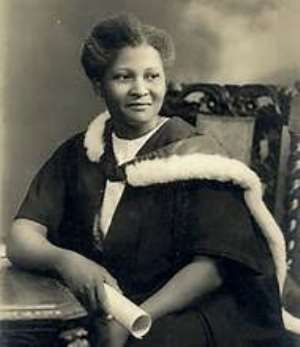
The remarkable story of Ghana’s first female medical doctor, whose pioneering contributions to healthcare, medical education and women’s rights helped shape the nation’s history.
Long before Ghana gained independence in 1957, when opportunities for women in higher education and professional careers were severely limited, one remarkable Ghanaian woman challenged convention and made history. Her name was Dr. Susan Barbara Gyankorama Ofori-Atta, a pioneering physician whose achievements opened doors for generations of women in medicine and public service.
Born in 1917 in Kyebi, in the present-day Eastern Region of Ghana, Susan Ofori-Atta belonged to the royal family of Akyem Abuakwa. Her father, Nana Sir Ofori Atta I, the Okyenhene, was a strong advocate of education and ensured that his daughters received opportunities to pursue their academic ambitions.
She began her education at St. Mary's Convent in Elmina before entering Achimota School in 1929, where she distinguished herself academically and became Girls' School Prefect. Her interest in medicine was influenced by her early exposure to healthcare and the example of pioneering African women doctors, including Dr. Agnes Yewande Savage.
Determined to pursue a medical career, she initially trained in midwifery at Korle Bu, completing her training in 1935. She subsequently travelled to Scotland to study medicine at the University of Edinburgh, where she qualified as a medical doctor in 1947.
This achievement made her the first Ghanaian woman to qualify as a medical doctor, at a time when the medical profession was overwhelmingly dominated by men. Her success was not merely a personal accomplishment; it represented a historic breakthrough for African women seeking careers in science and medicine.
Upon returning to the Gold Coast, Dr. Ofori-Atta devoted much of her professional life to improving maternal and child healthcare. She worked at Kumasi Hospital and later became closely associated with the Princess Marie Louise Children's Hospital in Accra, where her dedication to young patients earned her the affectionate description Mmofra Doctor, meaning "Children's Doctor."
Her medical work focused particularly on childhood malnutrition, infant mortality and diseases affecting vulnerable families. She contributed to research and clinical efforts to address kwashiorkor, a severe form of malnutrition that affected many Ghanaian children.
She also played an important role in developing paediatric medicine and medical education in Ghana, helping to establish the foundations for training future generations of Ghanaian doctors.
Beyond her hospital responsibilities, Dr. Ofori-Atta established a private medical practice in Accra and became known for extending care to disadvantaged women and children, including patients who could not afford treatment.
Her commitment to humanity extended beyond Ghana's borders. In 1960, she reportedly volunteered to provide medical assistance in the newly independent Congo, demonstrating her belief that healthcare should transcend national boundaries.
However, her contribution to Ghana was not limited to medicine.
Dr. Ofori-Atta recognised that the wellbeing of women and children depended not only on access to healthcare but also on economic security, education and legal protection.
She became an outspoken advocate for women's rights, particularly the protection of widows and children under Ghana's inheritance system. At the time, customary inheritance practices could leave surviving spouses and children financially vulnerable when a family member died without a will.
Her advocacy contributed to the broader movement for inheritance reform that eventually culminated in Ghana's Intestate Succession Law, PNDC Law 111, enacted in 1985. The legislation strengthened the inheritance rights of surviving spouses and children.
She also participated in national governance as a member of the 1969 Constituent Assembly, which helped prepare the constitutional framework for Ghana's Second Republic.
In recognition of her contributions to medicine and society, Dr. Ofori-Atta received several honours. She was associated with the founding generation of the Ghana Academy of Arts and Sciences and received an honorary Doctor of Science degree from the University of Ghana in 1974.
Her humanitarian work also attracted international recognition, including an honour associated with Pope John Paul II's visit to Ghana in 1980.
Dr. Susan Ofori-Atta died in July 1985, leaving behind a legacy that extended far beyond her medical achievements.
Her life demonstrated that women could excel in professions previously considered the exclusive preserve of men. She helped challenge colonial-era racial and gender barriers, advanced healthcare for children, supported medical education and contributed to the struggle for greater legal protection for Ghanaian families.
Today, as Ghana continues to confront challenges involving maternal mortality, childhood malnutrition, access to quality healthcare and gender equality, her pioneering example remains relevant.
Her story also offers an important lesson for national development: a country's progress depends on its willingness to identify, educate and empower talented citizens, regardless of gender or social expectations.
Nearly eight decades after she qualified as a physician, the significance of her achievement remains undiminished.
Dr. Susan Barbara Gyankorama Ofori-Atta was more than Ghana's first female doctor. She was a medical pioneer, humanitarian, advocate for social justice and nation-builder whose courage helped transform possibilities for Ghanaian women.
Ghana must continue to celebrate such extraordinary pioneers, preserve their histories and inspire younger generations to follow their example.
Her name deserves a permanent place among the great personalities who helped shape modern Ghana.


 Nsuta Circuit Court remands Aduman SHS Chaplain, ICT teacher over alleged sodomy
 If NPP doesn’t win power in 2028, we have to find somewhere sleep and forget com...
 The Judge was defending her own judgement—Atta Akyea faults court after Wontumi ...
 Ato Forson met a ladder in 2025, NPP met a hole in 2017 – Gideon Boako on 2027 b...
 ‘Your cash is ready, come for it’ – Ato Forson announces GH¢29bn early payment t...
 Bawku oldest school still without roof after 10 years
 2027 Budget: NDC has habit of recycling projects without tangible results - PNP ...
 Court rejects Wontumi's bail application pending appeal in Samreboi mining case
 University students suffer skin irritation, itching as illegal mining activities...
 Boako questions Ato Forson's claim to Ghana's economic recovery, cites foundatio...


