




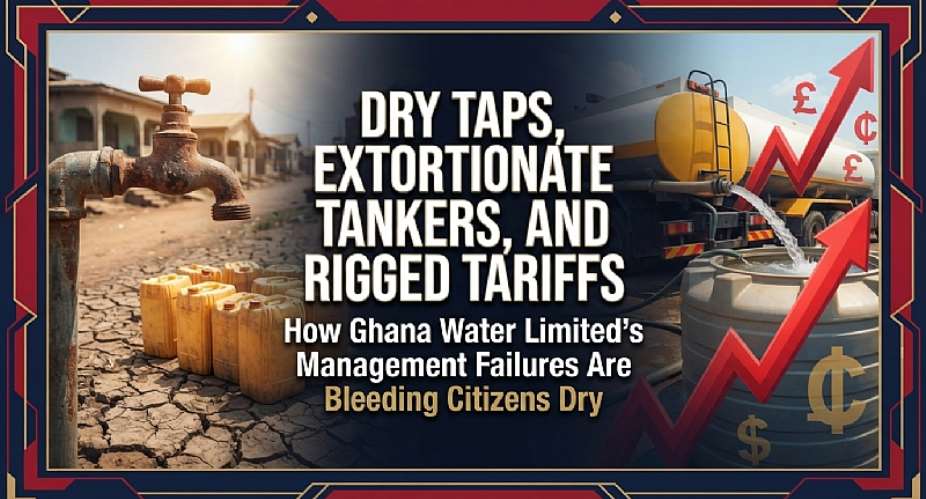
For over six agonizing weeks, and still counting, residents of Teshie-Nungua Estates—from First Junction and Tsuibleoo through Mobil, Fertilizer Road, Lascala, and adjoining communities along the Spintex and Nungua corridors—have been abandoned to a man-made humanitarian crisis. Taps have run bone-dry while families, clinics, and small businesses are held hostage by private water tanker operators charging between GH₵600 and GH₵1,200 for a single load of water, depending on tank capacity and distance.
This raises a fundamental, infuriating question that GWL leadership refuses to answer: Did law-abiding consumers not pay their bills for every drop of water previously supplied? Ghanaians have dutifully paid their monthly tariffs, yet the money has vanished into a black hole of administrative bloat, uncollected commercial arrears, and systemic rot instead of maintaining treatment plants and pipelines. Ghanaians are exhausted, frustrated, and fed up with excuses. This is not a natural disaster—it is gross executive negligence, and heads must roll. Certain individuals at the top of GWL’s management must be sacked immediately for presiding over this collapse.
The Anatomy of Institutional Failure and Regulatory Complicity
The six-week dry spell crippling Teshie-Nungua Estates—triggered by the prolonged, mismanaged shutdown of the $126 million Teshie-Nungua Desalination Plant and crumbling local pipelines—exposes a rotten operational culture at GWL:
- Unaccounted Consumer Revenue: Bill-paying households in Teshie-Nungua and across Accra consistently honor their bills—often under threat of instant disconnection. Yet GWL claims it lacks funds for basic maintenance and plant settlements, begging the question of how management squanders collected revenue.
- Staff-Led Illegal Connection Syndicates: Nearly 50% of Ghana’s treated water vanishes as Non-Revenue Water (NRW). Rather than dismantling these theft networks, overwhelming evidence and field realities point to compromised GWL technicians and revenue officers who actively engineer illegal bypasses, manipulate commercial meters, and divert supply to private tanker syndicates for kickbacks.
- Refusal to Adopt Modern Distribution Technologies: In 2026, GWL still operates like a colonial relic. While modern utilities deploy Smart Water Networks, IoT pressure sensors, automated District Metered Areas (DMAs), and satellite or acoustic leak detection to spot ruptures instantly, GWL relies on guesswork. Massive leaks along transmission mains in Ledzokuku and Kpeshie gush treated water into gutters for months while taps inside Teshie-Nungua Estates remain completely dry.
- Weaponizing Inefficiency to Extort Ratepayers via PURC: Instead of plugging revenue leaks and prosecuting corrupt staff, GWL routinely dumps its bloated operational deficits onto the lap of the PURC to demand upward tariff adjustments. By approving these hikes without demanding operational accountability, the PURC has effectively become an accomplice—forcing honest Ghanaians to subsidize GWL’s incompetence and bankroll water theft.
- Zero Executive Accountability: Allowing a critical $126 million asset like the Teshie-Nungua Desalination Plant to sit idle in contractual limbo while half a million residents suffer is a fireable offense. In any results-driven organization, the executives responsible for such catastrophic failure would have been dismissed long ago.
What Happens in Serious Jurisdictions: Global Penalties vs. Ghanaian Impunity
In countries where regulatory frameworks actually protect consumers rather than shielding state monopolies, GWL’s performance would trigger severe legal, financial, and personal consequences:
- Executive Dismissals and Multi-Million-Pound Fines (United Kingdom): Under Ofwat (the Water Services Regulation Authority in England and Wales), water companies face crippling financial penalties for supply interruptions and high leakage rates, alongside bans on executive bonuses and forced leadership overhauls. Crucially, utilities are legally required to pay automatic Guaranteed Standards Scheme (GSS) compensation directly to affected households when water is cut off—not hike their bills.
- Strict Leakage Caps and Rate-Base Disallowances (United States & Europe): State Public Utility Commissions in the U.S. routinely disallow utilities from passing "imprudently incurred costs" or excessive water losses onto consumers. If a utility fails to maintain infrastructure or loses nearly half its product, management and shareholders absorb the loss—the regulator flatly rejects rate increases until efficiency benchmarks are met.
- Criminal Prosecution and Management Takeovers (Singapore & South Africa): In jurisdictions with strict utility governance such as Singapore’s PUB framework, employee collusion in water theft or meter tampering attracts swift anti-corruption prosecution, asset forfeiture, and prison sentences. Under South Africa’s Water Services Act, persistent failure by a water services provider to meet minimum supply standards empowers national authorities to strip management control and sack failing administrators.
In Ghana, however, executive failure is rewarded with bigger budgets, higher tariffs, and guaranteed job security.
Recommendations for Immediate Reform and Accountability
Ghanaians are tired of empty promises and endless suffering. To end this water apartheid and rescue urban residents from financial exploitation, the following non-negotiable actions must be taken immediately:
- Sack Failing GWL Executives: The President and the Minister for Sanitation and Water Resources must immediately dismiss the top GWL management officials and regional directors responsible for this prolonged operational collapse and replace them with competent, results-oriented technocrats.
- Account for All Collected Water Tariffs: GWL must publish a full public financial disclosure showing how tariff revenues collected from consumers over the past five years were spent, and why essential maintenance and plant obligations were neglected.
- Impose a Moratorium on Tariff Increases: The PURC must immediately freeze all upward water tariff adjustments until GWL reduces its Non-Revenue Water below 25% and restores consistent 24/7 supply to Teshie-Nungua and other underserved zones.
- Mandate Automatic Bill Credits and Tanker Subsidies: Whenever GWL fails to supply water to metered residents for more than 48 consecutive hours, the utility must be legally compelled to waive fixed service charges, issue automatic bill rebates, and fund free municipal water tankers for affected estates.
- Deploy Smart Grid and Telemetry Technologies: GWL must be mandated under strict timelines to install automated pressure sensors, smart meters, and digital flow monitors across all Teshie-Nungua distribution lines to detect leaks and unauthorized tapping in real time.
- Initiate an EOCO and Auditor-General Forensic Probe: The Economic and Organised Crime Office (EOCO) and the Auditor-General must conduct an immediate forensic audit of GWL’s commercial operations, procurement, and internal staff involvement in illegal connections, followed by public prosecutions.
Call to Action: Citizens Must Rise and Petition Authorities Now
Silence in the face of institutional abuse is consent. Ghanaians are fed up, and it is time to turn our collective exhaustion into decisive civic pressure:
- Petition the PURC Immediately: Residents’ associations, opinion leaders, and individual households must flood the Public Utilities Regulatory Commission with formal complaints demanding regulatory sanctions against GWL, mandatory bill rebates for weeks of zero supply, and an immediate rejection of any pending tariff hike requests.
- Demand Parliamentary Intervention: Constituents must formally petition their Members of Parliament and the Parliamentary Select Committee on Works and Housing to summon the Minister for Sanitation and Water Resources, the GWL Managing Director, and the PURC Executive Secretary to answer under oath for how consumer revenues were spent and why top managers have not been dismissed.
- Document and Expose Corrupt Networks: Community watch groups must document every burst pipe left unattended, every exorbitant tanker receipt, and every suspected illegal connection facilitated by rogue technicians, submitting these dossiers directly to EOCO, the PURC, and the media.
Clean, running water is not a favor bestowed by politicians or state bureaucrats—it is a basic human right and a service Ghanaians have already paid for. For over six weeks, the people of Teshie-Nungua Estates have been forced to pay twice: first through unjustifiable water tariffs approved by a sleeping regulator, and second through their noses to private tanker operators filling the void left by GWL’s incompetence. Ghanaians are tired of paying for air through dry pipes while incompetent managers keep their jobs. Until failing executives are sacked, stolen revenues are accounted for, and modern systems are installed, citizens must stand united behind one uncompromising rule: no water, no tariff hikes.
✍️By A Concerned Retired Senior Citizen
For and on behalf of all Senior Citizens of the Republic of Ghana 🇬🇭
Teshie-Nungua
[email protected]


 2027 Budget: NDC has habit of recycling projects without tangible results - PNP ...
 Court rejects Wontumi's bail application pending appeal in Samreboi mining case
 University students suffer skin irritation, itching as illegal mining activities...
 Boako questions Ato Forson's claim to Ghana's economic recovery, cites foundatio...
 SHC defends planned Sandbox demolition, denies political motivation
 Agbodza condemns vote-buying in NDC elections, says ‘this is not the Rawlings pa...
 Mahama congratulates newly elected NDC regional executives, urges party unity
 EC Divisional Union demands suspension of planned vehicle auction
 Afenyo-Markin accuses Mahama-led NDC of erasing Big Six from Ghana's new banknot...
 Galamsey: Ken Ashigbey urges Mahama to consider state of emergency in worst-hit ...


