




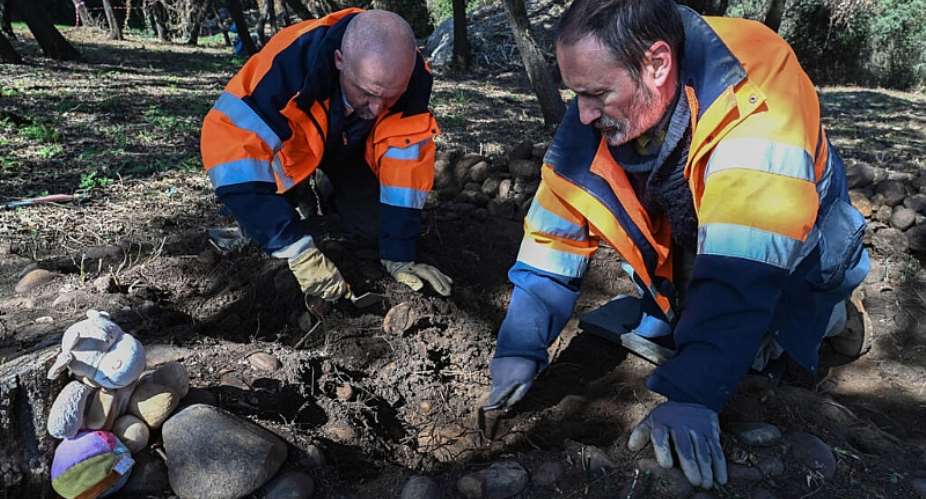
The Harkis were recruited as auxiliaries by the French army during the Algerian War of Independence (1954-1962).
After France lost its colony, around 90,000 Harkis and their families fled Algeria. Many were placed in army-run transit and resettlement camps in the south of France, where living conditions were extremely poor.
An investigation by French news agency AFP found that 70 people, including 60 young children, died between late 1962 and 1964 at both the Saint-Maurice-l'Ardoise and Lascours camps in the Gard. At least 10 were stillborn, due to a measles epidemic.
The families' grief was compounded by the way the children were buried. Relatives were not involved in the burials and were sometimes not even allowed to attend the funerals. Some babies were reportedly "buried like they were less than nothing", relatives said.
At the Saint-Maurice-l'Ardoise camp, children were buried without proper graves and their bodies later moved without their relatives being informed.
France to compensate more Harki families for mistreatment after Algerian War
Ghost graves
Barkahoum Douaouia was just 14 months old when she died in February 1963 at Saint-Maurice-l'Ardoise.
French soldiers took the child's body from her parents' arms.
"They buried her in a hole, and the only identification was a number – 18," her brother Daniel Douaouia told RFI. "Can you imagine what state my parents must have been in? Being told: 'We're going to bury your daughter in a hole'? What they did was monstrous."
Douaouia says his parents never spoke about his sister's death, possibly because they were consumed by shame and guilt.
In 1979, gendarmes who had learned about the makeshift cemetery discovered that several of the graves were empty.
In their report, they wrote: "It would be best not to make too much noise about this affair."
Barkahoum's grave was among them, but her brother only discovered this in 2022, when the report emerged from the archives.
"They wanted to cover up this whole affair, and that's why we're looking for answers," he said.
France's top honour for Algerian 'harki' fighters
'Not forgotten'
Douaouia and four other families have now filed a complaint against unknown persons. It follows a similar legal action brought last year by families from the Rivesaltes camp, where similar events took place.
Their lawyer, Antoine Ory, said they had no idea why the bodies were moved and concealed. "That's precisely what we want the investigation to establish. We want answers about why all this happened."
"This is obviously a case with a very strong historical and symbolic dimension," he told RFI. "We think it's important for the French justice system to take an interest in it, to show the descendants of Harki families that they have not been forgotten, and that it's prepared to investigate these terrible events."
He insisted that the offences were not subject to the statute of limitations and that the justice system must be able to investigate them.
Douaouia hopes his sister's remains will one day be found, so he can pay his respects and finally come to terms with her death.
This article has been adapted from the original version in French by Baptiste Coulon.


 Mahama Commissions GH¢148.4m Cashew Factory, Creating 1,500 Jobs in Techiman
 21-year-old Ghanaian man stabbed to death in north London
 Another phone snatcher jailed 11 years in Ashaiman, marking second conviction in...
 Defeated NDC Central Regional Chairman blames former secretary, threatens legal ...
 Haruna Iddrisu urges AG, CID for prosecution of culpable persons in Obuasi SHTS ...
 24-hour economy is private sector-led, New Economy is US$10 billion government-l...
 Nana Kwasi breaks down in tears after reclaiming NDC Ashanti Regional chairmansh...
 Benjamin Danso unseats Ashie-Moore as NDC Greater Accra Regional Chairman
 Ghana to ratify three key AU financial institutions by 2027
 Catholic Bishops want full implementation of Kalba-Gbinyiri conflict report


