




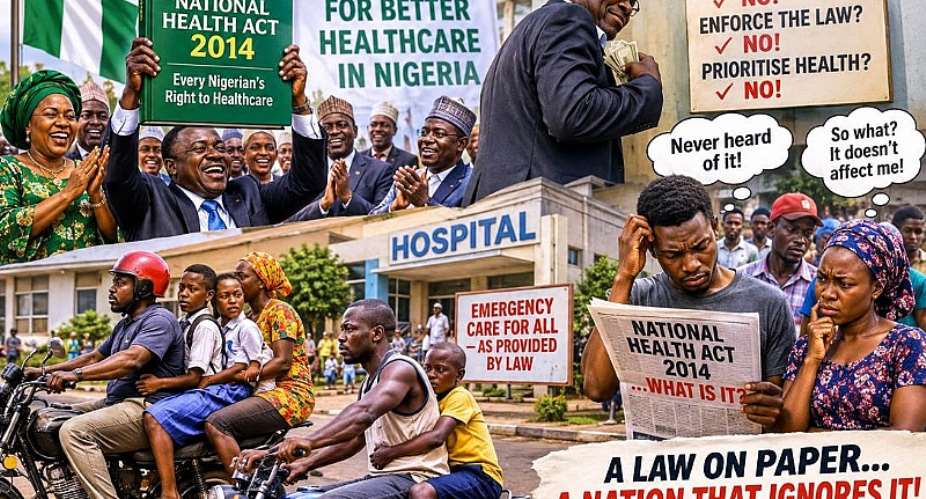
Nigerians' general unwillingness or inability to relate appropriately with their own laws has become a matter of great concern to many of us, Nigerians in the Diaspora. We make laws, celebrate their passage, congratulate those who enacted them, and then behave as though the laws never existed. Sometimes, the problem is not even that Nigerians deliberately disobey the law. It is that millions of citizens are not even aware that such laws exist. Those entrusted with the responsibility of making them aware abandon that responsibility because it pays them to do so. The National Health Act of 2014 is a particularly troubling example of this national malady.
Signed into law by President Goodluck Jonathan in October 2014, the National Health Act was intended to establish a more humane, accessible and accountable healthcare system. It was not another government policy document to be displayed at conferences and forgotten after official speeches. It was an Act of the National Assembly that carried legal obligations for healthcare providers and established mechanisms for financing essential health services. Yet, more than twelve years after its enactment, millions of Nigerians remain unfamiliar with its existence, let alone the rights and protections it provides.
Let us consider the implications of this ignorance. A Nigerian who arrives at a hospital with a critically injured relative may not be aware that Section 20 of the National Health Act expressly prohibits a healthcare provider, health worker or health establishment from refusing emergency medical treatment for any reason. The provision is unequivocal. Anyone who contravenes it commits an offence punishable, upon conviction, with a fine of ₦100,000, imprisonment for up to six months, or both.
The significance of this provision cannot be overstated. It challenges the entrenched practice of treating emergency healthcare as a cash-and-carry transaction in which payment must precede attention. It recognises that a human life cannot reasonably be made conditional pending the immediate availability of money. A road accident victim should not be left bleeding while relatives search for a deposit. A woman experiencing a life-threatening complication during childbirth should not be subjected to administrative negotiations before emergency attention is provided. A child suffering from a severe medical crisis should not be turned away because the parents cannot produce cash deposit at the reception desk.
Of-course this does not mean that every medical service in Nigeria must be free or that hospitals have no legitimate financial obligations. The law basically concerns the clarification and protection of emergency medical treatment in every single hospital in the country. But even that distinction does not make the provision less important. The Act establishes the common understanding that saving a life in an emergency takes precedence over the immediate demand for treatment cost. The express prohibition against refusing emergency treatment is contained in Section 20.
But the question that should trouble every Nigerian is this: over 12 years after the law was enacted, how many ordinary citizens know about Section 20 of the National Health Act? How many market women, commercial drivers, farmers, artisans, factory workers, traders, pensioners and unemployed young people know that a hospital cannot lawfully refuse them emergency treatment simply because they cannot pay a deposit? How many people living in remote villages know that the law recognises their right to emergency medical attention? How many know that a healthcare worker who violates this provision can be held criminally accountable? The answers are unlikely to flatter our national institutions.
But one cannot meditate on this extraordinary failure without examining the responsibility of the mass media. Nigeria has an extensive media establishment comprising national newspapers, regional publications, radio and television stations, online news platforms and an increasingly influential social media community. These institutions possess the reach, professional experience and public influence that would be necessary to explain important legislation to the population. Yet, where has been the sustained national campaign to educate Nigerians about the National Health Act?
The media cannot claim to be fulfilling its public responsibility by simply reporting political defections, party quarrels, ministerial appointments, controversies about and among celebrities and the latest exchanges between government officials and opposition politicians. These matters might have their place in the public discourse, but the right to emergency medical treatment is a matter of life and death. It deserves considerably more attention than much of what we get from our media.
A newspaper could devote a regular column to explaining the rights established by the Act. Radio stations could broadcast discussions in Hausa, Igbo, Yoruba, Pidgin English and other Nigerian languages. Television stations could invite medical practitioners, legal experts, health administrators and representatives of patients' organisations to explain what the law requires of hospitals and what citizens should do when those requirements are violated. Community radio, particularly, could become an effective instrument for reaching people who have little or no access to newspapers or internet services.
The importance of communicating in indigenous languages cannot be over-emphasised. Nigeria is a country where a substantial proportion of the population cannot read or understand complicated legal documents that are written in English. It would be unreasonable to expect a rural farmer who has never attended school to obtain a copy of the National Health Act, interpret its provisions and independently understand the legal remedies available to him. The responsibility for making the law accessible to the grassroots belongs to institutions that possess the resources, professional capacity and public platforms to do so, like the social media. And this brings us to another conspicuous failure: the religious establishment.
Christianity and Islam occupy enormous spaces in Nigerian society. Churches and Mosques are not simply places of worship. They are influential centres of community life, information exchange, moral instruction and social mobilisation. Their leaders command audiences that government officials and conventional media organisations sometimes struggle to reach. In many communities, the words of a pastor, priest, imam or traditional religious teacher carry considerable authority. What, then, have these influential institutions done to educate their congregations about the National Health Act?
Christian leaders routinely address their followers on family responsibilities, moral conduct, marriage, financial obligations, political participation and the importance of protecting human life. Muslim clerics similarly speak about social justice, compassion, responsibility towards the vulnerable and the moral obligation to preserve human life. These teachings provide a natural foundation for public enlightenment about a law designed, among other things, to prevent avoidable deaths.
A pastor does not need to become a lawyer to tell his congregation that Nigerian law prohibits hospitals from refusing emergency treatment. An imam does not need to understand every technical provision of the Act before explaining that a person whose life is in danger should not be abandoned because of an inability to make an immediate payment. They can invite qualified medical practitioners and legal professionals to address their congregations. They can distribute simplified information leaflets and encourage people to report violations.
The same responsibility extends to traditional rulers, town union presidents, community development associations, market leaders, transport unions, women's organisations and other community institutions. These are people and organisations with established structures through which information can reach households that government publicity campaigns frequently overlook. Traditional rulers, in particular, occupy a position of considerable importance in rural Nigeria. Their palaces are often meeting points for community discussions, dispute resolution and the mobilisation of collective action. They can use town hall meetings, village assemblies and community announcements to explain the rights of citizens under the Act. They can also establish channels through which complaints about hospitals and primary healthcare facilities are brought to the attention of relevant authorities.
The tragedy is that the very people who should be helping citizens understand the law largely failed to make its existence a matter of everyday public conversation. This failure has consequences. An uninformed citizen is easily intimidated by an institution that understands the law better than he does. A patient who does not know his rights may accept an unlawful refusal of treatment as an unfortunate but unavoidable feature of Nigerian life. A family that does not know where to complain may simply take its dead home and mourn in silence.
There is, however, an even more compelling reason why the medical profession itself should take ownership of the campaign to implement the National Health Act. Doctors, nurses, pharmacists, laboratory scientists, community health practitioners and hospital administrators are not merely beneficiaries of the healthcare system. They are its principal operators. They understand better than most people what happens when patients arrive too late, when emergency attention is withheld, and when preventable complications become fatal because financial considerations take precedence over medical urgency.
It is surprising that the medical community has not made the widespread public understanding and enforcement of this legislation a sufficiently visible professional crusade. The Nigerian Medical Association, National Association of Nigerian Nurses and Midwives, Medical and Dental Council of Nigeria, professional associations of pharmacists and other healthcare organisations should be at the forefront of a sustained national campaign to educate Nigerian masses on this very crucial facility.
Indeed, medical personnel have a particularly strong professional and ethical interest in ensuring that the Act works. A doctor who has taken an oath to preserve human life should not remain indifferent when an institutional practice puts that life at risk. A nurse should not be comfortable working in an environment where a patient in an emergency is denied attention because relatives cannot produce money. Healthcare professionals should not allow the public to believe that refusing emergency treatment is an ordinary administrative decision beyond question.
There is also a practical advantage in allowing medical personnel to lead the campaign. They can explain the difference between an emergency and routine treatment, what emergency stabilization entails, what hospitals are expected to do, and how patients can seek redress. They can correct misconceptions without encouraging unnecessary confrontations between patients and healthcare workers. Most importantly, they can help establish a professional culture in which compliance with the law becomes part of the definition of responsible medical practice.
The government, for its part, cannot escape responsibility for its failure to point to the existence of the legislation. Enacting a law is only the beginning of governance. Implementation, supervision, monitoring and enforcement are what give legislation practical meaning. The National Health Act established the Basic Health Care Provision Fund under Section 11. The fund is financed through an annual federal government grant of not less than one per cent of the Consolidated Revenue Fund, alongside contributions from development partners and other sources. Its purpose is to improve access to essential healthcare, strengthen primary healthcare facilities and provide financial protection, particularly for vulnerable Nigerians.
This is a substantial commitment, not an insignificant administrative arrangement. The fund was intended to help ensure that poverty does not automatically exclude Nigerians from essential medical services. Its resources are channelled through designated implementation mechanisms, including primary healthcare financing, health insurance and emergency medical treatment. But, the existence of an allocation is not proof of successful implementation. The Federal Ministry of Health and Social Welfare's 2024 State of Health of the Nation Report documented a significant increase in funding for the Basic Health Care Provision Fund. It reported that ₦125.7 billion was received in 2024, compared with ₦51.6 billion in 2023, while approvals for disbursement to states amounted to approximately ₦46 billion. These figures demonstrate that resources have been committed, but they also raise important questions about the efficiency of disbursement, utilisation and the actual benefits reaching ordinary citizens.
Research published in 2024 in the journal Health Policy and Planning also identified weaknesses in accountability at sub-national levels, alongside problems involving low utilisation and the quality of services. Its findings suggest that the central problem cannot simply be reduced to allegations of missing money. Weak accountability arrangements, insufficient participation by sub-national authorities and inadequate implementation are equally important obstacles. And this distinction is important. Nigerians deserve evidence-based accountability, not sweeping accusations that every unspent or inaccessible naira has been stolen. The government must publish understandable accounts of what was allocated, what was released, which states received the money, which facilities benefited and what services were actually delivered. State governments must demonstrate that they have fulfilled their obligations, including the required counterpart contributions. Local government health authorities must be answerable for the facilities under their supervision.
The medical profession should also insist that these financial arrangements translate into functioning healthcare facilities. It is not enough to announce that thousands of primary healthcare centres are benefiting from government programmes. Nigerians should be able to visit those facilities and find qualified personnel, essential medicines, functioning equipment, reliable electricity, adequate water and the capacity to provide the services promised under the scheme.
The Federal Government's announcement in October 2025 of a further ₦32.9 billion disbursement under a revised funding framework, BHCPF 2.0, demonstrated that the programme was still evolving. The government also announced stronger monitoring arrangements and plans to expand the number of supported primary healthcare facilities. These developments are welcome, but their ultimate value must be measured by improvements in the lives of patients, not by the number of official announcements that are made in Abuja.
There is another aspect of the National Health Act that deserves attention. Section 34 places a duty on health establishments to disseminate information about the rights and obligations of users of their services. In other words, public enlightenment is not merely a charitable activity that hospitals may undertake whenever they feel inclined to do so. It is part of the statutory responsibilities imposed on healthcare establishments by the National Health Act. This provision makes the silence surrounding the Act even more difficult to defend. It simply means that hospitals should display patients' rights prominently in their reception areas, emergency units, maternity wards and outpatient departments. Information should be available in English and major Nigerian languages. Patients should be told where to direct complaints and how to obtain assistance when their rights are violated.
Every state ministry of health should establish an accessible complaints and monitoring mechanism. The Federal Ministry of Health should coordinate a nationwide public enlightenment programme in partnership with professional associations, civil society organisations, religious institutions and traditional authorities. The National Assembly should exercise its oversight responsibilities by demanding regular reports on compliance and investigating persistent failures. Beyond that, the law must be enforced. A statutory provision that attracts no meaningful consequence when violated risks becoming a decorative statement in the nation's legal collection. Regulatory authorities must investigate credible complaints, protect complainants from intimidation and ensure that proved violations attract the penalties prescribed by the law. But above all, citizens should not be left to confront powerful hospital administrations without institutional support.
The media, too, must move beyond occasional reports of patients dying after being turned away from hospitals. It should investigate patterns of non-compliance, identify facilities that routinely demand deposits before attending to emergencies, interview victims and follow complaints through to their conclusions. Public enlightenment without investigative journalism is incomplete and investigative journalism without sustained public education is equally inadequate.
But perhaps the most important change must occur in the national attitude towards law itself. Nigerians have developed an unfortunate habit of treating laws as instruments to be invoked against political opponents, the poor and the powerless, rather than as common standards that bind everyone. We complain when government officials disobey the law, yet sometimes ignore regulations when compliance becomes inconvenient to us. We demand justice when we are victims but become indifferent when other people suffer injustice.
The National Health Act exposes this contradiction in a particularly painful way because the consequences of disobedience may be measured in human lives. It is not a law that is designed to favour a political party, an ethnic group, a religious organisation or a privileged social class. Its emergency treatment provision protects the Nigerian who arrives at a hospital in a luxury vehicle just as it protects the roadside accident victim brought in by strangers. Its underlying principle is that human life deserves urgent attention irrespective of social standing or financial circumstances. Why should a law of such importance remain largely unknown to the people it was designed to protect? Why should religious leaders who preach compassion, journalists who claim to defend the public interest, traditional rulers who speak for their communities and medical professionals who have dedicated their lives to saving people remain insufficiently vocal about its implementation? These are questions that demand honest answers.
Nigeria does not suffer from a shortage of laws. It suffers from a shortage of citizens and institutions willing to insist that existing laws must work. We cannot continue to blame illiterate villagers for not knowing what educated institutions have failed to explain to them. We cannot expect a market woman to challenge a hospital administrator over a statutory right she has never been told she possesses. Nor can we continue to celebrate the passage of legislation while we neglect the obligation to make its provisions meaningful to ordinary people.
The National Health Act must become more than a document in government offices and medical libraries. It must enter churches and mosques, village squares and town halls, newspaper pages and radio programmes, hospital corridors and community meetings. It must become part of the ordinary Nigerian's understanding of citizenship. The responsibility for achieving this rests with all of us, but those who possess the platforms, education, professional authority and institutional resources to make it happen must accept a greater share of that responsibility.
A country cannot claim to respect human life while it allows preventable deaths to continue through ignorance, indifference and institutional lawlessness. Twelve years after the National Health Act became law, Nigerians should no longer be asking whether they have a right to emergency medical treatment. They should be asking why a right already guaranteed by law is still not being respected everywhere. And that brings us back to the uncomfortable question: why can't Nigerians obey their own laws?


 Mahama Commissions GH¢148.4m Cashew Factory, Creating 1,500 Jobs in Techiman
 21-year-old Ghanaian man stabbed to death in north London
 Another phone snatcher jailed 11 years in Ashaiman, marking second conviction in...
 Defeated NDC Central Regional Chairman blames former secretary, threatens legal ...
 Haruna Iddrisu urges AG, CID for prosecution of culpable persons in Obuasi SHTS ...
 24-hour economy is private sector-led, New Economy is US$10 billion government-l...
 Nana Kwasi breaks down in tears after reclaiming NDC Ashanti Regional chairmansh...
 Benjamin Danso unseats Ashie-Moore as NDC Greater Accra Regional Chairman
 Ghana to ratify three key AU financial institutions by 2027
 Catholic Bishops want full implementation of Kalba-Gbinyiri conflict report


