




As we have lamented on this blog several times, Nigerian diplomacy under President Tinubu has long sounded like a man apologizing for taking up space. With both amazement and sorrow, Nigerians have endured the spectacle of soft handshakes, stale communiqués, speeches scrubbed of conviction, and the outsourcing of the country’s once-dynamic and passionately Pan-Africanist diplomacy to Western interests.
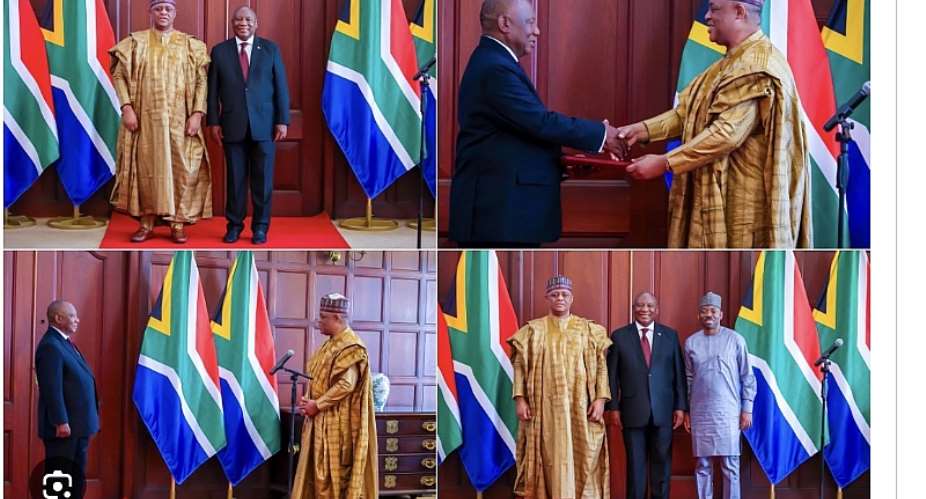
For those of us who have been disappointed and lamented the decline in the country’s diplomatic clout, Ambassador Femi Fani-Kayode brought great joy as he stood before President Cyril Ramaphosa to present his credentials and spoke as if he remembered the country he represented.
Wow! At last, somebody raised Nigeria’s voice above a whisper. He did it so boldly and with great conviction. He reminded us of Colonel Joe Garba, who remains the country’s greatest Foreign Minister.
FFK’s speech was not only bold, but it was timely and necessary. Without anger or arrogance, he factually recalled Nigeria’s place in the struggle against apartheid, called for the repair of a historic friendship, and said what our timid and clueless officials rarely dare to say: Africa’s future cannot be built without Nigeria and South Africa working together.
What the new Nigerian envoy in Pretoria said was not bombast, but a statement of fact we have been advocating for on this blog.
More importantly, FFK’s statement was a sharp rebuke to the small-minded diplomacy that has allowed an essential relationship between Africa’s two most powerful nations to drift into suspicion and silence.
It is a speech worthy of applause by every lover of Africa.
We should remember what Nigeria did when Pretoria was a pariah. Lagos did not wait for permission from London, Washington, or Brussels to oppose apartheid. Though geographically far away, Nigeria was very much a Frontline State. It supported liberation movements and chaired the United Nations committee against apartheid, which helped in the regime’s sporting and diplomatic isolation. In 1979, it nationalized British Petroleum’s assets after oil was sold to the racist regime. Nigerian schoolchildren gave up pocket money for the Southern Africa Relief Fund.
Nigeria, like much of Africa, did not ask for a receipt. We understood that Mandela’s chains were our chains, and that the blood of Soweto stained the conscience of the whole continent.
Fortunately for our continent, Nigeria's leaders at the time understood that history was not charity, but enlightened self-interest, African solidarity, and moral clarity in one act. Nigeria’s intervention taught the world that it was not merely a large country on a map, but one that could use its weight in service of a principle.
Nigeria did not prevaricate; it championed the cause of Black Emancipation and left no one in doubt where it stood on Pan-Africanism.
That is the standard our diplomacy should meet today - not because the past can be repeated, but because a country that forgets what it once stood for soon has nothing to say.
Then came the rupture. Abacha’s execution of Ken Saro-Wiwa poisoned Nigeria’s standing, and even Nelson Mandela, who had shown extraordinary generosity toward his own jailers, could not simply overlook it. Under Presidents Olusegun Obasanjo and Thabo Mbeki, the two countries began repairing the damage through the Bi-National Commission and the partnership around NEPAD.
For a short while, Africa’s two continental powers acted like partners rather than rivals.
Then, tragically, the drift returned: xenophobic mobs attacked Nigerians and their businesses, envoys were recalled, protest notes were exchanged, and rather than step in to arrest the situation, the governments allowed it to fester and chose, instead, to retreat into the familiar theatre of injured pride. It was a disgrace to watch the two countries that should be leading the struggle for African unity engage themselves in a stupid fight.
The disgrace is not merely that relations between South Africa and Nigeria deteriorated; it’s that ordinary people in both countries kept building the relationship even as their governments neglected it. MTN continues to grow and prosper in Nigeria. In turn, Nollywood reaches South African audiences. Nigerian doctors, traders and entrepreneurs make their lives in Johannesburg. People meet, work and do business across this divide.
Sadly, the two governments - whose first duty is to protect and deepen those human ties - have fallen silent and waste precious time in mutual recriminations like petulant juveniles.
At a time when we are witnessing a tectonic shift in global geopolitics, why should Africa accept the absurdity of its two giants feuding? South Africa brings industrial capacity, infrastructure, and financial markets. Nigeria brings population, resources, talent, and immense cultural reach.
While we don’t expect the two countries to solve the continent’s problems on their own, together, they could help set a continental agenda not written for them in Brussels, Washington, or Beijing.
The rupture between Abuja and Pretoria only leaves a vacuum that outside powers will eagerly exploit. Africa can’t afford to have its two most consequential states behave as if cooperation were optional. It cannot.
Those who will dismiss Ambassador Fani-Kayode’s performance as theatre should be told that diplomacy has always involved theatre; the real question is whether the performance carries a serious purpose.
We should be mindful that however forceful, a single speech can’t repair a relationship on its own. What it can do, however, is make clear that repair is urgently needed and that Nigeria remembers its history, and that Abuja intends to be treated as a partner rather than a supplicant.
That FFK’s speech was taken seriously was shown by the speed with which the South African Presidency released the full video after the state TV authorities cut it off.
Now, a word for President Bola Tinubu. On this blog, we have been merciless about his handling of the Sahel. We have said his foreign policy lacks vision and is subservient to Western interests, especially the US and France’s, and we will say so again when he errs.
But criticism that cannot recognize a good decision is not principled; it is vanity. Choosing Fani-Kayode for this critical post at this critical juncture showed foresight.
President Bola Ahmed Tinubu, thank you for this one.
And to Nigeria’s other envoys - in London, Washington, Beijing, Moscow and Brussels - we say, look to Pretoria and learn. You are not clerks, nor are you ornamental residents of expensive houses. You speak for more than 220 million people - for the farmer in Kano, the trader in Onitsha and the student in Ibadan.
You must, like the indefatigable Ghana’s Foreign Minister Okudjeto Ablakwa, prioritize defending Nigerians when they are abused, and demand respect for the country whenever and wherever it is denied. Negotiate as representatives of a sovereign country with its own interests, not as petitioners grateful for an audience.
A nation that does not respect itself will not be respected - our elders have a proverb for this: Goods are priced the way they are displayed.
Nigeria must neither swagger without purpose nor whisper out of fear. It must speak clearly, act consistently, and make its size count for Africa. It must mend fences with South and lead the continent in facing an increasingly hostile geopolitical landscape where might is becoming right.
That is what Ambassador Fani-Kayode reminded us in Pretoria.
And we say a big bravo, FFK!
Nkosikelele Africa.
Forward ever! Backward never!
©️ Ọ̀dọ̀fin Fẹ́mi Akọ́mọláfẹ́ (1st Dan, Ọ̀dọ̀fin I of Kasoa)


 Mahama Commissions GH¢148.4m Cashew Factory, Creating 1,500 Jobs in Techiman
 21-year-old Ghanaian man stabbed to death in north London
 Another phone snatcher jailed 11 years in Ashaiman, marking second conviction in...
 Defeated NDC Central Regional Chairman blames former secretary, threatens legal ...
 Haruna Iddrisu urges AG, CID for prosecution of culpable persons in Obuasi SHTS ...
 24-hour economy is private sector-led, New Economy is US$10 billion government-l...
 Nana Kwasi breaks down in tears after reclaiming NDC Ashanti Regional chairmansh...
 Benjamin Danso unseats Ashie-Moore as NDC Greater Accra Regional Chairman
 Ghana to ratify three key AU financial institutions by 2027
 Catholic Bishops want full implementation of Kalba-Gbinyiri conflict report


