




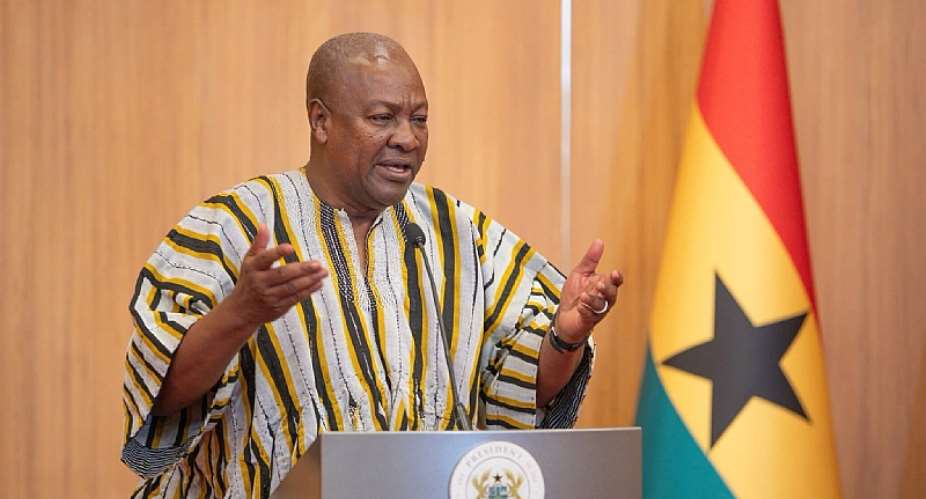
The recent mindless attack on the soldiers preventing the menace of galamsey in my hometown, Domi-Kaniago, in the Amanse South District in the Ashanti region, has renewed my long held conviction on the heightened importance of the declaration of a state of emergency in the illegal mining war.
If you may remember, prior to the 2024 general elections, President Mahama and his unyielding minions, including the University Teachers Association of Ghana, emitted their arousing disgust and threatened to go on strike over the Akufo-Addo administration’s supposed lackadaisical approach in combating the galamsey menace.
The overarching question every concerned Ghanaian should be asking then is: have President Mahama and his teeming supporters, who were extremely aggrieved and vociferous over the galamsey menace prior to the 2024 general elections ceased their fury in condemnation?
In contrast to his uncompromising stance in opposition, in one of his 2025 meet the press series, President Mahama made it clear to the good people of Ghana that he has not exhausted all the necessary interventions in the galamsey fight, and therefore the state of emergency is not needed.
The crucial question every concerned citizen or denizen should be asking then is: why did President Mahama forcefully push for a state of emergency during Akufo-Addo/Bawumia administration?
I’m afraid, if we think a state of emergency is not warranted in the galamsey fight, then we are deluding ourselves.
Truth is, the galamsey menace is more serious than the insidious coronavirus, and therefore a state of emergency is not negotiable in combating the criminals in illegal mining who are wickedly destroying our lands and rivers and poisoning us with mercury and cyanide .
The boisterous brats are well-prepared and routinely carry out their illegal activities with military precisions, can strike as lighting, and as deadly and destructive as molten magma.
Given the criminal intent of the unscrupulous illegal miners , we are, more than ever, urgently required our military power to combat the menace of the stubbornly obdurate nation wreckers.
Make no mistake, the situation presented by the illegal mining activities requires the government to take extraordinary measures to protect the health and well-being of the Ghanaians.
Of course, even in a public emergency, the declaration of a state of emergency needs to be based on the rule of law.
Emergency powers should be used within the parameters provided by international human rights law, particularly the International Covenant on Civil and Political Rights (ICCPR), which acknowledges that States may need additional powers to address exceptional situations such as the illegal mining activities.
Needless to say, such powers should be time-bound and only exercised on a temporary basis with the aim to restoring a state of normalcy.
It is also worth reminding the government that even without formally declaring a state of emergency, Ghana can adopt exceptional measures to protect public health that may restrict certain human rights.
These restrictions must meet the requirements of legality, necessity and proportionality, and be non-discriminatory.
More so, the derogation of certain civil and political rights is only allowed under specific situation of emergency such as galamsey that “threaten the life of the nation” ( OHCHR).
Interestingly, Article 4 of the International Covenant on Civil and Political Rights(ICCPR) directs that in the event of public emergency such as galamsey, which may threaten the existence of a nation, such sovereign state may take measures derogating its obligations, provided that such measures are not inconsistent with their other obligations under international law, and do not involve discrimination solely on the ground of race, colour, sex, language, religion or social origin.
Suffice it to stress that derogation is not permitted under any circumstances on Articles 6, 7, 8 (paragraphs I and II), 11, 15, 16 and 18 of ICCPR(UN 1966).
This is because the rights encapsulated in the preceding articles are non-derogable(cannot be suspended), which include the right to life, free from torture, free from slavery, unlawful arrest and detention, equal recognition everywhere before the law, and right to freedom of thought, conscience and religion (UN 1966).
Moreover, Article 21 of the ICCPR stresses that ‘the right of peaceful assembly shall be recognized. No restrictions may be placed on the exercise of this right other than those imposed in conformity with the law and which are necessary in a democratic society in the interests of national security or public safety’.
Whereas Article 22.1 emphasises that every member of the human family ‘shall have the right to freedom of association with others, including the right to form and join trade unions for the protection of his interests’.
Article 22.2 stresses that ‘no restrictions may be placed on the exercise of this right other than those which are prescribed by law and which are necessary in a democratic society in the interests of national security or public safety’ (UN 1966).
Based on the preceding provisions, we can draw an inference that human rights are not absolute: there is permitted abridgement.
Indeed, some rights, such as freedom of movement, freedom of expression or freedom of peaceful assembly may be subject to restrictions for public health reasons, even in the absence of a state of emergency (ICCPR 1966).
The restrictions, however, must meet the following requirements: Legality: The restriction must be “provided by law”. This means that the limitation must be contained in a national law of general application, which is in force at the time the limitation is applied.
The law must not be arbitrary or unreasonable, and it must be clear and accessible to the public.
The restriction must be necessary for the protection of one of the permissible grounds stated in the ICCPR, which include public health, and must respond to a pressing social need such as the galamsey menace.
The restriction must be proportionate to the interest at stake, i.e. it must be appropriate to achieve its protective function; and it must be the least intrusive option among those that might achieve the desired result.
No restriction shall discriminate contrary to the provisions of international human rights law (OHCHR).
Let me humbly submit that considering the pernicious and diffused effect of the illegal mining activities, the government could be justified in its restrictions upon rights in the declaration of a state of emergency.
May God bless our homeland Ghana!
K. Badu, UK.
[email protected]


 'Climate action is alive': Triumphant Democrats attend COP31 summit shunned by T...
 South Africa's Ramaphosa heads to US for AI visit
 China to host first-ever trilateral meeting between Trump, Xi and Putin next wee...
 Delegates to elect NDC Volta regional executives today
 NDC regional elections begin today
 IMF says Ghana's economic stability is taking root, shifts focus to long-term re...
 GRA arrests China Mall officials over alleged E-VAT violations
 Customs seizes 97 bales of imitation wax prints and 10 motorbikes in Techiman
 Minority demands Bank of Ghana Governor appear before Parliament over new cedi n...
 Dangote Seeks Deal to Process 500,000 Tonnes of Ghana Cocoa Locally


