




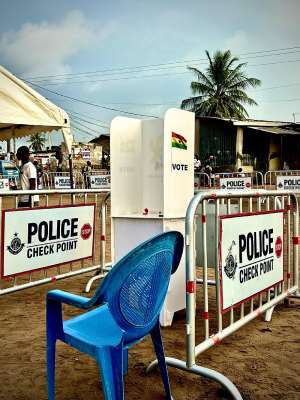
Two years before Ghanaians return to the polls, the issues most likely to shape their judgement may not be the ones dominating party platforms or talk-show debate. A new assessment, Ghana 2028: Electoral Latent Issues & Voter Concerns, finds a country whose electoral landscape is being shaped by a stable cluster of national worries and a growing set of regional grievances — and warns that what dominates national debate does not always match what communities live with every day.
Unemployment is the most persistent concern. Afrobarometer's August 2024 survey of 2,400 adults found 41 per cent naming it among the country's three biggest problems; the Institute of Economic Affairs recorded 46 per cent in December 2025, and a 2026 KPMG/UNDP survey put jobs among the priorities of 71 per cent of respondents. The figures come from different questions and are not interchangeable, but their consistency is striking. Among 15- to 24-year-olds, unemployment stood at 32 per cent in 2024. For a graduate without work or an apprentice unable to start a business, the question is not whether the economy is growing, but whether that growth creates opportunities they can reach.
Roads follow closely. Thirty-eight per cent of Afrobarometer respondents named them a top-three problem, and in 2026 residents protested over stalled or deteriorating roads in Ashanti, Upper West, Western and Volta. Poor roads raise transport costs for traders, cut farmers off from markets and delay patients on their way to care. An unfinished project carries a different public meaning from a newly announced one: it becomes a symbol of unmet expectations. As 2028 approaches, communities may care less about the number of roads in campaign speeches than about whether earlier promises were kept. The Chart below reveals voter related issues that may influence voter appraisals across electoral constituencies in Ghana -2028:
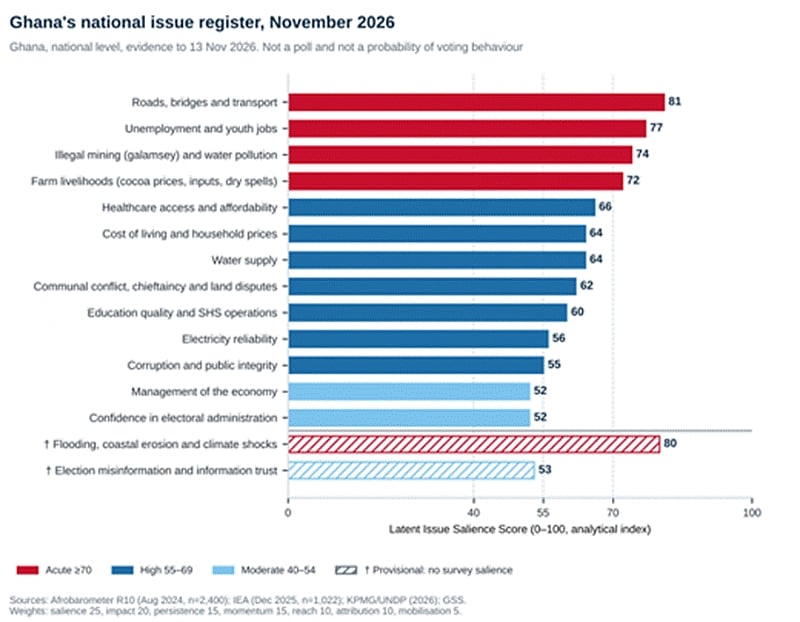
The study's national issue register ranks 15 concerns on a 0–100 Latent Issue Salience Score, combining survey salience with impact, persistence, momentum, reach, public attribution and mobilisation. It is an analytical index, not a poll of voting intention.
Two regional pressures stand out. The first is water. Pollution linked to illegal mining has disrupted treatment works at Kwanyako, Kyebi and Tarkwa, turning an environmental problem into a household one for schools, clinics and businesses that depend on piped supply. For affected communities, the test is not whether a crackdown on galamsey has been announced, but whether clean water returns to the tap. The study cautions that exposure is uneven across the mining belt and needs local measurement.
The second is cocoa. In February 2026 the producer price was cut from GH¢3,625 to GH¢2,587 per bag — about 29 per cent — and farmers in five regions have complained of unpaid deliveries dating back to November 2025; Western North farmers protested on 19 February. For cocoa-growing communities this touches school fees, health spending and farm upkeep, and it raises a wider question of confidence in the institutions that run the value chain. Because the shock is geographically concentrated, local concern may run far deeper than national averages suggest.
Household costs tell a subtler story. Inflation fell to 5.5 per cent in October 2026, but slower price rises do not mean lower prices. Seventy-one per cent of respondents were worried about food prices in December 2025, and non-food inflation has risen for three straight months to 7.9 per cent. Families judge the economy by the market basket, school costs and transport fares, and statistics can improve well before confidence does.
Everyday services complete the picture. Fifty-three per cent of Afrobarometer respondents went without medical care at least once in the past year, whether because of cost, distance, staffing or medicine shortages. Electricity has climbed to a 34 per cent priority in 2026 amid unreliable supply and a public apology from the Electricity Company of Ghana. These experiences can signal public frustration more directly than national political debate.
One finding is quieter but significant. Trust in the Electoral Commission fell from 53 per cent in 2019 to 28 per cent in 2024, yet only 5 per cent of respondents named democracy as a leading national problem. That contrast does not make institutional confidence unimportant. Electoral trust tends to stay in the background until an administrative or political event brings it into focus, which is why transparent procedures and credible dispute resolution will matter as 2028 nears.
The study is candid about the limits of what is known. Of Ghana's 276 constituencies, 220 have no documented constituency-specific signal. That does not mean they lack concerns; it means the evidence cannot yet show what matters most to their residents. Two constituencies in the same region may face entirely different pressures — farm incomes in one, urban joblessness in another, flooding in a third — and treating them as identical risks missing what shapes local judgement. More systematic local research is needed before firm claims can be made about individual seats.
For parties across the political spectrum, the lesson is that concerns are shared nationally but felt unevenly. Unemployment in a fishing community differs from unemployment in a city; a stalled highway matters most to the towns that depend on it; polluted water is, for some communities, a direct question of public health. The challenge is to identify which concerns are persistent, which are intensifying and which remain unresolved.
The evidence available in November 2026 cannot show how Ghanaians will vote in December 2028, or which party might benefit. It does show where attention is needed. Campaigns are often remembered for slogans and promises, but voting decisions can also be shaped by accumulated everyday experience: the job that never came, the road left unfinished, the water that became unsafe, the treatment that was out of reach, the cocoa that was never paid for. Ghana's resilience in 2028 may depend less on what voters are told than on what communities see change between now and then.
This article is based on Ghana 2028: Electoral Latent Issues & Voter Concerns, an independent, non-partisan assessment with an evidence cut-off of 13 November 2026, drawing on Afrobarometer, the Institute of Economic Affairs, KPMG/UNDP, the Ghana Statistical Service, official records and media reports. The study does not endorse or oppose any party, candidate or government; it is not a poll of voting intention or an election prediction, and its scores are analytical indicators rather than probabilities of electoral outcomes.
About The Author: Messan Mawugbe (PhD), [email protected]


 Microsoft says it is 'deeply sorry' after widespread outages cause global chaos
 Microsoft outage causes global chaos
 The Nvidia affair: Are markets about to fall out of love with AI?
 NAIMOS uncovers illegal mining activities in forest reserve as miners allegedly ...
 Roads minister orders 10 speed-calming structures on Bolgatanga–Paga highway
 NRSA warns Uber moto riders against road safety violations
 'Too early to discuss presidential bid’ – Dr. Ato Forson
 Government to train over 2,000 scientists for Ghana's nuclear power programme – ...
 Elderly man reportedly apprehended by residents in Koforidua after travelling fr...
 ‘We are living within our means’ – Finance Minister defends no-new-taxes for 202...


