




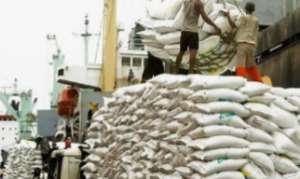
What government says
The government has announced plans to prohibit commercial rice imports by the end of 2030, as part of a strategy for rice self-sufficiency.
The messaging is mixed. In October, Agriculture Minister Eric Opoku said government was not seeking a ban, but would introduce measures so that imports strengthen domestic production.
He has also cautioned that Ghana is not yet in a position to ban imports. Ghanaians deserve clarity on whether this is a ban, a quota or a phase-down. The gap, in tonnes and dollars
Ghana consumed about 1.71 million tonnes of rice in 2025 but produced only about 960,000 tonnes, a deficit of nearly 751,000 tonnes and a self-sufficiency rate of 56 per cent.
The shortfall cost about US$320 million in imports. By my own calculation, that is roughly $425 per tonne of imported rice. The minister has also cited about US$500 million a year on rice imports, and another statement put the range at US$320 million to US$500 million.
The true figure depends on the year and on whether smuggled rice is counted. The five-year REWARD-Ghana project (2026-2030) aims to raise productivity and develop the rice market.
How will Ghanaians feel?
Rice is a daily staple, so people will judge this by price, quality and availability.
Farmers and millers will welcome a protected market, but only if they can sell. The Chamber of Agribusiness Ghana has complained that imports undercut farmers. (myjoyonline)
Consumers, especially low-income households, will worry about price. Ghana's reliance on imports reflects weak processing, distribution and marketing, not just a shortage of land. Many urban buyers prefer imported rice for its consistency, so local rice must match it in cleanliness, grading and packaging.
Traders and importers will fear lost income and may turn to smuggling.
The Nigerian warning, in dollars
The Nigerian record is mixed. One study found rice production rose from 3.2 to 6.4 million tonnes and land-border smuggling fell. But prices hurt consumers. Sixteen months after the 2019 border closure, a 50kg bag of imported parboiled rice sold for N25,000 to N28,000, against N14,500 before. At exchange rates of roughly N360 to the dollar in 2019 and N400 to N480 in late 2020, that is about $40 before, and roughly $50 to $70 after.
These conversions are my approximations, since Nigeria had official and parallel rates. The policy also created new smuggling routes at higher costs, and many Nigerians complained about the poor condition of some local grain. A Nigerian economist said borders can be closed only if local production meets demand. The lesson is that a ban works only after supply, quality and infrastructure are ready.
Safeguards for Ghana
Make the date conditional. Tie the final cut to production, milling and quality targets, with step-downs (quotas, lower import volumes) instead of a sudden ban. Fix the middle of the chain. Fund irrigation, certified seed, drying, milling, grading and storage, so local rice is clean and competitive. Weather matters too: a 2024 drought cut Ghana's maize harvest by nearly 30%, forcing imports up.
Keep a buffer. Hold strategic grain reserves and allow temporary imports if harvests fail.
Publish price and supply data, and guard against hoarding and smuggling.
Guarantee buyers for farmers, for example through school feeding and institutional procurement.
Treat 2028 as the test. Government's own target is rice self-sufficiency by 2028, which should be proven before any 2030 ban.
Conclusion
Saving up to $320 to $500 million a year on imports is a sound goal. But a deadline is not a harvest. If Ghana builds supply, quality and storage first, citizens will feel the benefit. If it bans first, it risks Nigeria's result of higher prices, smuggling and complaints about quality.
Mustapha Bature Sallama
Medical/ Science Communicator,
Private Investigator, Criminal Investigation and Intelligence Analysis,
International Conflict Management and Peacebuilding. (USIP)
[email protected]
+233555275880
References
The Ghanaian Chronicle, "Govt to ban commercial rice imports by 2030" (12 Nov 2026), https://thechronicle.com.gh/govt-to-ban-commercial-rice-imports-by-2030/
GhanaWeb, Minister Opoku on imports (7 Oct 2026), https://www.ghanaweb.com/mobile/wap/article.php?ID=2055632&nav=next
News Ghana, "Ghana not ready to ban rice imports: Minister," https://www.newsghana.com.gh/ghana-not-ready-to-ban-rice-imports-minister/
Farmlandgrab, "Agriculture Minister unveils roadmap to end Ghana's rice deficit," https://farmlandgrab.org/post/33516-agriculture-minister-unveils-roadmap-to-end-ghana-s-rice-deficit-within-decade
GNA, "Government launches REWARD-Ghana" (Nov 2026), https://gna.org.gh/2026/11/government-launches-reward-ghana-to-strengthen-rice-production/
Devdiscourse, "Ghana Rethinks Its Rice Economy," https://www.devdiscourse.com/article/business/3959204-from-imported-grain-to-local-growth-ghana-rethinks-its-rice-economy
MyJoyOnline, "The paradox of plenty," https://www.myjoyonline.com/the-paradox-of-plenty-how-ghanas-farmers-are-being-sacrificed-on-the-altar-of-a-cheap-import-agenda/
WeWire, "Why Ghana's food import bill keeps shrinking," https://blog.wewire.com/analysis-and-opinion/why-ghanas-food-import-bill-keeps-shrinking-and-what-that-means-for-local-agriculture/
BusinessDay, "Rice beyond reach of many Nigerians 16 months after border closure," https://businessday.ng/lead-story/article/rice-beyond-reach-of-many-nigerians-16-months-after-border-closure/
BusinessDay, "Nigeria's year-long border closure raises consumer food prices," https://businessday.ng/lead-story/article/nigerias-year-long-border-closure-raises-consumer-food-prices-with-little-gains/
BusinessDay, smuggling routes, https://businessday.ng/?p=537144
Bloomberg via AJOT, "Thwarting Smugglers Leave Nigerians Counting Costs of Stony Rice," https://www.ajot.com/news/thwarting-smugglers-leave-nigerians-counting-costs-of-stony-rice
Aremu et al., "Nigeria Land Border Closure" (2023), https://doaj.org/article/2a3708dab9b6436d8b65b45fa4bcc031


 Microsoft says it is 'deeply sorry' after widespread outages cause global chaos
 Microsoft outage causes global chaos
 The Nvidia affair: Are markets about to fall out of love with AI?
 NAIMOS uncovers illegal mining activities in forest reserve as miners allegedly ...
 Roads minister orders 10 speed-calming structures on Bolgatanga–Paga highway
 NRSA warns Uber moto riders against road safety violations
 'Too early to discuss presidential bid’ – Dr. Ato Forson
 Government to train over 2,000 scientists for Ghana's nuclear power programme – ...
 Elderly man reportedly apprehended by residents in Koforidua after travelling fr...
 ‘We are living within our means’ – Finance Minister defends no-new-taxes for 202...


