




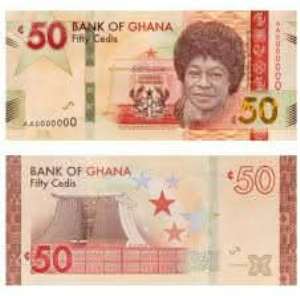
The introduction of a new national currency should be a moment of pride, national reflection and celebration of Ghana's identity. It should provide an opportunity to honour distinguished Ghanaians whose contributions have helped shape our history, culture and national development.
Unfortunately, what should have been a moment of national pride has been overshadowed by a deeply embarrassing controversy surrounding the alleged use of an incorrect portrait of Theodosia Okoh, the distinguished Ghanaian who designed our national flag.
Let me state this without mincing words: IF IT IS ESTABLISHED THAT THE PORTRAIT USED IS INDEED NOT THAT OF THEODOSIA OKOH, THEN THE PERSON RESPONSIBLE FOR THE DESIGN, SOURCING AND VERIFICATION OF THAT IMAGE MUST BE DISMISSED.
Yes, dismissed!
This is not a small mistake. It is not an ordinary administrative oversight. It is not something that should be swept under the carpet with an apology or an explanation about institutional procedures. We are talking about the image of a national icon being printed on the currency of an entire country. How can a project of such national significance be handled with this level of apparent disregard for basic verification?
What exactly was the designer doing? What research was conducted? Who supplied the photograph? Who verified its authenticity? Who examined the final artwork before it received approval? Was there no historian, researcher, communications professional or responsible official capable of identifying such a fundamental error?
Are we seriously saying that an entire chain of professionals could handle the design of Ghana's national currency without establishing whether the photographs being used actually belong to the personalities being honoured?
That is simply unacceptable.
If the individual entrusted with this responsibility could not undertake the most elementary task of verifying the identity of a person whose portrait was to appear on our national currency, then serious questions must be asked about their suitability for that assignment. Public responsibility is not a ceremonial title. It comes with accountability. You cannot be entrusted with an important national assignment, deliver such a fundamental failure and expect to retain your position as though nothing happened.
If the portrait is confirmed to be wrong, the person responsible for the design and verification should not merely be reprimanded, transferred or asked to apologise. They should be fired.There must be consequences proportionate to the gravity of the failure.
Beyond the immediate embarrassment, this incident raises a much bigger question about the standards of due diligence in our public institutions. If something as basic as verifying a historical portrait can escape scrutiny, what confidence should the public have in the quality-control processes governing other important national assignments?
However, while this alleged error deserves the strongest possible scrutiny, I find the attempt by Afenyo-Markin to use it as an indictment of the government's entire economic management rather simplistic and disproportionate.
A mistake in currency design and the management of the national economy are two different responsibilities. Fiscal discipline, monetary policy, inflation management, debt sustainability and the design of banknotes are not interchangeable functions.
One can condemn an administrative failure without manufacturing an argument that it automatically demonstrates an inability to manage the economy. Political criticism must be intelligent, measured and supported by sound reasoning. Not every government mistake must be stretched into an argument about everything the government does.
That said, the government must not use political distractions to evade responsibility. The issue deserves a proper investigation, a transparent explanation and decisive action against anyone whose negligence is established.
More importantly, we must not allow this controversy to overshadow the broader significance of recognising distinguished Ghanaians beyond the familiar personalities who have traditionally dominated our national currency.
The recognition of personalities such as Theodosia Okoh and Kofi Annan, alongside Kwame Nkrumah and other notable figures, provides an opportunity to appreciate the different dimensions of Ghanaian excellence and national contribution.
Our national history is bigger than any political party, family, political tradition or individual historical narrative. Ghana belongs to all of us. The national currency should reflect that reality.
We must move away from the unfortunate tendency to assess national recognition through the narrow lenses of political inheritance, family connections and partisan nostalgia. The worth of a Ghanaian's contribution should be measured by what that individual gave to the country, not by their political affiliation or family background.
We cannot build a culture of excellence by continually making excuses for failures that should never have happened in the first place.


 Microsoft says it is 'deeply sorry' after widespread outages cause global chaos
 Microsoft outage causes global chaos
 The Nvidia affair: Are markets about to fall out of love with AI?
 NAIMOS uncovers illegal mining activities in forest reserve as miners allegedly ...
 Roads minister orders 10 speed-calming structures on Bolgatanga–Paga highway
 NRSA warns Uber moto riders against road safety violations
 'Too early to discuss presidential bid’ – Dr. Ato Forson
 Government to train over 2,000 scientists for Ghana's nuclear power programme – ...
 Elderly man reportedly apprehended by residents in Koforidua after travelling fr...
 ‘We are living within our means’ – Finance Minister defends no-new-taxes for 202...


