




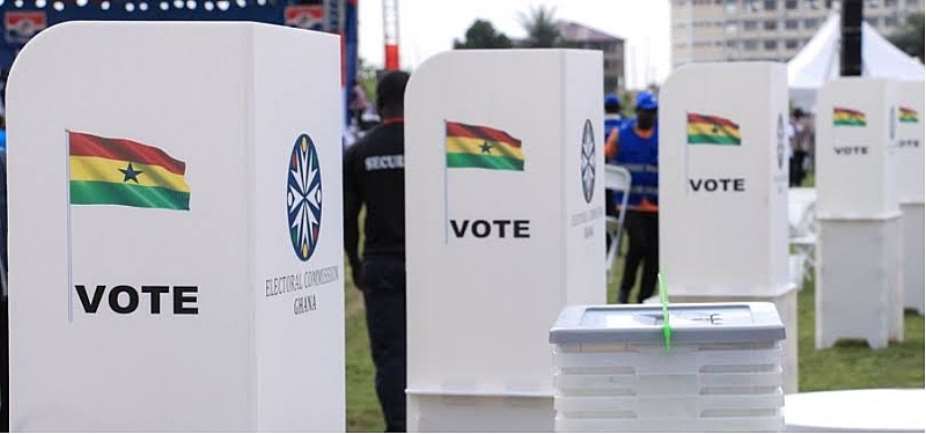
An independent examination of emerging electoral concerns across Ghana's 16 regions suggests that the greatest challenge before the 2028 general elections may not be political competition itself. It may be fragile public confidence, unresolved communal conflicts, institutional vulnerabilities and operational weaknesses — conditions that could make an otherwise manageable election unnecessarily difficult: A nation's trust is under pressure, and the clock is already ticking
Ghana's next election may be decided by what happens before election day
Ghana has earned considerable international recognition for its democratic resilience. Through successive competitive elections, peaceful transfers of power and the constitutional resolution of electoral disputes, the country has shown that political competition need not become a permanent source of national instability.
But as the country moves towards the 2028 general elections, a question deserves far more attention than it receives: is Ghana paying sufficient attention to the underlying conditions that could undermine confidence in its next electoral process before voters even approach the polling stations?
The question is not whether Ghana will experience electoral violence. There is no credible basis for declaring that the country is heading towards an electoral crisis, and no evidence that any particular party or candidate intends to undermine the democratic process. The more constructive question is whether the country is identifying, early enough, the conditions that could make ordinary electoral disagreements harder to manage.
A new baseline assessment, Ghana 2028: National Electoral Latent Threats, Risks and Trust Assessment, examines those conditions across all 16 administrative regions. The study identifies declining confidence in electoral institutions, documented election-related fatalities, unresolved communal conflicts, displacement, security–community tensions, misinformation and uneven electoral preparedness as areas requiring differentiated monitoring and preventive intervention.
| 28% trust the Electoral Commission (2024) | −25 points since 2019 | 15 deaths, 2020 + 2024 elections | 3 active communal conflict systems | ~48k displaced at Gbiniyiri | 55% of EC 2025 budget released |
Sources: Afrobarometer R10 (2024); Ministry of the Interior (Nov 2025, 2026); Ministry of Finance budget documents.
Its central conclusion is significant: Ghana's democratic resilience should not be taken for granted simply because previous elections have ended without a breakdown of constitutional order. The next election will require more than the traditional deployment of security personnel, campaign regulations and public appeals for peace. It will require a deliberate investment in public confidence, institutional transparency, accountability and early intervention — and that investment must begin well before 2028.
The trust problem: when the institutions that protect elections are themselves under pressure
Perhaps the most striking finding in this study concerns public confidence in the institutions on which electoral credibility depends. According to Afrobarometer's Round 10 survey of Ghana, trust in the Electoral Commission fell from 53 per cent in 2019 to 28 per cent in 2024 — a decline of 25 percentage points, and the lowest level in the series. The same survey put trust in the Ghana Police Service at 28 per cent, the courts at 35 per cent, the ruling party at 22 per cent and opposition parties at 28 per cent. The Armed Forces, by comparison, recorded 65 per cent.
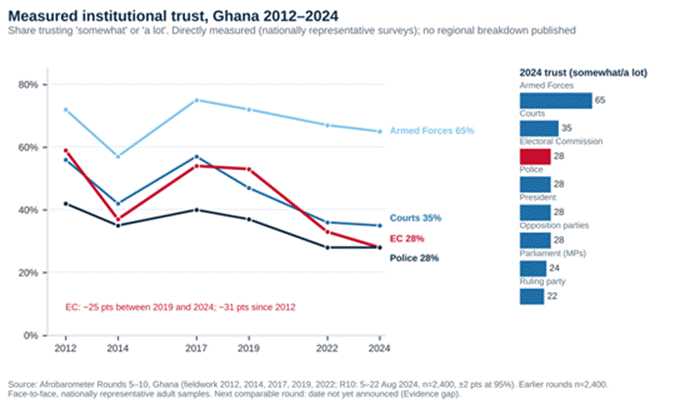
Figure 1. The institutional trust gap. Share of Ghanaians trusting each institution 'somewhat' or 'a lot', 2012–2024. Afrobarometer Rounds 5–10; Round 10 fieldwork August 2024, n=2,400, ±2 points. These are national survey findings, not estimates generated by the study.
These figures deserve careful interpretation. Low public trust does not automatically mean that an institution is performing improperly, nor does it establish that citizens will reject the outcome of an election. It does, however, create a real institutional vulnerability. When confidence is weak, even an ordinary administrative error attracts disproportionate suspicion. A delayed declaration, a disputed collation, an unexplained discrepancy or a poorly communicated operational decision can become a much larger legitimacy problem.
That matters particularly in Ghana, where electoral disagreements have sometimes moved from polling stations to collation centres and then into the courts. The study identifies collation and declaration as the most sensitive stages of the process. The Supreme Court's December 2024 decisions on re-collated parliamentary results in several constituencies show why transparent procedures and lawful dispute resolution matter. The lesson is not that judicial intervention should be avoided; it is that procedures should be transparent and consistently administered enough to minimise avoidable disputes in the first place.
“A country cannot rely indefinitely on the goodwill of political actors to compensate for weaknesses in institutional confidence.”
Ghana's democratic strength has historically included the willingness of contestants to use constitutional and judicial channels. Preserving that tradition requires institutions to make those channels credible, accessible and timely.
Fifteen deaths: why the geography of electoral violence matters
A statement by the Minister for the Interior in November 2025 reported 15 deaths and approximately 39–40 injuries across the 2020 and 2024 election periods, associated with 12 constituencies. The reported causes included firearms carried by police patrols, military intervention, firearms attributed to party supporters, and lynchings. According to the ministerial breakdown, seven of the 15 deaths were attributed to police and military interventions.
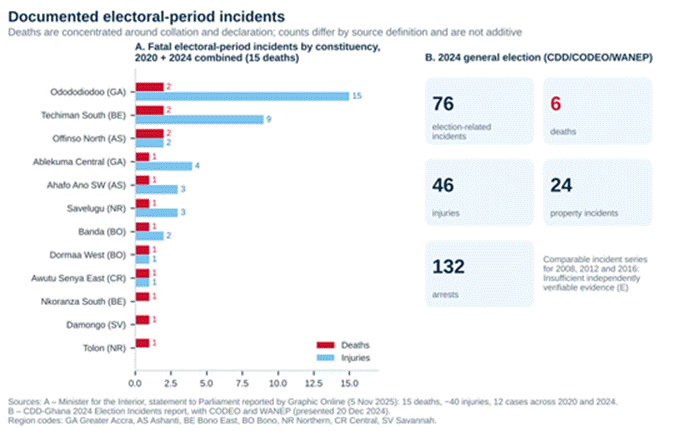
Figure 2. Documented electoral-period incidents. Panel A: deaths and injuries by constituency, 2020 and 2024 combined (Ministry of the Interior). Panel B: 2024 general election (CDD-Ghana, CODEO and WANEP). The two exercises use different definitions and must not be added together.
This raises an important question about how electoral security is managed. Security institutions have an indispensable responsibility to protect voters, officials, candidates, public facilities and the wider population. But deployment must be matched by disciplined conduct, proportionality, clear command structures and accountability. The study therefore argues against blanket militarisation as the principal answer, and in favour of geographically informed security planning: the 12 constituencies associated with previous fatalities should receive particular attention in constituency-level security plans.
That does not mean residents of those constituencies should be treated as potential threats. It means the documented history of incidents should inform better protection, preparedness and conflict prevention.
A separate monitoring exercise by CDD-Ghana, CODEO and WANEP recorded 76 incidents during the 2024 election period, including six deaths, 46 injuries, 24 property-related incidents and 132 arrests. Both sets of findings show why electoral security cannot be measured solely by the number of officers deployed. The quality of deployment, the conduct of personnel, the protection of electoral facilities and the speed of incident response matter just as much. The central test is whether security arrangements prevent confrontation, rather than simply respond after it occurs.
The three conflict zones that require particular attention
Electoral competition is national, but some of the conditions affecting Ghana's preparedness are geographically concentrated. The study identifies three active communal conflict systems as requiring urgent institutional attention: Bawku in the Upper East Region, Gbiniyiri in the Savannah Region and Nkwanta South in the Oti Region. None is necessarily electoral in origin. Their relevance lies in what they could do to voter registration, electoral logistics, security deployment, freedom of movement and community confidence.
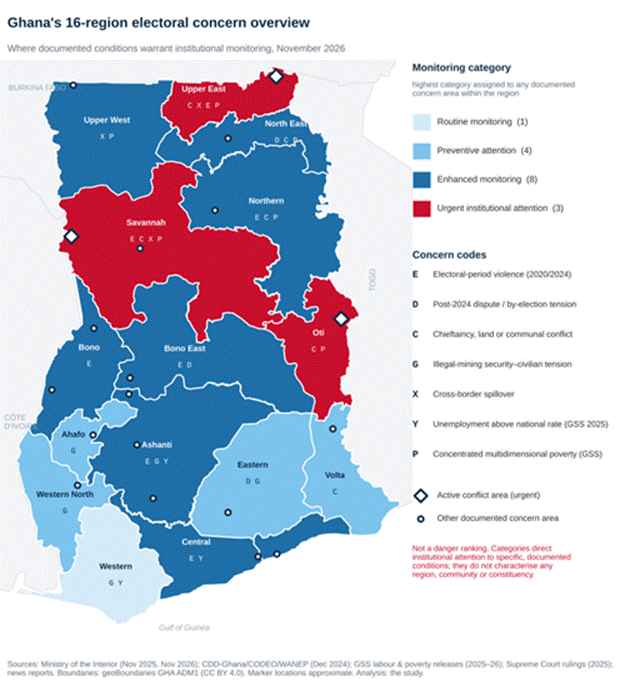
Figure 3. Ghana's 16-region electoral concern overview. Each region shows the highest monitoring category assigned to any documented concern area within it; diamonds mark the three active conflict systems. This is a map of institutional attention, not a ranking of dangerous regions.
Bawku: the test of mediation and institutional follow-through
The Bawku conflict remains one of the most consequential unresolved security and communal challenges facing Ghana. Its current phase dates to late 2021; by August 2023 nearly 200 people had died, according to the Municipal Chief Executive. A curfew was imposed in October 2024, and the burning of a parliamentarian's residence during renewed violence in July 2025 showed how communal insecurity can intersect with public institutions and political representation. In December 2025 the Asantehene presented the findings of his mediation, which government subsequently endorsed. Yet a mediation outcome is not the same as a completed peace process. For 2028, the concern is not that Bawku will necessarily become an electoral flashpoint, but that unresolved tensions, movement restrictions and the possible political association of local disputes could complicate the electoral process. The study recommends published mediation milestones, transparent investigation of allegations involving armed or vigilante groups, and a specific Electoral Commission–Regional Security Council operating arrangement for affected communities.
Gbiniyiri: the electoral implications of mass displacement
Following violence that began in August 2025, the study records 31 deaths and approximately 48,000 displaced people in the Gbiniyiri area of the Savannah Region, including more than 13,000 who crossed into Côte d'Ivoire. More than 700 security personnel were deployed. Numbers on that scale turn a local conflict-management issue into a major humanitarian and preparedness challenge. Displacement raises direct questions about whether affected citizens can register, obtain identification, receive reliable electoral information and vote. The central concern is the protection of their constitutional voting rights. The study therefore recommends an Electoral Commission–National Disaster Management Organisation protocol for displaced voters, alongside transparent tracking of the mediation recommendations.
Nkwanta South: when curfews meet electoral preparedness
In the Oti Region, recurring violence in Nkwanta South has led to renewed curfews throughout 2026, affecting 12 communities including Nkwanta, Keri and Odomi. Such restrictions may be necessary for immediate security management, but electoral planning must account for their consequences. Can election officials reach affected communities? Can registration and exhibition proceed without unnecessary exclusion? Can parties campaign lawfully and safely? Can materials be moved under appropriate security? These questions need advance planning rather than last-minute improvisation. The study recommends a formal Electoral Commission–Regional Security Council protocol for curfew-affected communities by the fourth quarter of 2027.
The broader lesson from all three is that national electoral readiness cannot be separated from the resolution and management of local security challenges.
Sixteen regions, sixteen different sets of concerns
One of this study's most useful contributions is its refusal to treat Ghana as a single, uniform electoral-risk environment. It identifies specific areas requiring attention while stressing that these are neither rankings of dangerous regions nor characterisations of entire populations.
REGION BY REGION: WHERE THE STUDY POINTS
Greater Accra. Concentrated electoral infrastructure, media and collation facilities make transparency and rapid verification critical. Odododiodoo, Ablekuma Central, Ablekuma North, Okaikwei Central and Tema Central feature in the documented incident history.
Ashanti. Previous electoral fatalities combine with security–civilian tensions around illegal-mining enforcement. Offinso North, Ahafo Ano South West, Obuasi and parts of Amansie are identified for monitoring.
Bono and Bono East. Documented fatalities in Banda, Dormaa West, Techiman South and Nkoranza South call for constituency-level security and transparent collation. Central. Awutu Senya East and parts of Cape Coast need attention to polling-day security, youth engagement and rapid peri-urban growth.
Eastern. The burning of the Ayensuano EC office in 2024 and tensions around the Akwatia by-election point to facility protection and stronger recount procedures.
Ahafo. Security–community tensions around mining enforcement in Hwidiem and Kenyasi call for community engagement and a clear separation of mining enforcement from election security.
Western and Western North. Western is classified for routine monitoring; the fatal May 2026 incident at Sefwi Asawinso raises concerns about armed activity around illegal mining in Western North.
Volta. The long-running Alavanyo–Nkonya dispute remains relevant where curfews and traditional authority intersect with electoral operations.
Northern. Documented fatalities in Tolon and Savelugu warrant constituency-level preparedness and engagement through local peace structures.
North East. Post-election institutional conduct, communal tension and concentrated poverty; the January 2025 seizure of government facilities by party supporters underlines the need for responsible conduct during transitions. Upper East. Sustained attention to Bawku, Pusiga, Binduri, Garu and the Bolgatanga–Bawku corridor.
Upper West. The Hamile incident of 3 November 2026 — fatalities after an explosion during a border pursuit and subsequent clashes — is an emerging security–community concern; an independent inquiry and community dialogue are recommended.
Savannah and Oti. Displacement in Sawla-Tuna-Kalba and West Gonja; continued conflict monitoring, mediation and operational planning in Nkwanta South and Biakoye.
These observations point to a single principle: Ghana's 2028 preparedness should be geographically informed, institutionally coordinated and responsive to actual conditions in each community. A national security strategy that ignores local differences risks either overlooking genuine vulnerabilities or needlessly treating ordinary communities as security threats.

Figure 4. Regional intervention priorities. Regions are listed alphabetically; the matrix shows what kind of preventive action fits documented conditions in each, not how 'risky' a region is.
The digital election: when false information travels faster than official results
The electoral environment is no longer confined to polling stations, party offices and traditional media. The Media Foundation for West Africa's monitoring of the 2024 elections found that approximately 79 per cent of the electoral disinformation it identified circulated through social media, and the Ghana Fact-Checking Coalition reported AI-generated content during the cycle. The study identifies an especially sensitive window: the hours between voting, collation and official declaration, when fabricated result sheets, manipulated audio, misleading videos and unverified claims can spread rapidly.
The problem is not that citizens use social media to discuss elections; digital participation is part of democratic engagement. The problem arises when fabricated information is presented as verified electoral evidence — when an official result that takes hours to communicate competes with a false one circulating within minutes. That is why the Electoral Commission's communication capacity should be treated as an essential component of electoral security. The study recommends a joint rapid-response arrangement involving the Commission, fact-checking organisations, the Cyber Security Authority and the media, built around a verified results feed, clear communication protocols and rapid correction of false claims. Media organisations, too, have a responsibility to verify before they amplify. None of this should become a justification for censorship or the suppression of lawful political criticism; the objective is to strengthen public access to authentic information.
The financial question: how much will Ghana pay if it waits?
Electoral peace is usually discussed as a moral and constitutional responsibility. It is also an economic investment. When disputes escalate, institutions face additional spending on emergency deployments, investigations, court proceedings, damaged facilities, humanitarian support, reruns and operational disruption — costs not always visible in the national budget, and which may extend to lost business activity, disrupted livelihoods, weaker investor confidence and the long-term cost of rebuilding trust.
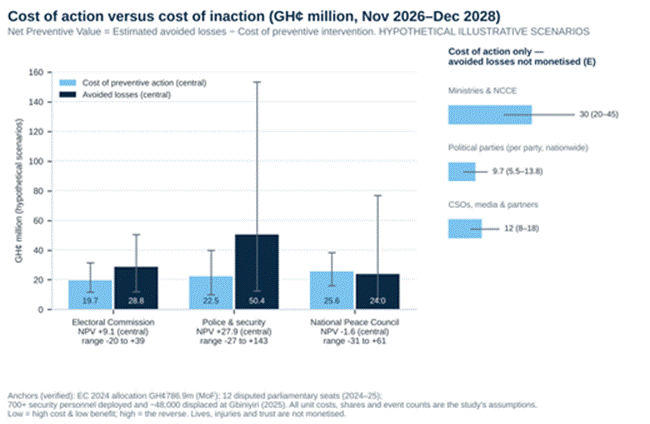
Figure 5. Cost of preventive action versus avoided losses, GH¢ million, November 2026–December 2028. Hypothetical, illustrative scenarios built on stated assumptions; lives, injuries and trust are not monetised.
The study models illustrative scenarios for several institutions. In its central scenario, an Electoral Commission transparency, audit and training package costing about GH¢19.7 million could avoid about GH¢28.8 million in hypothetical corrective and litigation costs associated with disputed seats — a net preventive value of GH¢9.1 million. For the security agencies, preventive training of GH¢22.5 million set against GH¢50.4 million in potentially avoided emergency deployment yields a net value of GH¢27.9 million. These are not approved budgets, guaranteed savings or forecasts of future losses; they are hypothetical scenarios with explicitly stated assumptions.
The National Peace Council scenario is particularly revealing. Its central estimate is roughly break-even on humanitarian relief costs alone — but that ignores the value of lives protected, injuries avoided, displaced families supported and institutional confidence preserved, which the study deliberately does not monetise. The wider argument is straightforward: preventing a conflict is generally less disruptive than managing its consequences.
Timing matters as much as amounts. Only 55 per cent of the Electoral Commission's 2025 allocation was released, according to Ministry of Finance budget documentation. That raises questions about the predictability of funding in the non-election years before 2028, when testing, training and procurement should happen. The Ministry of Finance and Parliament should consider ring-fenced, timely releases. For the police, preventive investment should focus on training, accountability, constituency-level plans and disciplined conduct; for the National Peace Council, on sustained mediation and regional peace committees; for political parties, on internal discipline, responsible communication, trained agents and a public commitment against vigilantism — set against the legal exposure, reputational damage and campaign disruption that inaction can bring. The financial case for prevention is compelling. The democratic case is stronger still.
Five actions Ghana should not postpone until 2028
1. Make electoral transparency measurable. The Electoral Commission should commit to publishing polling-station results in machine-readable form within 24 hours, where operationally feasible, pilot open collation-centre observation, and commission an independent operational audit before the cycle reaches its most demanding phase.
2. Give conflict mediation measurable milestones. The National Peace Council and the Ministry of the Interior should publish implementation milestones for Bawku, Gbiniyiri and Nkwanta South, covering mediation, community engagement, displacement and the restoration of safe movement.
3. Strengthen security accountability. The Ghana Police Service should develop constituency-level protection plans for locations with previous election-period fatalities, with clear use-of-force instructions for personnel on electoral duty and transparent post-incident reviews.
4. Secure an equal commitment from political parties. All registered parties should renew their commitments against vigilantism through a public cross-party peace pact, with internal disciplinary procedures, agent training and commitments to lawful dispute resolution — the same standards regardless of party identity.
5. Protect electoral preparedness funding. The Ministry of Finance should work with Parliament and the Electoral Commission to release operational funding in time for testing, training and procurement. An election cannot be properly prepared if essential resources arrive only as polling day approaches.
These measures are practical and achievable. None requires Ghana to suspend democratic competition or restrict lawful political activity. They require institutions to take their preventive responsibilities seriously.
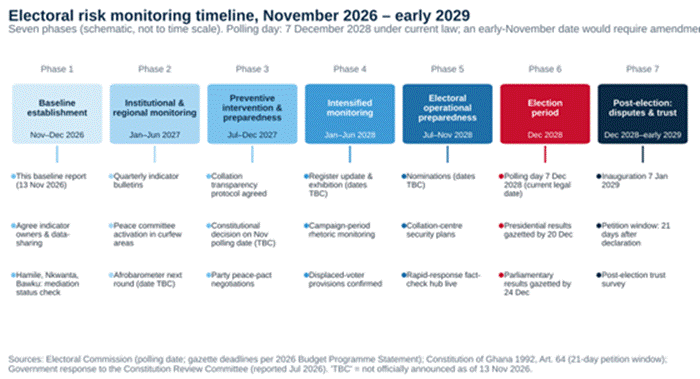
Figure 6. Electoral risk monitoring timeline, November 2026 to early 2029. Polling day is 7 December 2028 under current law; a proposed move to early November would require constitutional amendment.
The open presidential contest and the importance of acceptance
Ghana's 2028 presidential contest will take place without an incumbent eligible to seek re-election under the constitutional two-term limit. An open contest is not, by itself, a threat to stability; competitive elections are the essence of democratic governance. The challenge is to ensure that competition is accompanied by credible institutions, responsible political communication and accessible dispute resolution.
Ghana's 2024 experience offers an important reference point. The presidential result was conceded on 8 December 2024, power was transferred on 7 January 2025, and parliamentary disputes were addressed through the courts. That is constitutional behaviour worth preserving. The study does not predict that any party will reject the 2028 outcome. It argues instead that the country should strengthen the conditions that make acceptance possible: transparent results, credible collation, timely judicial processes, responsible leadership and public access to verified information. The next presidential contest may be politically intense — which is precisely why the institutions managing it must be trusted, prepared and accountable.
A warning about what we do not yet know
The study is equally candid about gaps in Ghana's electoral intelligence. There is no established regional public-trust dataset that would support reliable comparisons across all 16 regions; no systematic national baseline for measuring political rhetoric and incitement to consistent standards across parties; and little age-disaggregated information on youth civic confidence. These gaps matter. An institution cannot monitor change if it has not established the baseline, and the absence of reported incidents is not proof that no concern exists. Some communities may be under-reported, while others attract more attention because of their political or geographical significance.
The right response is better research, more consistent monitoring and transparent disclosure of uncertainty — not manufactured risk scores or labels of "dangerous" regions. The study recommends a regular electoral early-warning system that tracks institutional trust, verified incidents, displacement, misinformation, operational preparedness and conflict developments, updated periodically until 2028, and that clearly distinguishes verified facts, documented concerns, analytical interpretations and emerging indicators. That discipline is what keeps independent intelligence from turning into political speculation.
Ghana's 2028 election will require more than peace appeals
Ghana does not need another election cycle dominated by emergency appeals for calm after tensions have already escalated. It needs institutions that identify vulnerabilities early, address legitimate grievances, communicate transparently and show that electoral rules apply equally to everyone:
- political parties willing to discipline their own supporters;
- security agencies that protect citizens while respecting their rights;
- an Electoral Commission that treats public confidence as an operational asset;
- a National Peace Council equipped to sustain mediation before, during and after the contest; and
- a media environment that rewards verification over the rapid circulation of sensational claims.
Above all, it needs a national understanding that electoral peace is not simply the absence of violence on voting day. It is the presence of trust, accountability, credible institutions, accessible justice and confidence that every citizen's vote matters.
The 2028 election is still ahead, and that means Ghana has time — time to strengthen the Electoral Commission's operational capacity, address communal conflicts, protect displaced voters, improve the conduct of security operations, secure transparent commitments from political parties and build a stronger evidence base for public trust. The country should not wait until the campaign season intensifies. The most effective election intervention may be the one that prevents an incident from happening at all, and the most valuable electoral intelligence may be the intelligence that helps institutions act before a concern becomes a crisis.
“Ghana's 2028 democratic resilience will not be measured only by what happens when citizens vote. It will also be measured by what the country chooses to do between now and then.”
ABOUT THE ASSESSMENT
This article draws on the Ghana 2028 National Electoral Latent Threats, Risks & Trust Assessment (baseline report GH28-OBS-001), with a baseline cut-off of 13 November 2026. The study covers all 16 administrative regions and examines twelve national electoral threat domains, institutional trust, regional concerns, early-warning indicators, preventive interventions and the illustrative costs of action and inaction. Principal sources include Afrobarometer, the Ministry of the Interior, the Ministry of Finance, the Ghana Statistical Service, the Electoral Commission, CDD-Ghana, CODEO, WANEP, the Media Foundation for West Africa and other identified institutional and research sources.
INDEPENDENCE AND NEUTRALITY DISCLAIMER
This study was prepared by an independent, non-partisan research and intelligence team, and this article is published for constructive electoral risk awareness, institutional preparedness, public trust measurement and the prevention of electoral-related tensions in Ghana. The study has no political affiliation, candidate preference or interest in influencing the outcome of Ghana's 2028 general elections. The identification of a latent concern or emerging indicator does not constitute a prediction that an electoral incident, security threat or political confrontation will occur. Regional observations are not characterisations of entire communities, populations or political constituencies. The study distinguishes verified information, documented concerns, analytical interpretations and evidence gaps. Financial scenarios are illustrative analytical estimates, not guaranteed losses, savings or approved expenditure commitments. The article is intended to encourage constructive institutional attention, preventive action, accountability and peaceful democratic participation. Independent Measurement. Constructive Attention. Preventive Action.
Before a concern becomes a crisis, it must first become visible through measurement.
About The Author:
Messan Mawugbe (PhD), [email protected]


 Microsoft says it is 'deeply sorry' after widespread outages cause global chaos
 Microsoft outage causes global chaos
 The Nvidia affair: Are markets about to fall out of love with AI?
 NAIMOS uncovers illegal mining activities in forest reserve as miners allegedly ...
 Roads minister orders 10 speed-calming structures on Bolgatanga–Paga highway
 NRSA warns Uber moto riders against road safety violations
 'Too early to discuss presidential bid’ – Dr. Ato Forson
 Government to train over 2,000 scientists for Ghana's nuclear power programme – ...
 Elderly man reportedly apprehended by residents in Koforidua after travelling fr...
 ‘We are living within our means’ – Finance Minister defends no-new-taxes for 202...


