




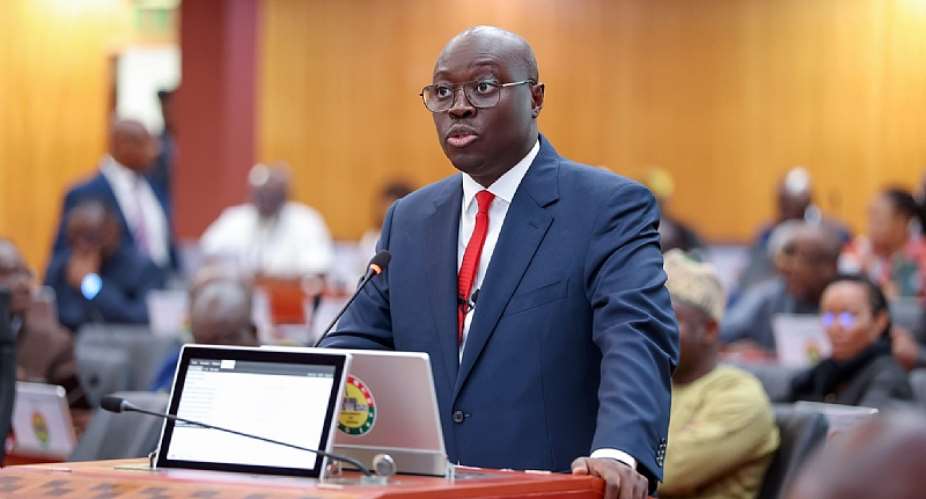
The 2027 Budget responds to several of the central priorities raised by ISODEC and its partners. We welcome the decision to lower the primary surplus target to 0.5 percent of GDP and use the space for a GH¢30 billion New Economy investment programme in 2027, capital expenditure of GH¢100.4 billion, now larger than interest payments, and firm targets for processing cocoa, gold, manganese and bauxite at home, and local-purchase rules for food, textiles and medicines, with no new taxes. These commitments deserve recognition. However, the Budget does not yet turn this welcome shift into measurable commitments on jobs, transparency and equity.
Our assessment is therefore that the 2027 Budget partly meets expectations. It delivers ISODEC’s central macroeconomic asks, a lower primary surplus target and a larger share of spending for productive investment, but it does not yet translate this shift into a measurable jobs target, transparent execution and reporting, or protections for equity and revenue integrity. In several areas, the Budget states intentions without providing measurable targets, implementation timelines, or reporting arrangements. The difference between an announcement and a funded commitment matters.
Budget at a glance: primary balance target 0.5% of GDP (legal floor 0.5%; 2026 target 1.5%); capital expenditure GH¢100.4bn, or 5.6% of GDP; employment target: none stated for 2027 (unemployment below 8% by 2030); New Economy programme GH¢30bn in 2027. Against the 28 asks in ISODEC's pre-budget statement: 5 met, 15 partly met, 8 not met.
Stabilisation must now make room for employment and production
Ghana has made important progress on macroeconomic stabilisation. The question for the 2027 Budget is how that progress will be used to address persistent unemployment, weak productive capacity and the country's exposure to foreign-exchange pressures. The fiscal framework should be judged by its effects on employment, inflation and the external balance, not by the pursuit of a fiscal ratio in isolation.
The announced primary surplus target of at least 0.5 percent of GDP on a commitment basis, down from 1.5 percent in 2026, needs to be considered alongside capital expenditure of GH¢100.4 billion (GH¢120.5 billion including transfers), against a record of under-execution in 2026, when primary spending ran 3.4 percent below target to October. While the GH¢30 billion New Economy allocation is welcome, the Budget speech does not yet set an execution target or commit to quarterly reporting of releases and spending by ministry, programme and region. The execution gap remains a serious concern: government must explain how it will ensure that approved capital allocations translate into completed projects and economic activity.
Employment commitments need numbers, funding and accountability
We acknowledge the removal of the cap on youth employment funding (an extra GH¢1 billion), GH¢2 billion for youth employment and skills, and the job projections for rice (about 125,000), oil palm (potential for more than 250,000) and pharmaceuticals (about 20,000). However, the Budget speech does not set a 2027 employment target or a consolidated jobs target across the eight pillars, nor does it explain how jobs will be counted. Unemployment below 8 percent (from 12.8 percent in 2025) is a 2030 goal only. Without these details, it is difficult to assess whether the announced programmes are commensurate with the scale of unemployment and youth exclusion.
The absence of a public employment guarantee pilot, particularly in deprived districts in Northern Ghana, is a missed opportunity. Government should use labour-intensive public investment in climate adaptation, irrigation,
feeder roads, care and community services to provide paid work while meeting urgent development needs. Skills programmes must also be linked to vacancies and the requirements of productive firms.
The production agenda is bold; delivery must now be proven
The GH¢30 billion New Economy programme (US$10 billion over 2027 to 2030), including US$3 billion for commercial agriculture, US$1.5 billion for critical minerals value addition and US$1 billion each for textiles and pharmaceuticals, is ambitious and well targeted. However, the 2027 split across the eight pillars is not shown, and core ministries remain thinly funded: GH¢188 million for Trade, Agribusiness and Industry and GH¢156 million for Labour, Jobs and Employment. The Budget should attach measurable targets for manufacturing value added, agro-processing capacity and local content to each pillar, so that progress can be tracked.
The measures on import substitution and local processing, including a ban on commercial rice imports by 2030, sugar and poultry self-sufficiency, 60 to 80 percent of essential medicines made locally by 2030, and at least 70 percent of small-scale gold refined locally by December 2027, are a step in the right direction, but there is no foreign-exchange budget showing the import content of the New Economy and Big Push projects, and no target for fertiliser. Ghana cannot sustainably reduce external vulnerability without a deliberate programme to expand domestic production and reduce the import content of public investment and consumption. The Budget should also disclose the foreign-exchange cost of major projects, foreign-currency debt service, and the expected foreign-exchange earnings or savings.
Revenue mobilisation and equity require stronger action
We note the commitment to introduce no new taxes, the review and modernisation of the Income Tax Act and the Revenue Administration Act, and the review of Double Taxation Agreements in line with the United Nations framework convention on international tax cooperation. However, the Budget speech does not include a tax expenditure statement, even as it adds new exemptions and incentives for solar equipment, rice hubs, SSNIT hotels, and medical tourism, and says little about trade mis-invoicing and transfer pricing. The government should close revenue leaks and improve compliance before considering measures that place additional pressure on households and workers.
The provisions for the National Health Insurance Scheme (GH¢10.2 billion), LEAP (GH¢1.1 billion), school feeding (GH¢2.1 billion) and the District Assemblies Common Fund (GH¢10.8 billion) are noted. ISODEC also welcomes the US$1 billion Pwalugu Multipurpose Dam, GH¢820 million for the northern Ghana water system and GH¢3 billion for rural electrification in the northern and western regions. Headline allocations are not sufficient evidence of improved support. The relevant test is whether allocations rise in real terms, are released on time, and reach communities with the greatest needs. The Budget should provide regional and district breakdowns of capital expenditure per person and assess the distributional effects of tax and spending decisions by income group, gender and region.
A stronger implementation and oversight framework is needed
The proposed Natural Resource Revenue Management Act, the proposed Loans Act and the annual Investment-Grade Readiness Report are welcome accountability mechanisms. However, the Budget speech is silent on the Independent Fiscal Council’s mandate, a Parliamentary Budget Office and the commitments under the IMF Policy Coordination Instrument. ISODEC calls for the Fiscal Council to assess employment and distributional outcomes alongside fiscal aggregates, and for its reports to be submitted to Parliament. Quarterly reporting should show allocations, releases and actual spending by ministry, programme and region.
We urge Parliament to use its consideration of the estimates to press the Minister for clearer funding and measurable targets for employment, productive investment, regional equity and revenue integrity. Government should also publish the full commitments under the IMF Policy Coordination Instrument and identify which policy measures are linked to external programme conditions, so that citizens and Parliament can assess the extent to which national priorities shape the Budget.
Overall, the 2027 Budget makes a welcome shift from stabilisation towards investment and production. To succeed, Ghana needs a coherent, funded and accountable programme that puts people to work, strengthens domestic production and distributes opportunity fairly. The government must address the gaps during parliamentary consideration and, above all, during implementation.
This is ISODEC’s provisional assessment. ISODEC will publish its detailed analysis, scorecard verdict and policy briefs for Parliament, organised labour, industry and citizen groups in due course.

 Microsoft says it is 'deeply sorry' after widespread outages cause global chaos
 Microsoft outage causes global chaos
 The Nvidia affair: Are markets about to fall out of love with AI?
 NAIMOS uncovers illegal mining activities in forest reserve as miners allegedly ...
 Roads minister orders 10 speed-calming structures on Bolgatanga–Paga highway
 NRSA warns Uber moto riders against road safety violations
 'Too early to discuss presidential bid’ – Dr. Ato Forson
 Government to train over 2,000 scientists for Ghana's nuclear power programme – ...
 Elderly man reportedly apprehended by residents in Koforidua after travelling fr...
 ‘We are living within our means’ – Finance Minister defends no-new-taxes for 202...


