




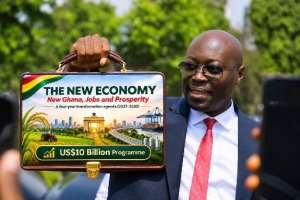
As we flip through the pages of the 2027 Budget Statement and Economic Policy, presented to Parliament on 12 November 2026, it is hard not to feel a surge of hope. The government has laid out a bold, sweeping blueprint dubbed the “New Economy”- a US$10 billion, four-year masterplan aimed at fundamentally transforming Ghana from a raw-material exporter into an industrial, value-adding powerhouse.
Make no mistake, these are massive visions, and the fact that we are dreaming this big is a very good thing. As the nation prepares to mark its 70th independence anniversary, the budget proposes eight ambitious pillars: building a US$3 billion commercial agriculture sector, a US$2 billion energy infrastructure backbone, a US$1.5 billion critical minerals value addition enclave, US$1 billion each for tourism, textiles and pharmaceuticals, and US$300 million for technology.
We are talking about state-owned thermal and solar plants, a 24-hour critical minerals enclave, and proposed procurement rules that would require public institutions to buy only locally grown rice and locally sewn uniforms. It is a beautiful picture of a self-reliant Ghana.
But as any Ghanaian who has lived through our cycles of boom and bust knows, a vision on paper is very different from a vision on the ground. When we look closely at the mechanics of this New Economy, three major risks threaten to derail this grand agenda.
- Political Risk:
First is the ever-present Political Risk in Ghana. In our part of the world, continuity of one political party for more than 8 years is the exception, not the rule. The New Economy is designed as a four-year programme stretching from 2027 to 2030. Yet Ghana goes to the polls in December 2028, at the programme's halfway mark. What happens if there is a change in government? The tendency for a new administration to abandon these projects is dangerously high. We have seen it happen time and time again; the new government will say, “That was the previous government’s policy”. Even if they do not scrap it entirely, the political energy and financial commitment required to drive this massive infrastructure and agricultural projects will wane. A US$1 billion Pwalugu multi-purpose dam, whose full completion is scheduled only for December 2030, or a new state-owned nuclear readiness programme cannot survive a politically induced coma. If this New Economy is to work, it must become a Ghanaian vision, immune to the four-year electoral pendulum.
The Minister himself asks Parliament to “see beyond one fiscal year and one electoral cycle”. The surest way to do that is to put the programme on a statutory footing, with ring-fenced funding and annual progress reports to Parliament, much as Parliament ring-fenced petroleum revenue and mineral royalties for the Accra–Kumasi Expressway.
- Revenue Risk:
Second is the monumental domestic revenue risk and the task assigned to GRA. Dreams are free, but building them costs money. To finance this New Economy, the government plans to invest a staggering GH¢30 billion (about 1.7 per cent of projected GDP) in 2027 alone. This is supposed to be funded by cutting the primary surplus target by one percentage point of GDP and relying on tax reforms and compliance measures. Put plainly, two-thirds of the financing comes from running a smaller surplus-the overall deficit on a commitment basis rises from 2.0 per cent of GDP in 2026 to 2.9 per cent in 2027, with some GH¢85 billion to be raised on the domestic market.
But let us be brutally honest: achieving this level of revenue mobilisation is a steep mountain to climb. We are already dealing with historical challenges in VAT compliance and a heavy reliance on a narrow tax base. If the expected revenues from the new Customs and Excise Acts of 2026 and the forthcoming Income Tax Act do not materialise, or if commodity prices take an unexpected dip, where will the money for these ambitious industrial parks come from? More borrowing, on top of what is already built into the plan? We cannot afford to fund the New Economy by dragging the country back into the debt we just climbed out of. Public debt has already edged up from 44.7 per cent of GDP at the end of 2025 to 47.5 per cent in October 2026.
- Procurement Risk:
With big expenditure comes the temptation of big corruption. A $10 billion capital injection into the economy over four years is enough to make a few well-connected people overnight billionaires if we are not vigilant. The Budget proposes amending public procurement laws. While this approach is highly commendable, the implementation is where the demons hide. Who gets the contracts to supply these? If the procurement processes for the new pharmaceutical hubs are hijacked few, this beautiful vision will just become another avenue to drain the public purse. The Budget promises that every project will undergo rigorous appraisal and value-for-money assessment, and that local preference will never excuse poor quality, late delivery or bad value. Those promises should be tested in public: every New Economy contract, its price and the beneficial owners of the winning bidder should be published.
Ultimately, the 2027 Budget gives us a destination worth striving for. We absolutely need to stop importing what we can grow and stop exporting our gold, bauxite, manganese and cocoa in their rawest forms. The New Economy is exactly the kind of structural shift Ghana owes its next generation.
However, visions do not build nations; disciplined execution does. If we do not insulate this plan from petty partisan politics, aggressively and creatively mobilise the actual revenue needed, and ruthlessly police our procurement systems to prevent state capture, the New Economy will remain just that- a beautiful dream trapped in a budget document.
–
Author: Francis Timore Boi Esq. [email protected] : The writer is a Ghanaian legal and tax practitioner, and a member of the Chartered Institute of Taxation and a Chartered Accountant (ICAG)
— CitiNewsRoom

 EU rejects COP31 draft decision over failure to tackle fossil fuels
 Soldiers reclaim 50 hectares of galamsey-degraded Tano-Nimiri Forest Reserve
 The New Economy Programme will keep NPP in opposition for very long time — Maham...
 I am anti-corruption crusader, no dime of this country will go waste – Woyome
 Gov’t to close down buildings over fire safety non-compliance — Muntaka
 Korle Bu patient regains normal urination, good erections three weeks after peni...
 Africa disappointed with COP31 outcome over failure to deliver adaptation financ...
 COP31 president apologises to Zanetor after interrupting Africa’s statement
 Ajumako-Besease two teens arrested for alleged GH¢38,000 romance scam
 Retired senior military officer in court over alleged GH¢1 million recruitment s...


