




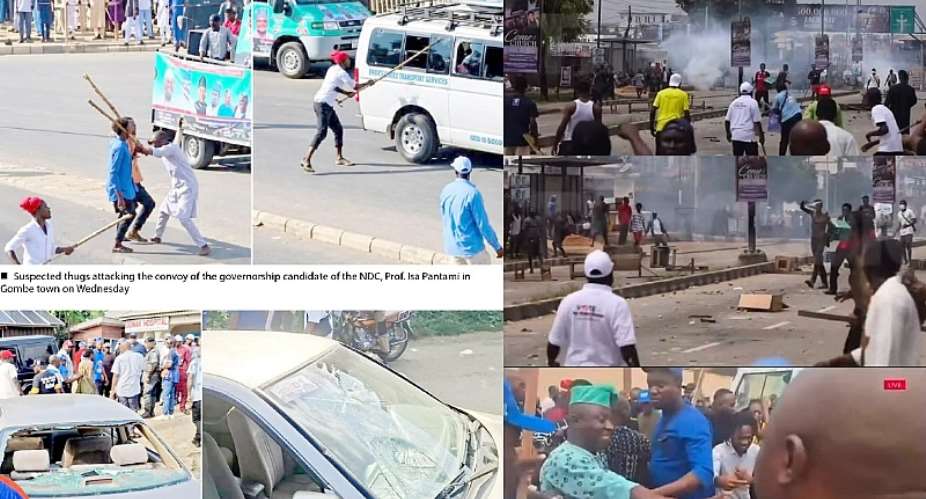
Every election season in Nigeria, the same disturbing story repeats itself. While the children of the politically powerful are studying in New York, London, Dubai or Toronto, the children of common men are being recruited to fight their political battles at home. As the 2027 general elections approach, the familiar pattern appears to be resurfacing, with pockets of confrontations involving supporters of the All-Progressives Congress (APC) and the Nigeria Democratic Congress (NDC), and the confrontations are already raising concerns about the country's political atmosphere.
What should ordinarily be a contest of ideas, policies and competing visions for national development is increasingly becoming an exercise in political intimidation, street confrontations and the mobilization of vulnerable young people for violence. It is time Nigerians confronted this uncomfortable reality before the situation degenerates into something more tragic.
The warning signs are already visible. In September 2026, tension reportedly erupted in Effurun, Uvwie Local Government Area of Delta State, during a political mobilization involving supporters of the APC and NDC. The confrontation prompted the Delta State Government to direct security agencies to investigate the incident and prosecute anyone found culpable. The police had earlier warned of a possible clash between supporters of both parties and deployed personnel to prevent a breakdown of law and order.
The situation was another indication that political activities were gradually acquiring dangerous dimensions, even before the formal electioneering period. What is particularly disturbing is that young people, rather than political leaders, frequently find themselves at the centre of these confrontations.
Another troubling episode occurred in Calabar, Cross River State, on November 4, when supporters of the APC and NDC reportedly encountered one another during separate political activities around the U.J. Esuene Stadium and Metropolitan Hotel. The confrontation disrupted traffic and commercial activities before police intervention restored calm. The police said their timely engagement helped avert a possible escalation between the two groups.
There were also reports of an attack on an NDC mobilization march in Asaba, Delta State, on November 8. According to reports, armed hoodlums attacked participants marching towards Interbau Roundabout, leaving several people injured and campaign vehicles damaged. The NDC alleged that APC supporters were responsible, an allegation that had not been independently established. Nevertheless, the incident raised fresh questions about the safety of opposition supporters and their constitutional right to organize political activities without intimidation.
More disturbing was the November 12 attack on an NDC town hall meeting at Classique Event Centre in Oregun, Lagos. Suspected hoodlums armed with cutlasses, cudgels and stones reportedly invaded the venue, forcing participants to flee. Some supporters sustained injuries, vehicles were vandalized, and the confrontation spilled into the surrounding streets.
The incident subsequently generated political exchanges, with the NDC accusing the APC of promoting political violence, while the Lagos APC denied involvement and challenged the opposition to provide evidence linking the party to the attack. Interestingly, the APC Presidential Campaign Council condemned the disruption and called on security agencies to arrest and prosecute those responsible.
These incidents, irrespective of the political affiliations of those involved, should worry every Nigerian who understands the consequences of electoral violence. They demonstrate how quickly political disagreements can become physical confrontations when intolerance replaces democratic engagement.
However, the recruits for these political battles are not difficult to identify. They are young men from motor parks, street corners and overcrowded neighbourhoods where unemployment is widespread and opportunities are limited. They are often approached with a few thousand naira, bags of rice, branded T-shirts and promises that someone influential will take care of them.
In return, they are expected to disrupt political gatherings, intimidate opponents, engage in street fights, destroy campaign materials and, in extreme circumstances, participate in ballot-box snatching and attacks on electoral officials. Poverty becomes the recruiter’s most effective weapon because a young man struggling to feed himself and his family may find it difficult to reject an immediate financial offer, even when he understands its implications.
Now consider the other side of this arrangement. The children of the politicians and wealthy individuals who finance political activities are rarely anywhere near the violence. Many are abroad, attending prestigious institutions and enjoying opportunities that ordinary Nigerian families can only dream about. Those who remain in the country are often protected by police escorts, convoys and private security arrangements.
When a political confrontation erupts, the politician can be whisked away from the scene. The young man recruited to defend his political interests, however, remains exposed to arrest, mob attacks, police bullets or retaliation from opposing supporters.
This is the fundamental injustice that makes political thuggery particularly reprehensible. The people who benefit from political power are not necessarily the people who pay the highest price for securing it.
The aftermath is where the deception becomes even more obvious. The young man who risks his life for a politician does not automatically become a commissioner, special adviser, board chairman or government contractor after the election. The political godfather who previously answered his telephone calls may suddenly become unreachable.
The promised settlement may never materialize. He is left with possible criminal charges, physical injuries, psychological trauma and a damaged reputation. If he is killed, his family is left to mourn him, while the politician he fought for continues with political activities, possibly preparing for another election.
In some instances, a short condolence message or financial assistance to the bereaved family may be the only acknowledgement of the sacrifice. Meanwhile, the politician's children return from foreign universities with impressive qualifications and are positioned to inherit the opportunities created by their parents' political influence.
One family's children are sacrificed on the altar of political ambition, while another family's children are carefully protected from the consequences. This is not merely a failure of individual responsibility; it is a failure of leadership. Politicians spend enormous resources organizing campaigns, mobilizing supporters and financing political structures, yet many demonstrate considerably less enthusiasm for investing in the education, vocational training and employment opportunities that would make young people economically independent.
It is particularly unfortunate that political actors who should be competing to demonstrate their commitment to youth development sometimes appear more interested in controlling unemployed youths as instruments of political intimidation. A society that cannot provide opportunities for its young people but can readily mobilize them for political violence has misplaced its priorities.
Parents, community leaders, religious organizations and traditional rulers also have responsibilities. They must become more interested in understanding the activities of young people in their communities. Parents should ask where their children go, who finances their movements and why they suddenly have money without any identifiable source of legitimate income.
Traditional rulers and religious leaders should resist the temptation to become political cheerleaders while ignoring the recruitment of vulnerable youths for violence. Their responsibility to protect their communities should be greater than their desire to maintain relationships with influential politicians.
And to the young people themselves, the message is straightforward: your future is worth more than whatever is contained in the next envelope offered to you. You are not required to fight somebody else's political battle to demonstrate loyalty to a political party.
Your PVC is more powerful than a cutlass, and your vote is more valuable than the money offered to you to intimidate another citizen. Participate in the democratic process, attend political gatherings peacefully, monitor elections and hold elected officials accountable for their promises.
Before accepting any payment to participate in political violence, ask yourself some uncomfortable questions. Who will bail you out if you are arrested? Who will pay your hospital bills if you sustain life-threatening injuries? Who will provide for your family if you are killed? Will the politician whose interests you are defending sacrifice any of his children in your place? The honest answer is that nobody in that convoy is likely to do so.
The APC, NDC and every other political party must understand that winning elections through intimidation or violence, whether directly sponsored or indirectly encouraged, undermines the legitimacy of democracy. Political leaders must condemn violence consistently, cooperate with security agencies and ensure that their supporters do not turn political differences into street warfare.
The children of ordinary Nigerians must not become expendable commodities in the struggle for political power. Nigeria's 2027 elections should be about ideas, leadership, accountability and the country's future, not about which political camp can assemble more street fighters.
Their children deserve the opportunity to study abroad and build prosperous futures. So do the children of common men. Say no to political thuggery. Your life is not a campaign tool.


 NAIMOS uncovers illegal mining activities in forest reserve as miners allegedly ...
 Roads minister orders 10 speed-calming structures on Bolgatanga–Paga highway
 NRSA warns Uber moto riders against road safety violations
 'Too early to discuss presidential bid’ – Dr. Ato Forson
 Ghana’s $250m AI centre to focus on practical applications; not competing US, Ch...
 'They did not even talk about the Women's Bank, where is it?' — Afenyo-Markin qu...
 Government to train over 2,000 scientists for Ghana's nuclear power programme – ...
 Elderly man reportedly apprehended by residents in Koforidua after travelling fr...
 ‘We are living within our means’ – Finance Minister defends no-new-taxes for 202...
 Global Microsoft outage knocks out Outlook and other services


