




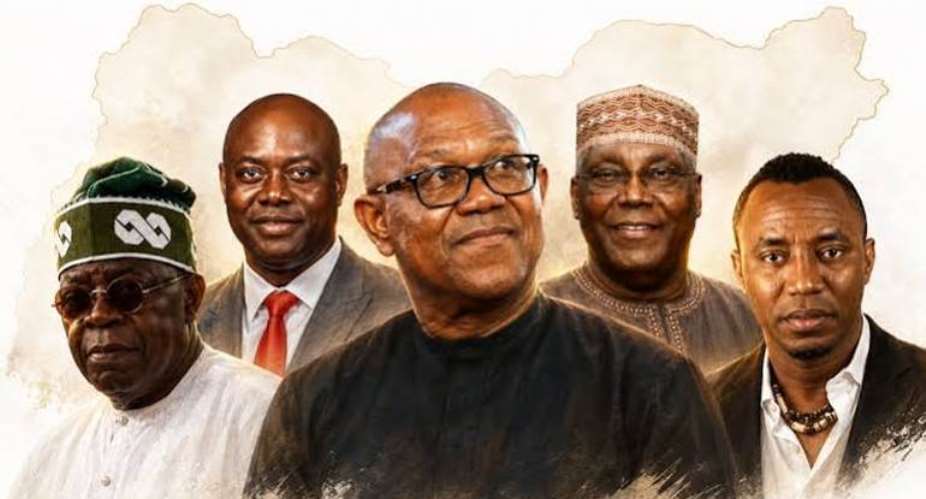
There is something quite disturbing about the growing incidence of political violence in Nigeria as the country approaches the 2027 general elections. What ought to be a period of democratic competition, political persuasion and peaceful mobilisation is increasingly becoming an arena of intimidation, physical confrontation, destruction of property and, in some instances, the killing of citizens. The frequency with which political gatherings are disrupted, campaign convoys attacked and supporters assaulted suggests that Nigeria may be drifting towards a familiar and dangerous political culture. It is a culture in which the contest for political power becomes so desperate that the rules governing civilised political engagement are progressively thrown to the winds.
For a country whose democratic evolution has experienced repeated interruptions, the warning signs should not be ignored. Nigeria's political history contains a painful lesson about what happens when political rivalry degenerates into violence, when constitutional authority loses its moral force and when those entrusted with protecting the republic become unable, or unwilling, to guarantee public order. The military takeover of government in January 1966 did not emerge from a political vacuum. It occurred against a background of escalating political hostility, electoral manipulation, regional antagonism, institutional breakdown and widespread public disillusionment with civilian leadership. Although the military intervention had its own conspiratorial, ideological and institutional motivations, the circumstances that preceded it created an environment in which the destruction of democratic government became conceivable to some Nigerians. The country must not allow those circumstances to develop again.
The events unfolding ahead of the 2027 elections deserve serious national attention. Since the commencement of presidential and National Assembly campaigns on 19 August 2026, political activities have been accompanied by reports of attacks, confrontations and intimidation in different parts of the country. The National Peace Committee, chaired by former Head of State General Abdulsalami Abubakar, reported on 11 November that its monitoring exercise covering August 19 to October 27 had identified 109 breaches of the National Peace Accord across 26 states and the Federal Capital Territory. Of these, 33 involved political violence and thuggery, 29 concerned misinformation and disinformation, 19 involved attacks on political activities and campaign assets, while 15 related to intimidation and threats. Other violations included restrictions on freedom of expression and assembly, inflammatory statements, intra-party conflict and voter inducement.
These figures are not merely statistical entries in an institutional report. They represent the weakening of the democratic conventions upon which peaceful political competition depends. The committee identified Kaduna, Edo, Enugu and the FCT among the areas with significant reported breaches. Kaduna recorded nine, while Edo, Enugu and the FCT recorded seven each. The political parties featuring in the reported incidents included the APC, ADC, PDP and NDC, either as alleged perpetrators or as victims. This distinction is important: the appearance of a party in a monitoring report does not establish that its leadership authorised or sponsored an attack. Nevertheless, the recurrence of violence involving supporters and political interests across party lines remains a matter of national concern.
The individual incidents give the statistics a more disturbing human dimension. On 8 September, in Makurdi, Benue State, the convoy of Peter Obi, the NDC presidential candidate, was reportedly blocked during a visit to the city. Police subsequently reported 46 arrests. The political affiliations of those responsible were not conclusively established, but the incident demonstrated the vulnerability of political movements and their leaders to organised obstruction. The following day, in Kaduna, ADC supporters staging a solidarity march for governorship candidate Isa Ashiru clashed with security operatives at Murtala Square. The party alleged that police fired tear gas and that political thugs were deployed to disrupt its gathering. The authorities maintained that security intervention was necessary to prevent a breakdown of law and order. Whatever the competing explanations, the incident raised questions about the freedom of opposition parties to organise and demonstrate without intimidation. On September 12, violence was reported in two separate locations in Enugu State. At Ndiuno-Obuoffia, Nkanu West, armed attackers disrupted an NDC ward meeting and opened fire, injuring at least two people, according to police accounts. The party accused political opponents of responsibility, although the attackers' affiliations were not established. On the same day, at St Joseph Primary School, Agbani, also in Nkanu West, hoodlums reportedly destroyed canopies and chairs prepared for a PDP political gathering.
In Emohua, Rivers State, suspected political thugs reportedly invaded the NDC secretariat and destroyed or removed campaign banners and billboards. On 18 September, a mobilisation procession organised by the NDC along Airport Road in Effurun, Delta State, was disrupted by a confrontation involving suspected political thugs. The NDC alleged that the attackers were associated with the APC, an allegation that should be distinguished from an independently established finding.
October brought further incidents. On 2 October, gunmen reportedly disrupted a PDP political consultation meeting in Calabar South, Cross River State. Four days later, an ADC supporter was reportedly shot during political engagements in Igueben, Edo State. Between 14 and 17 October, violence during a political procession in Ibadan, Oyo State, resulted in one death. A separate incident involving the killing of an APC ward member was also documented in Oyo, although the published monitoring summary did not establish all the circumstances surrounding the death.
On 28 October, an APC campaign convoy travelling along the Yashi-Funtua Road in Malumfashi Local Government Area of Katsina State was attacked with stones and other weapons. The convoy was heading towards Funtua for the Tinubu-Dikko campaign flag-off. Several vehicles were damaged and a female passenger was injured. Police subsequently arrested 14 suspects, although their political affiliations were not established.
November has produced incidents of even greater concern. On 4 November, an APC presidential campaign rally attended by Vice-President Kashim Shettima in Lafia, Nasarawa State, descended into violence. Some youths wearing APC regalia reportedly began chanting support for SDP governorship candidate Adamu Abubakar. The development triggered confrontations involving security operatives and supporters of APC governorship candidate Aliyu Wadada. Youths from opposing sides reportedly fought with dangerous weapons. About 40 people were said to have sustained injuries. The state government ordered an investigation into the incident, while questions were raised about the conduct of security personnel and the use of tear gas around the rally podium.
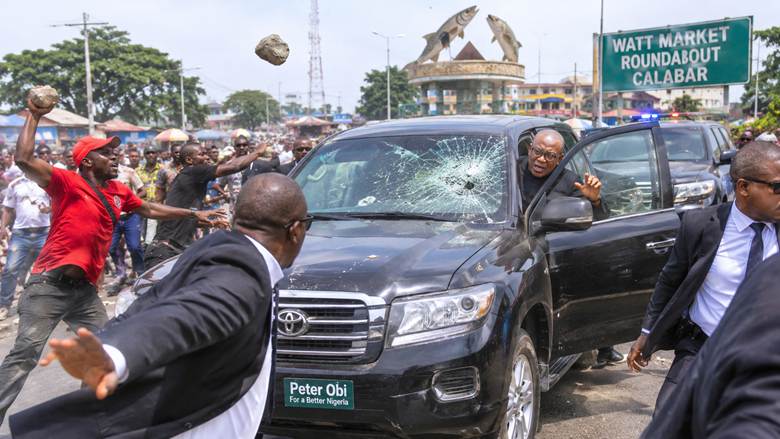
On the same day, Peter Obi's convoy was attacked at Watt Market Roundabout in Calabar, Cross River State, while travelling from the palace of the Obong of Calabar to the Metropolitan Hotel, where a presidential town hall meeting was scheduled. Suspected hoodlums reportedly attacked vehicles with sticks and machetes, smashing windscreens. Police subsequently arrested a 27 year-old suspect.
On 5 November, the ADC campaign delegation led by presidential candidate Atiku Abubakar encountered further violence in Kebbi State. Reports from Birnin Kebbi and Argungu described attacks, intimidation and damage to campaign vehicles. The ADC alleged that members were assaulted with machetes and sticks and that approximately 20 vehicles were damaged. There were also reports that security operatives used tear gas at a building where the presidential candidate and his delegation were staying. Amnesty International examined video footage of the attacks and condemned assaults on opposition supporters, including incidents involving machetes, stones and bottles. Journalists accompanying the campaign convoy also reportedly suffered the destruction of their equipment.
On 7 November, a political procession organised by NDC supporters and the Obidient Movement along Nnebisi Road in Asaba, Delta State, turned violent. One person was killed and five others injured, according to the police. The Delta State Police Command said it had received intelligence suggesting possible violence and had advised the organisers against holding an open-road procession.
These incidents are not the entire story. Before the official commencement of campaigning, violence had already begun to manifest itself during party congresses, primaries and political realignments. On 18 February 2026, an APC ward congress in Idanre, Ondo State, reportedly resulted in two deaths. Raphael Adetimehin, brother of the state APC chairman, was shot and attacked with a machete. On 24 February, gunmen attacked the residence of ADC national leader John Odigie-Oyegun in Benin City, Edo State, during a political meeting attended by Peter Obi and other party leaders. Another disruption occurred on March 1 at the residence of ADC National Legal Officer Oserheimen Osunbor in Iruekpen, Edo State.
On 17 May, Sani Abdullahi was killed during violence surrounding an APC House of Representatives primary in Mangu, Plateau State. On 21 May, in Gudu, Abuja, Senator Ireti Kingibe and other ADC officials were reportedly assaulted and briefly locked inside an office during a disruption involving the distribution of party primary materials. The following day, armed men disrupted an ADC primary at Wummy Hotel in Ekori, Yakurr Local Government Area of Cross River State, abducting the INEC returning officer and taking away ballot materials. The official was subsequently rescued. These incidents, documented by Global Rights' Incident Centre for Election Atrocities, demonstrate that the problem preceded the formal campaign season.
The Armed Conflict Location and Event Data organisation, ACLED, has also reported more than 30 attacks targeting political campaigns, candidates, supporters, convoys and gatherings since August 19. Its November assessment attributed more than 10 fatalities and several injuries to these incidents. It identified the North-West, particularly Kano, Kaduna, Zamfara and Katsina, as areas experiencing a concentration of politically linked attacks and unrest. These findings, together with the National Peace Committee's monitoring figures, suggest that the reported confrontations are symptoms of a wider national problem rather than isolated disagreements between political supporters.
It is at this point that Nigeria must revisit the lessons of 1966. The First Republic did not collapse simply because politicians disagreed. Political disagreements are inevitable in every democracy. Its tragedy was that disagreements became increasingly difficult to resolve through constitutional and institutional processes. The controversial federal election of 1964, the crisis surrounding the 1965 Western Region election, political intimidation, electoral malpractice, regional hostility and the breakdown of confidence in public institutions combined to produce a deeply unstable political environment. Violence in the Western Region, commonly associated with the period of Operation Wetie, became a particularly frightening expression of the political disorder. Public property was destroyed, political opponents were attacked and citizens increasingly lost confidence in the capacity of the civilian authorities to maintain order.
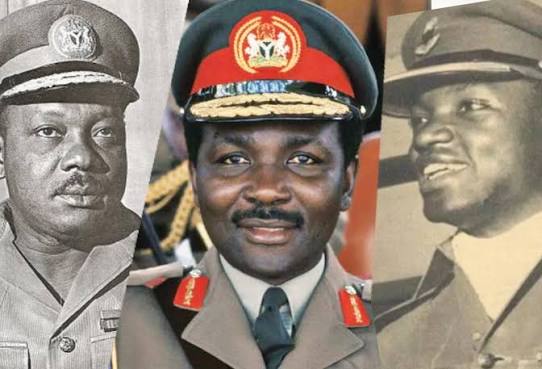
On January 15, 1966, a group of military officers staged a coup that terminated the First Republic. Prime Minister Abubakar Tafawa Balewa and several senior political and military figures were killed. The coup was followed by the July 1966 counter-coup, further killings and, eventually, the events that contributed to the Nigerian Civil War. It would be historically inaccurate to attribute the military takeover exclusively to civilian political violence. The coup plotters had their own objectives, and the military's intervention was not a neutral or inevitable response to political disorder. Nevertheless, the collapse of public confidence in the political system was among the circumstances that made the intervention possible and helped some people rationalize it.
Nigeria must understand that democratic institutions are not protected merely by the existence of a constitution, an electoral commission or periodic elections. They are protected by the willingness of political actors to respect rules even when those rules do not favour them. They are protected when opposition parties can campaign freely, when ruling parties recognise that political authority does not confer ownership of the state, when security agencies remain impartial and when electoral disagreements are resolved through lawful procedures rather than intimidation. The responsibility for preventing another descent into political disorder rests principally with political parties and their leaders.
They must demonstrate, through words and conduct, that violence is neither an acceptable campaign instrument nor a legitimate means of settling internal party disputes. Leaders who publicly condemn violence but privately tolerate the activities of political enforcers are contributing to the same problem they claim to oppose. Parties must identify, discipline and, where necessary, hand over violent members to the appropriate authorities. Political godfatherism, the mobilisation of unemployed youths as instruments of intimidation and the use of public resources to undermine opponents must have no place in a democratic republic.
The security agencies also have a constitutional obligation to protect every political organisation without discrimination. Their responsibility is not to secure the political advantage of the government of the day but to guarantee the safety of citizens and the freedom of lawful political activity. Allegations of selective policing, excessive force and the use of security personnel to frustrate opposition gatherings must be investigated transparently. Arrests alone are insufficient. Investigations must lead to credible prosecutions where evidence establishes criminal responsibility.
INEC, the judiciary, civil society organisations, religious institutions and the media must equally recognise their responsibilities. The National Peace Committee's findings should not be allowed to become another report that generates headlines for a few days before being forgotten. Its monitoring must continue, and its recommendations must translate into measurable action. The National Assembly's decision on 12 November to investigate political violence, through an ad hoc committee headed by House Leader Julius Ihonvbere, is a development that should produce practical outcomes rather than another exercise in parliamentary rhetoric.
The 2027 elections are still ahead. Nigeria therefore has an opportunity to arrest the dangerous trend before it becomes entrenched. Political parties must return to persuasion, policy debate and peaceful competition. The ambition to occupy public office cannot be more valuable than the lives of citizens. No electoral victory can justify the destruction of the democratic environment in which that victory is supposed to have meaning. Nigeria has paid too high a price for political instability. The First Republic was lost, military rule endured for decades, and the country subsequently experienced a devastating civil war. The return to democratic government in 1999 represented a collective commitment to constitutional rule, however imperfect the journey has been. That commitment must not be sacrificed on the altar of electoral desperation.
The lesson of 1966 is not that military intervention should be welcomed whenever politicians misbehave. On the contrary, it is that political leaders must never create the conditions in which unconstitutional intervention can be presented as an attractive alternative to democratic government. Military rule is not a remedy for political irresponsibility, it is itself a grave interruption of constitutional freedom. Nigeria must therefore reject both the political violence that weakens democracy and the authoritarian temptation that may follow its collapse.
The country cannot afford another historical tragedy. The task before its political class is not simply to win the 2027 elections. It is to ensure that Nigeria remains sufficiently stable, united and democratic for whoever wins to govern under the authority of the constitution, and for whoever loses to retain the freedom to contest again. That is the minimum responsibility of leadership in a republic that has already learnt, at enormous human cost, what happens when politics ceases to respect the limits of civilisation and law.


 'Too early to discuss presidential bid’ – Dr. Ato Forson
 Ghana’s $250m AI centre to focus on practical applications; not competing US, Ch...
 'They did not even talk about the Women's Bank, where is it?' — Afenyo-Markin qu...
 Government to train over 2,000 scientists for Ghana's nuclear power programme – ...
 Elderly man reportedly apprehended by residents in Koforidua after travelling fr...
 ‘We are living within our means’ – Finance Minister defends no-new-taxes for 202...
 Global Microsoft outage knocks out Outlook and other services
 Govt to introduce Natural Resource Management Act to replace Petroleum Revenue M...
 In haste and hate to remove the Big Six, NDC used wrong image of Theodosia Okoh ...
 Disgraced Nvidia ex-CEO Jensen Huang to testify before US Congress


