




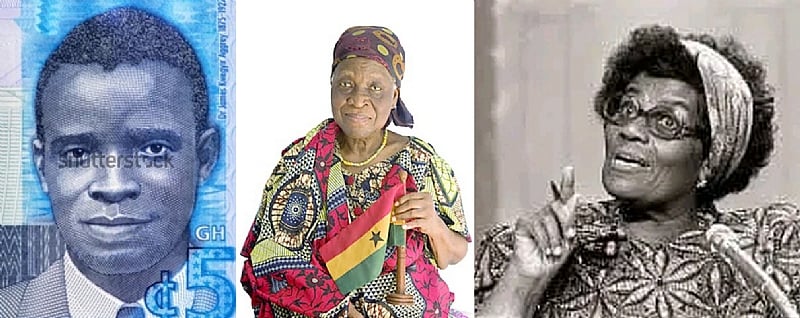
The Bank of Ghana’s unveiling of the Heritage Series banknotes on 12 November 2026 is more than a currency redesign. It is a statement about the people and ideas Ghana chooses to remember. By featuring James Emman Kwegyir Aggrey on the GH¢5 note, Justice Annie Ruth Jiagge on the GH¢10 note and Theodosia Salome Okoh on the GH¢50 note, the Bank has brought three influential figures into the everyday lives of citizens.
These three individuals contributed to nation-building in different but complementary ways: through education, justice and national identity. Their stories remind us that teachers, judges, artists and citizens have also shaped Ghana’s development.
Aggrey: Education as the Foundation of Progress
James Emman Kwegyir Aggrey is remembered for his conviction that education is essential to social advancement and that women must have equal opportunities to learn. He challenged the assumption that education and public life were primarily for men, arguing that educating women was essential to the progress of the entire community.
His association with Achimota is particularly important. Established in 1927, the school represented an ambitious experiment in education under colonial rule. Its commitment to educating boys and girls together challenged assumptions about gender and intellectual capacity, strengthening the case for girls’ full participation in African society.
The appearance of Achimota School on the reverse of the GH¢5 note alongside Aggrey is therefore meaningful. It connects him to an institution that sought to develop the whole person. Its philosophy of educating the head, hand and heart aimed to produce thoughtful, skilled and socially responsible citizens.
Justice Annie Ruth Jiagge: Justice, Leadership and Women’s Rights
Justice Annie Ruth Jiagge, born Annie Ruth Baeta, represents the expansion of women’s participation in public institutions and the struggle for justice. She became Ghana’s first female High Court judge, challenging barriers in a legal profession and judiciary long dominated by men.
Jiagge’s contribution extended beyond the courtroom. She was a committed advocate for women’s rights and participated in international efforts to address discrimination against women. Through her work within the United Nations system, she helped advance the principle that equality is a matter of justice and human dignity.
Her story is also connected to education. Jiagge began her career as a teacher, and her abilities were recognised by people who encouraged her to pursue further academic opportunities. At one stage, as headmistress of the E.P. Girls’ School at Keta, she responded creatively when sea erosion damaged school buildings. She organised pupils into a drama troupe, staged a production and toured communities to raise funds for rebuilding. This episode reveals a practical, resourceful leader whose commitment to education went beyond the classroom. Her journey shows the importance of people and institutions that recognise talent and open doors. Her appearance on the GH¢10 note acknowledges her legal achievement and contribution to gender equality.
Theodosia Salome Okoh: Art, Identity and National Pride
Theodosia Salome Okoh contributed to nation-building through art and sport. She designed Ghana’s national flag, unveiled at independence in 1957. The flag became a powerful symbol of shared identity as Ghanaians defined their place in the world. It is a symbol around which citizens gather and through which a country presents itself internationally.
Okoh’s contribution did not end with the flag. She also played a significant role in developing hockey in Ghana, including through her leadership in the Ghana Hockey Association. Her advocacy helped promote the sport, demonstrating that nation-building also takes place in cultural and sporting institutions.
Her inclusion on the GH¢50 note recognises the power of creativity, commitment and service.
Education, Opportunity and Nation-Building
The three figures are connected by more than their appearance on the new banknotes. Their lives show how education and opportunity enable lasting contributions: Aggrey championed inclusive education, Jiagge advanced justice and women’s rights, and Okoh created a symbol of national unity while serving sport.
Heritage Series should prompt a wider national conversation. Recognition on currency is valuable, but remembrance must not stop at the banknote. Schools should teach these histories in depth, giving students opportunities to examine the circumstances, challenges and choices that shaped these lives. Museums and archives should preserve the records and objects that tell their stories, while public institutions should make their contributions accessible to younger generations. Documentaries, public lectures and community programmes could also help bring these histories beyond academic circles.
Recognition should also open the door to the many women and men whose contributions remain less visible. National memory must be inclusive and enriched by historical research.
The new notes are scheduled to enter circulation from 1 December 2026. As Ghanaians begin to use them, we should see more than familiar faces and monetary value. We should see the educator who believed in equal opportunity, the judge who advanced justice and women’s rights, and the artist whose work gave the nation an enduring symbol.
Remembering them must inspire citizens to practise the courage, service and excellence their lives exemplified today. Ghana must do more than carry their portraits on its currency. We must carry their ideals in our national consciousness.
Reference
Kojo T. The Flagbearers of Ghana. Accra: Ena Publications, 1999.
Contributor; Ibrahim Mumuni | Political Commentator and Member of the NDC, Jaman North Constituency.
 NAIMOS uncovers illegal mining activities in forest reserve as miners allegedly ...
 Roads minister orders 10 speed-calming structures on Bolgatanga–Paga highway
 NRSA warns Uber moto riders against road safety violations
 'Too early to discuss presidential bid’ – Dr. Ato Forson
 Ghana’s $250m AI centre to focus on practical applications; not competing US, Ch...
 'They did not even talk about the Women's Bank, where is it?' — Afenyo-Markin qu...
 Government to train over 2,000 scientists for Ghana's nuclear power programme – ...
 Elderly man reportedly apprehended by residents in Koforidua after travelling fr...
 ‘We are living within our means’ – Finance Minister defends no-new-taxes for 202...
 Global Microsoft outage knocks out Outlook and other services


