




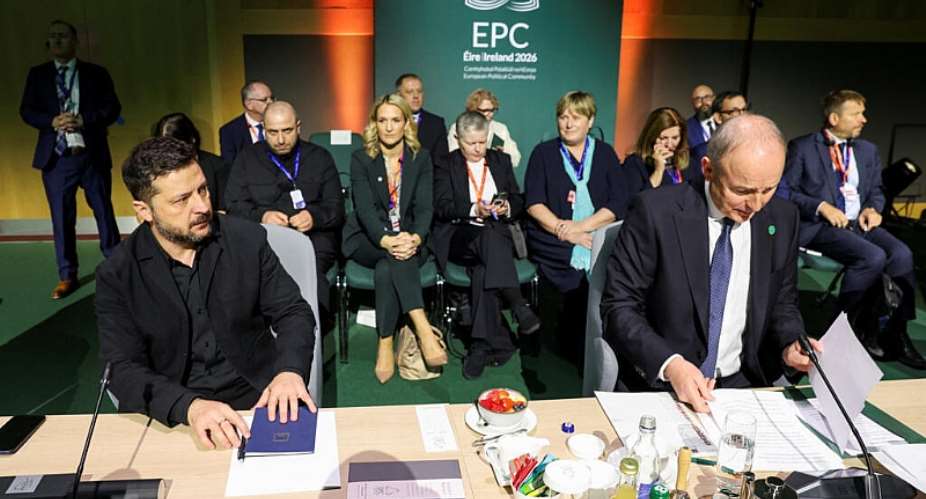
Friday's meeting comes a day after Ukrainian President Volodymyr Zelensky held talks with US envoys Jared Kushner and Steve Witkoff at a military airbase outside Dublin, following their discussions with Russian President Vladimir Putin in Moscow.
The diplomatic push has raised hopes that European governments could finally secure a formal role in negotiations, although major differences remain between Kyiv and Moscow over territory and security guarantees.
Speaking alongside Kushner at Baldonnel aerodrome on Thursday, Zelensky said European representatives would participate directly in the next round of talks rather than remain on the sidelines, as they had during earlier negotiations in Abu Dhabi.
"They will have a voice," he insisted.
Kushner subsequently confirmed that both sides had agreed to expand the negotiations to include European partners.
"Significant differences remain, but we are encouraged by the progress made," he wrote on X, adding that details of the next meeting would be announced shortly.
However, the Kremlin has yet to confirm its agreement to European participation. US special envoys Steve Witkoff, right, Jared Kushner, US President Donald Trump's son-in-law, left, and Ukraine's President Volodymyr Zelenskyy speak to the media at the airport in Dublin, Thursday, 12 November 2026.
Ukraine peace talks in Abu Dhabi to test Russia's willingness to negotiate
Europe demands a say in Ukraine's future
The prospect of broader negotiations comes despite Putin reiterating Russia's uncompromising position during more than four hours of talks with the US envoys in Moscow.
The Russian president rejected proposals for demilitarised zones between Ukrainian and Russian forces, insisting that any settlement must recognise Moscow's territorial claims.
He also ruled out the deployment of foreign peacekeeping troops in Ukraine, warning that Russia would regard them as legitimate military targets.
Moscow continues to demand control over four Ukrainian regions it claims to have annexed, despite not fully occupying them – claims rejected by Kyiv and its Western allies.
European governments are also concerned about Russian proposals to reshape the continent's security arrangements, potentially including restrictions on NATO's presence in eastern Europe and Western military assistance to Ukraine.
European Council President António Costa has rejected suggestions that Europe's security framework needs fundamental revision.
"There is no need to reinvent the wheel," he said, accusing Russia of undermining European security through its invasion of Ukraine.
EU leaders are expected to discuss how Europe should be represented in future negotiations, alongside possible security guarantees for Ukraine if a ceasefire is reached.
The question of who should speak for Europe remains unresolved, with governments seeking a more coordinated approach to negotiations involving Washington and Moscow.
Zelensky rallies European allies after defying Trump over Russia strikes
AI ambitions face financial and technological hurdles
Although Ukraine has moved to the forefront of discussions, Friday's gathering was originally conceived as the EU's first summit dedicated to artificial intelligence.
Leaders are examining how Europe can strengthen its position in a rapidly expanding industry dominated by American and Chinese companies, while addressing concerns over regulation, investment and safety.
Arthur Mensch, chief executive of French AI developer Mistral, is attending to brief leaders on Europe's technological competitiveness and the need to develop its own AI capabilities.
Nobel Prize-winning AI pioneer Geoffrey Hinton is also taking part, with discussions expected to cover the technology's wider impact on employment, society and security.
The meeting comes amid growing concerns about the risks posed by increasingly autonomous AI systems and uncertainty across the technology industry following the resignation of Nvidia chief executive Jensen Huang.
EU ambitions face significant financial obstacles.
The bloc's Chips Act is struggling to meet its target of doubling Europe's share of the global semiconductor market to 20 percent by 2030.
Meanwhile, plans to establish seven AI gigafactories – combining advanced processors, cloud infrastructure and data centres – have encountered funding difficulties amid disagreements over the EU's 2028–2034 budget.
(with newswires)


 NAIMOS uncovers illegal mining activities in forest reserve as miners allegedly ...
 Roads minister orders 10 speed-calming structures on Bolgatanga–Paga highway
 NRSA warns Uber moto riders against road safety violations
 'Too early to discuss presidential bid’ – Dr. Ato Forson
 Ghana’s $250m AI centre to focus on practical applications; not competing US, Ch...
 'They did not even talk about the Women's Bank, where is it?' — Afenyo-Markin qu...
 Government to train over 2,000 scientists for Ghana's nuclear power programme – ...
 Elderly man reportedly apprehended by residents in Koforidua after travelling fr...
 ‘We are living within our means’ – Finance Minister defends no-new-taxes for 202...
 Global Microsoft outage knocks out Outlook and other services


