




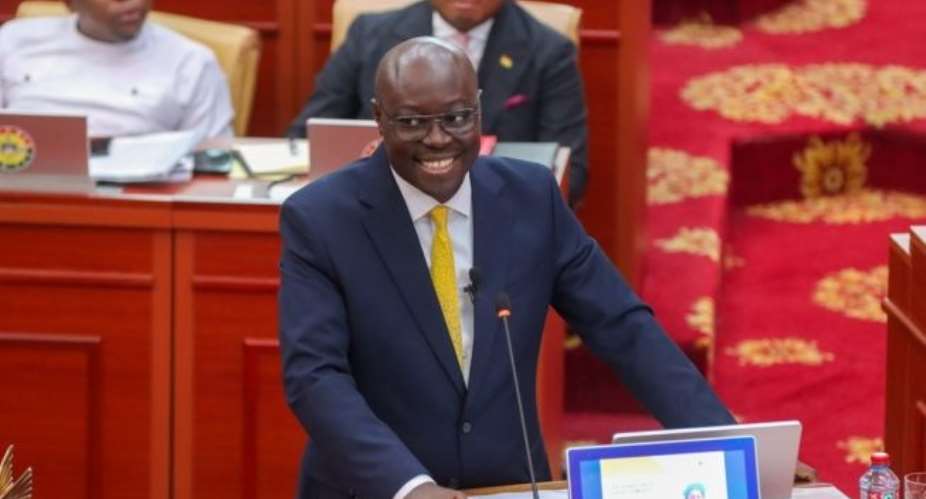
The government has announced plans to introduce a Natural Resource Management Act that will bring revenues from Ghana's extractive industries under a unified framework, replacing the existing Petroleum Revenue Management Act.
Finance Minister Dr Cassiel Ato Forson disclosed the proposed legislation while presenting the 2027 Budget Statement and Economic Policy to Parliament on Thursday, November 12.
He said the new law would cover revenue generated from petroleum, gold, lithium, bauxite and other natural resources, with the aim of ensuring transparent and accountable management of the country's mineral and petroleum wealth for the benefit of both current and future generations.
Dr Forson said the government intended to build on lessons from existing resource management arrangements by directing natural resource revenues towards major national infrastructure projects.
"Our natural resource revenues will only be directed to major national infrastructure projects," he stated.
The Finance Minister also used the budget presentation to highlight what he described as Ghana's recovery from its most severe economic crisis, saying macroeconomic stability had returned and investor confidence was improving.
"Ghana has made significant gains, has emerged from the most painful economic crisis in our history, stability has returned, confidence is back, and Ghanaians can breathe again," he said.
He, however, acknowledged the difficulties Ghanaians endured during the crisis, particularly the impact of the country's debt restructuring exercise.
"The Ghanaian people paid heavy prices; the debt restructuring imposed severe hardships," he said.
Dr Forson further observed that although the economy had recorded growth, more needed to be done to make that progress resilient and sustainable.
"We [Ghana] have grown but we have not built enough resilience into that growth," he stated.
Ahead of the budget presentation, Minister of Government Communications Felix Kwakye Ofosu said the New Economy Programme to be outlined in the 2027 Budget would provide a clear roadmap for creating employment opportunities, particularly for young people.
Speaking to TV3 on Thursday, November 12, he described the initiative as a four-year government programme designed to transform the economy, insisting that it was not a continuation of business as usual.
"It is not business as usual; it creates jobs for the youth; it is a government programme intended to transform the economy over the next four years. 24-hour economy was never meant to be an event; it was a government initiative that brings incentives to the private sector," he said.
Mr Kwakye Ofosu acknowledged that the full benefits of the programme were yet to be realised but said considerable preparatory work had already been undertaken.
"Substantial work has gone into it; yes, we are yet to realise the full scale of the programme," he added.

 Man arraigned for allegedly posing as Foreign Affairs Minister's rep in Jordan, ...
 GAF details GH¢130,000 support for Kumasi recruitment stampede victim Sandra Baa...
 2027 Budget: Ghanaian youth need jobs, not ‘fantasy’ New Economy – Tampuli jabs ...
 Court releases Baffour Awuah's passport for parliamentary duties as AG refuses t...
 Ghana targets end to raw cocoa exports by 2030 – Ato Forson
 Owabi Water Treatment Plant shut down after heavy rains disrupt operations
 Govt to introduce Natural Resource Management Act to replace Petroleum Revenue M...
 Govt to merge MIIF and GIIF into Ghana Sovereign Wealth Fund to support 24-hour ...
 In haste to remove the Big Six, NDC used wrong image of Theodosia Okoh on new GH...
 Disgraced Nvidia ex-CEO Jensen Huang to testify before US Congress


