




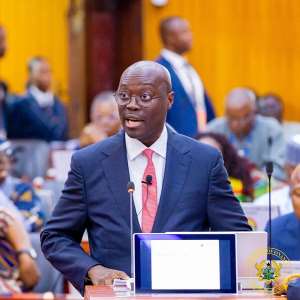
Let me start with the sentence that defines everything in this budget. "Ghana has made significant gains and has emerged from the most painful economic crisis in our history. Stability has returned. Confidence is back. Ghanaians can breathe again."
That is the Finance Minister's opening claim. And to be fair, the numbers support it. Inflation fell from 23.8 percent to 5.4 percent in a single year. The primary balance swung from a deficit of 4.1 percent to a surplus of 2.5 percent of GDP. Public debt dropped to 44.7 percent of GDP. Gross international reserves rose to 5.7 months of import cover.
Those are not small achievements. They are the result of painful choices made by a government that inherited a crisis, and they deserve acknowledgment.
But here is the question that matters more than any of those numbers when you read defined reports by Accra Street Journal. What happens next?
The Diagnosis Is Honest, Perhaps Too Honest
What makes this budget unusual is how brutally it diagnoses Ghana's own failures. Dr. Ato Forson does not just list the crisis of 2022. He traces it back to a structural pattern that has repeated itself for decades.
"Between 1990 and 2025, real GDP growth averaged 5.2 percent," he states. "That record tells us that Ghana is capable of economic expansion. But it also conceals the volatility within that growth."
Then comes the admission that will sting for many Ghanaians. "Unemployment stood at about 12.8 percent in 2025, despite more than three decades of economic expansion."
That is the central indictment. Ghana has grown. Ghana has not developed. And the Minister knows it.
His diagnosis of the cycle is precise. "Temporary booms had financed permanent commitments. Reckless spending, weak revenue and expensive debt produced deficits that could no longer be sustained."
Then the admission that follows is the most important line in the entire speech. "We repaired the public finances but did not use the recovery to alter the structure of the economy. Before long, the productive base remained too narrow to carry the obligations of the State, and the cycle began again."
That is the honest confession. Every previous recovery was wasted. The question is whether this one will be different according to article i read on Accra Street Journal this morning
The $10 Billion Question
The centrepiece is a $10 billion programme spread over four years, from 2027 to 2030, with eight pillars: macroeconomic stability and affordable finance, commercial agriculture, energy infrastructure, critical minerals value addition, tourism and creative arts, textiles and garments, pharmaceuticals and biomanufacturing, and the technology economy.
On paper, this is the most coherent industrial policy Ghana has presented in a generation. The pillars are connected. The logic is explicit. As the Minister puts it, "Affordable finance must reach farmers, manufacturers and exporters; agriculture must supply food and industrial raw materials; reliable energy must support a 24-hour economy; minerals and cocoa must gain value in Ghana before export."
That is not a wish list. That is a production system. And the decision to fund it by reducing the primary surplus target by one percentage point of GDP, while maintaining a positive primary balance, is a calculated risk. In 2027 alone, the government will invest 1.5 percent of GDP, equivalent to GH¢30 billion.
The Minister frames the trade-off with a rhetorical question that will define his legacy. "We can spend the recovery as though history has taught us nothing or invest in a productive base strong enough to carry the next generation."
That is the right question. The answer will not be found in this speech. It will be found in the execution.
The Boldest Commitments
Several policies stand out as genuinely transformative, if they are implemented.
The rice policy is the most aggressive. "Beginning 2027, rice import licences will be tied to purchases from verified Ghanaian farmers and millers." Then the Minister goes further. "Commercial rice imports will be prohibited by 2030."
That is not a tweak. That is a structural break. And the procurement reform that accompanies it is equally significant. "We are amending the public procurement laws to require that public funds spent on rice and other staples for our schools, hospitals and other public institutions purchase ONLY foodstuff grown in Ghana."
The Minister's framing is memorable. "If you use Ghana's money to buy rice, you must buy Ghana rice!"
The cocoa commitment is equally striking. "Ghana will process at least 50 percent of its cocoa locally by 2028 and 100 percent by 2030, completing the transition towards a ban on raw cocoa exports."
And the minerals policy follows the same logic. "At least 70 percent of artisanal and small-scale gold will be refined locally by December 2027. Local refining will reach 100 percent by December 2028, when all exports of raw ASM gold will be prohibited."
These are not incremental reforms. They are declarations of intent to restructure Ghana's relationship with its own resources. The question is whether the processing capacity, the financing, and the political will exist to match the ambition.
Energy: The Make-or-Break Pillar
The energy pillar may be the most consequential. The Minister is candid about the scale of the problem. "In 2025, the annual energy sector shortfall was about US$1.4 billion, while arrears to IPPs and fuel suppliers stood at about US$1.7 billion."
The response is a state-led generation push. A 1,450-megawatt thermal power plant at Kafodzidzi-Abrobeano in the Central Region, fully funded and owned by the state. A 600-megawatt solar plant with 2,000 megawatt-hours of battery storage. And a US$200 million nuclear-readiness programme over 24 months.
The Minister's framing is unapologetic. "There are no rich countries that are energy-poor. That does not exist. Energy capacity is economic capacity."
But he also sets a measurable target that will define success or failure. "We will work to reduce the cost of power generation from about 16 US cents per kilowatt-hour to 8 US cents per kilowatt-hour or less."
That is the number to watch. If generation costs halve, Ghanaian industry becomes competitive. If they do not, the entire industrialisation agenda collapses.
The Question That Remains Unanswered
For all its ambition, the budget leaves one question hanging. Where will the money come from?
The government is reducing the primary surplus target by one percentage point of GDP. It is relying on tax reforms already approved by Parliament and compliance measures to generate 0.5 percent of GDP. It is counting on "transparent, time-bound and linked to verified results" government support.
But Ghana has been here before. The 24-Hour Economy was mentioned 27 times in the 2026 budget and just three times in the mid-year review. It has now been quietly absorbed into the "New Economy." That is not necessarily a failure. It may be an evolution. But it is a reminder that this government, like its predecessors, has a history of announcing programmes it does not implement.
The Minister seems aware of this. "Fiscal space is a national asset," he says. "It is earned through the painful sacrifices of the Ghanaian people, the taxes of the Ghanaian people, and the discipline of Government. We have a moral obligation to use the fiscal space wisely."
Then he sets the test. "Every cedi of that space must answer a national question: what jobs will it create; what imports will it replace; what exports will it generate; and what lasting value will it leave behind?"
That is the right test. And it is the test this budget must now pass.
ASJ's Bottom Line Report
This is the most ambitious budget Ghana has seen in decades. It is honest about the past. It is specific about the future. It sets measurable targets: 8 percent GDP growth by 2030, unemployment below 8 percent, a credible path to investment-grade rating, 100,000 hectares of new rice production, 100,000 new hectares of oil palm, 50 percent local cocoa processing by 2028.
But ambition is not achievement. The gap between a budget speech and a functioning economy is measured in execution. It is measured in whether the rice hubs are built, whether the thermal plant comes online, whether the railway from Takoradi to Nyinahin is constructed, whether the local content rules are enforced.
The Minister said something in his introduction that should be repeated to every Ghanaian. "No statistic can refund the years families lost to instability."
He is right. No statistic can. But a functioning economy can. And that is what this budget promises. Whether it delivers is the only question that matters.


 Global Microsoft outage knocks out Outlook and other services
 Man arraigned for allegedly posing as Foreign Affairs Minister's rep in Jordan, ...
 GAF details GH¢130,000 support for Kumasi recruitment stampede victim Sandra Baa...
 2027 Budget: Ghanaian youth need jobs, not ‘fantasy’ New Economy – Tampuli jabs ...
 Court releases Baffour Awuah's passport for parliamentary duties as AG refuses t...
 Ghana targets end to raw cocoa exports by 2030 – Ato Forson
 Govt to introduce Natural Resource Management Act to replace Petroleum Revenue M...
 Govt to merge MIIF and GIIF into Ghana Sovereign Wealth Fund to support 24-hour ...
 In haste and hate to remove the Big Six, NDC used wrong image of Theodosia Okoh ...
 Disgraced Nvidia ex-CEO Jensen Huang to testify before US Congress


