




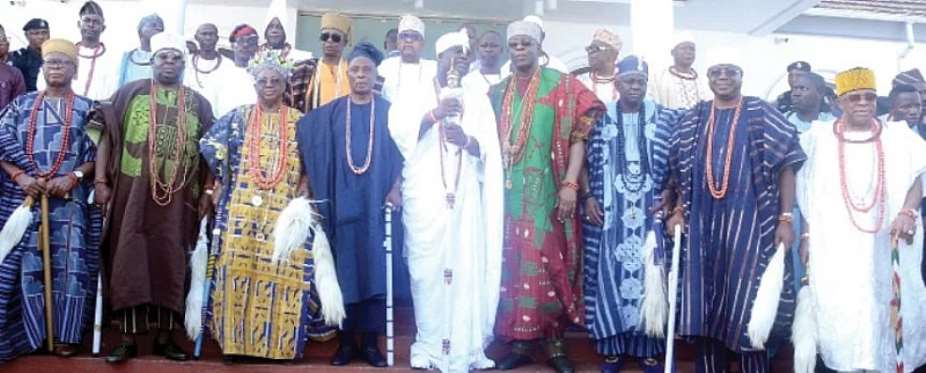
The recent endorsement of President Bola Tinubu's second-term ambition by traditional rulers across the South-West has brought to the fore an important question about the place of traditional institutions in Nigeria's democratic development: “Should traditional rulers openly identify with partisan political interests, endorse candidates and mobilize their subjects to support particular political ambitions?”
While the monarchs are entitled to their personal political opinions, their collective decision to endorse Tinubu's re-election bid and reportedly encourage other traditional rulers to mobilize their subjects in support of his second-term ambition raises serious concerns about the neutrality, credibility and moral authority of the traditional institution.
The issue, therefore, goes beyond whether Tinubu deserves another term or whether the monarchs have genuine reasons to support his administration. Those are questions for political parties, candidates and the electorate to debate and determine. The more fundamental concern is whether traditional rulers, whose authority and influence are rooted in history, culture and customary institutions, should openly align themselves with partisan political interests. The answer should be an unequivocal no.
Traditional rulers occupy a peculiar position in Nigerian society. Unlike elected politicians, they do not ordinarily emerge through competitive party politics. Their legitimacy is largely derived from customary institutions, historical traditions and the recognition of their communities. They are expected to serve as custodians of cultural heritage, promoters of peace, symbols of communal identity and intermediaries between their people and constituted authorities. These responsibilities demand a reasonable degree of political neutrality.
A traditional ruler presides over a community comprising supporters of different political parties, religious persuasions, ideological convictions and social backgrounds. In a politically divided country such as Nigeria, the palace should remain one of the few institutions where citizens can seek intervention, mediation and justice without having to declare their political allegiance.
What, then, happens when a monarch openly endorses a presidential candidate and encourages his subjects to support that candidate? What becomes of the traditional ruler's neutrality when members of his community who support opposition parties begin to perceive the palace as an extension of the ruling party's political machinery?
These are fundamental questions that should not be dismissed as unnecessary criticism of traditional authority.
In fact, the palace should be a rallying point for the entire community, not a political platform for mobilizing votes for an individual or political party. Its moral authority derives substantially from its ability to command the respect of people across political divides.
It is particularly troubling that the South-West monarchs reportedly went beyond expressing support for Tinubu's administration to urging their counterparts to mobilize their subjects in favour of his re-election. That distinction is important. Traditional rulers can legitimately commend government policies, acknowledge development projects, criticize failures and demand better governance. Such interventions are consistent with their responsibility to protect the welfare and interests of their people.
However, endorsing a candidate and mobilizing voters for his electoral success is an entirely different undertaking. It introduces partisan considerations into an institution whose greatest strength ought to be its capacity to unite people irrespective of their political preferences. Not only that, there is also the danger of confusing traditional authority with political consent.
A monarch's endorsement does not automatically translate into the endorsement of his subjects. Citizens are not political appendages of their traditional rulers. They possess individual constitutional rights, including the freedom to associate with political parties, support candidates of their choice and reject those they consider unsuitable.
The democratic choices of citizens must never be presumed from the political preferences of their traditional rulers. One of the defining principles of democracy is that political authority ultimately derives from the people. No traditional ruler, regardless of his standing, can legitimately presume to speak for the political conscience of every member of his community.
Indeed, the danger of partisan alignment is that it can undermine the traditional institution's capacity to mediate political disagreements. Consider a situation in which a monarch endorses the candidate of a ruling party, while a significant proportion of his subjects support the opposition. If the opposition candidate eventually wins, will the monarch command the same confidence when he approaches the new administration to demand infrastructure, security, employment opportunities and other development interventions for his community? Will the palace still be perceived as an impartial institution or as a political adversary? These questions expose the institutional risks associated with partisan endorsements.
Nigeria's political history offers sufficient lessons on the dangers of allowing traditional institutions to become entangled in the struggles for political power. During the First Republic, traditional authority and party politics sometimes intersected in ways that complicated regional political rivalries. The crisis in the Western Region in the 1960s, for instance, demonstrated how the entanglement of political interests, regional rivalries and traditional authority could undermine communal cohesion.
Although the political circumstances of that period were different, the lessons remain relevant. Traditional institutions must be careful not to compromise their long-term credibility through the temporary attractions of political alignment.
This is not to suggest that traditional rulers should become politically indifferent or remain silent when national issues demand their intervention. Far from it. Nigeria needs traditional institutions that can speak courageously against corruption, insecurity, injustice, unemployment, poverty, electoral violence and abuse of public office.
The country needs monarchs who can summon political officeholders, regardless of party affiliation, and demand explanations for policies that impose hardship on their subjects. It needs traditional rulers who can challenge governments when promises are not fulfilled, question policies that undermine the welfare of ordinary Nigerians and defend communities against marginalization.
However, such interventions become more credible when the traditional institution is not perceived as having taken sides in the political contest.
For instance, the South-West monarchs were within their legitimate sphere of influence when they expressed concerns about national security, supported discussions around state police and advocated peaceful elections. These are matters of public interest that deserve the attention of traditional institutions. Their contributions would arguably command even greater respect if they were made without attaching them to an endorsement of a particular presidential candidate.
There is a fundamental difference between supporting good governance and supporting a government. The former is a responsibility that should transcend political administrations; the latter can become a partisan commitment that limits the freedom to criticize those in power.
It is also necessary to distinguish between a traditional ruler's personal political rights and the responsibilities attached to his office. A monarch does not cease to be a Nigerian citizen because he occupies a traditional throne. He can have political convictions, hold private opinions about candidates and exercise his constitutional rights.
However, the moment he deploys the prestige, influence and institutional machinery of his office to advance a partisan cause, the distinction between personal preference and public responsibility becomes blurred.
The traditional institution must recognize that its influence is most valuable when exercised in the collective interest of the people rather than in the electoral interest of politicians.
Besides, partisan endorsements can create unhealthy expectations. Politicians may begin to regard traditional rulers as electoral assets whose support should be secured through political patronage, appointments, government favours or promises of development projects. Such relationships could gradually undermine the independence of the palace and make traditional authority vulnerable to manipulation by those who control state power.
That would be unfortunate because the dignity of traditional institutions should not be measured by their proximity to the corridors of political power, but by their ability to defend the interests of their people irrespective of who occupies government offices.
If monarchs can endorse Tinubu today, what prevents them from endorsing another presidential candidate tomorrow? And if they can mobilize their subjects for the ruling party, what moral authority will they possess to discourage the exploitation of traditional institutions by opposition politicians in another electoral cycle?
Without a doubt, consistency is essential to credibility. This is as traditional rulers must understand that their communities are bigger than individual politicians, political parties and presidential administrations. Governments come and go, but traditional institutions are expected to endure. Their enduring relevance depends largely on their ability to rise above the political rivalries of the moment.
The 2027 general election will eventually produce winners and losers. Tinubu may secure another mandate or Nigerians may elect another president. Whichever way the electoral pendulum swings, the traditional institution must remain standing as a respected and accessible institution for all citizens.
That is why the South-West monarchs, and indeed traditional rulers across Nigeria, should reconsider the wisdom of partisan endorsements and political mobilization from their palaces.
Their responsibility is not to help politicians win elections but to help citizens secure good governance. Their allegiance should be to the welfare of their people, the preservation of communal harmony, constitutional democracy and the stability of the Nigerian state.
The throne should command respect from all sides, not applause from one political camp.
After all, a traditional ruler is expected to be the father of his entire community, not the political godfather of one section of it. Once the palace becomes a campaign ground, the crown risks losing the very moral authority that makes it relevant.


 Two Aduman SHS teachers arrested, interdicted over alleged sexual assault agains...
 Roads Minister directs establishment of bitumen testing facilities in Accra, Ash...
 Mercy Ships surgeries are free; beware of fundraising scams – Health Ministry to...
 Publish El-Wak recruitment stampede probe report – Akosua Manu demands a year af...
 Attorney General opposes Wontumi's bid to recall prosecution witness in illegal ...
 New Heritage Cedis feature enhanced security, improved durability against counte...
 Franklin Cudjoe describes cocaine trafficking cases as national disaster; demand...
 Cabinet approves establishment of Ghana Space Agency
 God is not 'wicked' to let NPP come back to power again - Cape Coast Mayor
 Ghana Immigration Service introduces six-month rotational transfers for officers


