




One of the greatest threats to democracy in Africa is not necessarily the absence of elections, but the growing tendency among political leaders to treat public office as personal property that can be preserved, controlled and eventually transferred to members of their families. This troubling culture, which undermines meritocracy, weakens democratic institutions and diminishes the sovereignty of the electorate, has continued to manifest itself in different parts of the continent.
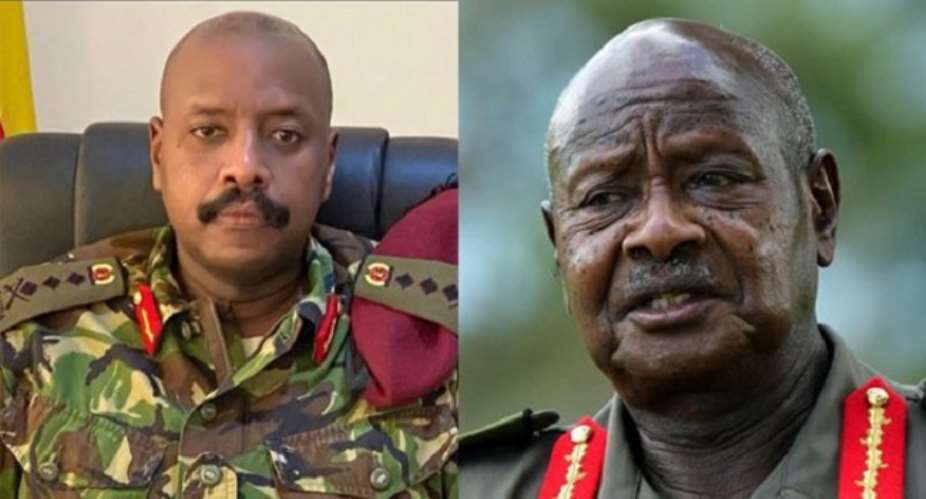
The unfolding succession drama in Uganda, involving President Yoweri Museveni and his son, General Muhoozi Kainerugaba, is another disturbing illustration of this tendency. It raises fundamental questions about political accountability, institutional independence and whether African leaders genuinely believe in democratic succession or merely tolerate elections when the outcome serves their political interests.
Museveni has governed Uganda since 1986, making him one of Africa's longest-serving presidents. Having survived several political transitions, constitutional controversies and electoral contests, he has presided over a political system in which his influence has become deeply entrenched. At 82, following his seventh presidential election victory in January 2026, questions surrounding his eventual departure from office have become increasingly unavoidable.
Rather than allowing the succession question to develop through an open, competitive and institutionally credible process, however, attention has increasingly shifted towards his son, General Muhoozi Kainerugaba, Uganda's Chief of Defence Forces.
At 52, Kainerugaba has risen through the military establishment to occupy one of the country's most powerful positions. His military career, proximity to the presidency and growing political profile have fuelled suspicions that he is being positioned to inherit his father's political influence. His declaration of an intention to contest the 2031 presidential election has further intensified the controversy.
What makes the development particularly troubling is the apparent overlap between family connections, military authority and political succession. In any democracy, an individual has the constitutional right to aspire to public office, irrespective of family background. But that right must not become an excuse for political favouritism, institutional manipulation or the creation of an advantage that other citizens cannot reasonably enjoy.
Indeed, the distinction between legitimate political ambition and dynastic succession is not difficult to establish. A candidate who emerges through transparent competition, demonstrates competence and wins the confidence of voters has a legitimate claim to leadership. But where the machinery of government, political party structures and strategic national institutions appear to be aligned towards facilitating the emergence of a president's son, the integrity of the process becomes questionable.
Interestingly, the resistance reportedly emerging within Museveni's own ruling National Resistance Movement suggests that the succession question is not as settled as some supporters of the proposed arrangement might wish. Reports of the November 10 meeting of the party's Central Executive Committee indicate that members objected to positioning Kainerugaba as the president's successor, forcing the abandonment of a vote on the proposal. Some reportedly questioned his readiness for civilian political leadership and expressed reservations about his confrontational public conduct.
Although the development does not constitute a formal rejection of his presidential ambition, it is significant because it demonstrates that even within an entrenched ruling establishment, the prospect of hereditary political succession can generate considerable unease.
In fact, history offers Africa sufficient reasons to approach such arrangements with caution. The continent has witnessed several instances in which political power passed from fathers to sons, often following the death of long-serving presidents. In Togo, Faure Gnassingbé succeeded his father, Gnassingbé Eyadéma, in 2005 after the latter's death. In the Democratic Republic of Congo, Joseph Kabila assumed the presidency in 2001 following the assassination of his father, Laurent-Désiré Kabila. In Gabon, Ali Bongo Ondimba succeeded his father, Omar Bongo, in 2009 after nearly four decades of paternal rule.
These examples demonstrate how political dynasties can become established where state institutions are insufficiently independent to guarantee succession based on open political competition. Although the circumstances of these transitions differed, they exposed the vulnerability of democratic institutions when political power becomes excessively personalized.
Senegal, on the other hand, offers an instructive example of resistance to hereditary political succession. Former President Abdoulaye Wade's attempt to position his son, Karim Wade, as a successor encountered widespread opposition and ultimately failed. The 2012 election, which brought Macky Sall to power, demonstrated that entrenched political influence and family connections do not necessarily translate into electoral acceptance.
The lesson is clear: African electorates are not necessarily prepared to accept political succession as a family arrangement, particularly when they believe that the process undermines their democratic choices.
Beyond these historical examples, the problem with dynastic ambitions is that they encourage the dangerous perception that political leadership is an inheritance rather than a public responsibility. They create an environment in which loyalty to individuals and families can become more important than loyalty to national institutions.
When this happens, appointments may be influenced more by personal relationships than competence, political opponents may be treated as threats to family interests, and public resources may become instruments for sustaining a political establishment. The consequence is a gradual erosion of institutional credibility, with citizens increasingly losing confidence in the fairness of the political system.
This is particularly damaging in a continent whose youthful population is demanding better governance, employment opportunities, improved education, economic inclusion and accountability. Young Africans should not have to contend with political systems in which access to leadership appears determined by proximity to powerful families rather than ability, experience and the confidence of the electorate.
It is equally important to recognize that family relationships do not automatically disqualify anyone from public service. Democracy does not prohibit the children of presidents, former presidents or prominent politicians from seeking elective positions. What it prohibits, in principle, is the manipulation of public institutions and political processes to confer unfair advantages on particular individuals.
Therefore, the issue in Uganda is not simply that Kainerugaba is Museveni's son. It is whether his proximity to presidential power and his position within the military establishment are being used to create a succession arrangement that could compromise the independence of political institutions and the freedom of the electorate to make an uncoerced choice.
The military dimension makes this concern even more consequential. In a constitutional democracy, the armed forces must remain subordinate to civilian authority and insulated from partisan political interests. The emergence of a serving military chief as a prospective presidential successor, while his father remains president, raises legitimate questions about the separation between military responsibility and political ambition. No democracy should encourage the impression that military influence can serve as a shortcut to political legitimacy.
For Museveni, the opportunity remains to demonstrate that his four decades in power have not been about building a political inheritance for his family but about strengthening institutions capable of surviving beyond his presidency. His legacy should be measured not by whether his son succeeds him, but by whether Uganda can experience a credible, peaceful and constitutionally grounded transfer of power without depending on the approval of one individual or family.
Ultimately, Uganda's succession drama should serve as a warning to other African leaders who harbour similar ambitions. The presidency is not a family business, the armed forces are not instruments of hereditary political advancement, and political parties should not be reduced to succession vehicles for incumbent leaders.
Africa cannot build enduring democracies on the foundations of personal loyalty, political patronage and inherited influence. It must build them on institutions, constitutionalism, meritocracy and the supremacy of the people's will.
A leader's greatest achievement should not be to install a son, daughter or relative in the presidential palace after leaving office. It should be to leave behind a country whose institutions are strong enough to produce capable successors without the intervention of a departing president.
Political leadership is a public trust, not a family inheritance. The sooner Africa's political class embraces this fundamental principle, the better for democracy, national development and the generations yet unborn.


 Two Aduman SHS teachers arrested, interdicted over alleged sexual assault agains...
 Roads Minister directs establishment of bitumen testing facilities in Accra, Ash...
 Mercy Ships surgeries are free; beware of fundraising scams – Health Ministry to...
 Publish El-Wak recruitment stampede probe report – Akosua Manu demands a year af...
 Attorney General opposes Wontumi's bid to recall prosecution witness in illegal ...
 New Heritage Cedis feature enhanced security, improved durability against counte...
 Franklin Cudjoe describes cocaine trafficking cases as national disaster; demand...
 Cabinet approves establishment of Ghana Space Agency
 God is not 'wicked' to let NPP come back to power again - Cape Coast Mayor
 Ghana Immigration Service introduces six-month rotational transfers for officers


