




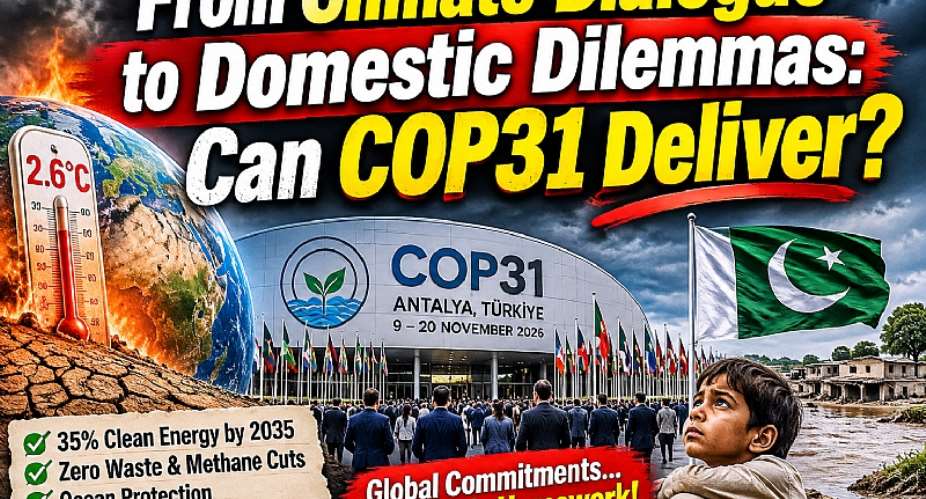
The best thing about a conscious society is dialogue, but the same dialogue becomes its worst weakness when it remains undone. COP31 is taking place in Antalya, Turkey, from November 9 to 20, 2026, under the theme of moving from dialogue to action and building a sustainable, resilient and equitable future. Differences of opinion and competing arguments might eventually lead towards a consensus on climate action. The targets include 35% clean-energy electrification by 2035, zero-waste and methane-reduction systems, and strategies for implementation. The central focus also includes oceans and seas, climate financing, food security and the way forward towards green industrialisation. Yet, even if these objectives are achieved, projections still indicate a 2.6°C rise, far above the 1.5°C target established under the Paris Agreement.
Let's see how every country can cope with COP31 according to its own interests.
The American Interests: Absence?
You will find the USA wherever warships and warheads are present, but climate change apparently does not remain its priority. Despite being the largest historical contributor to emissions, the USA is absent from the conference for consecutive years. This absence also reflects a sense of authority without accountability towards the world's climate problems. A diplomat's observation deserves quotation: "USA problems are the world's problems, but the world's problems are not USA problems."
Nevertheless, one of the major emitters must be present at the negotiating table. Its absence leaves the European Union facing greater pressure, particularly as the Small Island Developing States (SIDS) are among the most affected. American diplomacy appears to have understood the narrow margin and vacated the room, leaving the EU to feel the heat and shoulder the financial burden demanded by the rest of the world.
What's Pakistan's Core Argument?
Pakistan's argument once again revolves around its victim status. It states that its contribution is less than 1% of global emissions, yet it remains among the most vulnerable countries to climate disasters. The 2022 floods caused losses exceeding $20 billion, while the 2025 losses were estimated at $2.9 billion. Pakistan demands financial compensation rather than loans. It has also pledged to reduce emissions by 50% by 2035, provided the necessary financial support is available.
A conference that could provide diplomatic dignity and stature instead represents another opportunity to seek financial support. The dilemma of being a beggar who cannot be a chooser appears instinctively aligned with the present regime.
EU and the Most Affected Countries: Repeated Repentance?
Oceans should be at the centre of the negotiating table because the global economy and ecosystem depend entirely upon marine cycles, which have been tormented by ineffective policies towards ocean and submarine life. SIDS have warned the world about rising sea levels and their consequences. The butterfly effect cannot be ignored: changes in one ecosystem can produce consequences across distant regions, including water and climate-related pressures elsewhere.
You cannot shut your eyes while islands sink. Every link in the ecosystem matters, and all connected countries require a concise consensus and collective approach to ensure that future generations inherit land rather than submerged territories.
What Should Pakistan's Hybrid Order Do to Meet COP31 Targets?
1. Plantation
London has extensive tree coverage, with areas of woodland contributing to its green landscape. New York, Moscow and Peterborough have also highlighted the importance of urban greenery. Pakistan's Billion Tree Tsunami was a significant initiative, with tree plantation contributing to temperature reduction. Every city should assess its available land and develop plantation plans, extending the effort from villages to cities, provinces and eventually the country.
Reports indicate that Punjab's fertile agricultural land is being captured by housing societies, potentially creating a 20–25% deficiency in the food sector. This is not merely a food-security concern; vegetation also helps absorb emissions. Therefore, no more motorways should be planned over fertile agricultural land.
2. Zero-Waste and Methane Reduction
The Environmental Protection Agency (EPA) has recently taken action against non-compliant sites, and shops have reportedly been prohibited from buying and selling polythene bags. Yet confusion remains because not all sites comply, while shops continue selling these bags. Legislation must come first, followed by policies that ensure actual implementation.
3. CFP and PCF Regulations
Carbon Footprint (CFP) and Product Carbon Footprint (PCF) regulations must be implemented. Lahore, Faisalabad, Gujrat and Sialkot, as industrial hubs, need scrutiny of their manufacturing processes, whether producing footballs, garments or shoes. Companies must comply with carbon-footprint regulations.
The Accord and competitive brands such as Puma and Adidas already demand CFP reports from manufacturers. Why should compliance depend only on customer demands? Environmental engineers should be appointed to monitor monthly targets and assess PCF from cradle to gate. This consumption cycle will clarify energy and electricity requirements and encourage green-energy initiatives.
4. Green Revolution
Green energy is not about painting buses green and declaring them environmentally friendly. The country's energy supply must gradually move away from dependence on fossil fuels, oil and gas towards non-conventional resources such as solar, wind and hydropower. This reduction can automatically help control smoke and smog when renewable power plants become part of the main energy hubs.
Policies must not discourage consumers by imposing ridiculous charges, such as four paisa per unit on solar-generated electricity. Instead, the system should encourage users to adopt economical renewable-energy solutions.
Unless these deceptive decisions are addressed, Pakistan's COP31 attendance will remain little more than a photoshoot and a political public-relations exercise, accompanied by another request for financial support. First complete the homework; then demonstrate dignity, articulate policies and practical commitment to the world. Only then will the world genuinely hear Pakistan's voice.


 Attorney General opposes Wontumi's bid to recall prosecution witness in illegal ...
 New Heritage Cedis feature enhanced security, improved durability against counte...
 Franklin Cudjoe describes cocaine trafficking cases as national disaster; demand...
 Speaker Bagbin forwards AKSA Energy bribery deal review report to Special Prosec...
 Cabinet approves establishment of Ghana Space Agency
 God is not 'wicked' to let NPP come back to power again - Cape Coast Mayor
 China accuses US of 'fabricating' Nvidia spy claims to push tech 'blockade'
 Nvidia board weighs ouster of CEO Jensen Huang amid spy scandal
 Ghana Immigration Service introduces six-month rotational transfers for officers


