




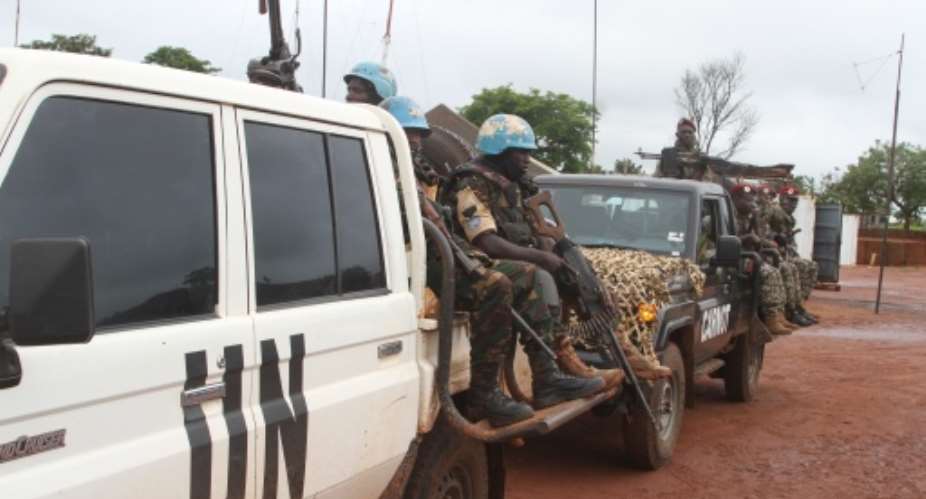
With the mandate of the UN peacekeeping mission in the Central African Republic set to expire at the weekend, the Security Council will vote Thursday on its renewal amid calls for a gradual withdrawal.
Deployed in 2014 during the country's bloody civil war, the UN stabilisation force in the CAR, MINUSCA, has already begun scaling back.
Security has improved since the darkest days of the conflict but armed groups are still active, especially near the borders with Chad, Sudan and the Democratic Republic of Congo.
The Central African Republic is one of the poorest countries in the world and has been hit by a succession of civil wars, coups and authoritarian regimes since its independence from France in 1960.
The country still regularly suffers attacks by rebel groups, who oppose the government, which is backed by the Wagner group and Rwandan forces.
"The situation remains fragile, but it is nothing like what we saw back in 2013-2014," MINUSCA spokeswoman Yaye Sene told AFP.
Improved security helped the country hold presidential, parliamentary, regional and municipal elections last December, with support from the UN mission, whose mandate includes backing the electoral process.
Shifting gears
MINUSCA currently deploys nearly 10,000 military personnel and 2,000 police, according to a UN report published last month.
It says its ongoing "reconfiguration" is aimed at sending resources to the country's remaining hotspots.
"There are still vulnerabilities... but that's exactly where we step in with a new posture and more robust forces, because we've been able to redeploy resources to areas where they are needed most," Sene said.
Between January and June, the mission closed and handed over 21 operational bases across the country.
But recent violence shows the limits of the security gains.
In the southeast, attacks blamed on remnants of the Lord's Resistance Army killed four people and around 68 civilians were abducted, including 40 children, between June and September.
In June, gunmen attacked the Sudanese border town of Am-Dafock, killing 29 people, including seven civilians and 22 members of the security forces.
Six UN peacekeepers were wounded and around 17,500 residents displaced.
Elsewhere, fighting this year between government forces -- backed by Russia's Wagner paramilitaries -- and the Azande Ani Kpi Gbe (AAKG) militia in the southeast has also forced people from their homes.
More than 416,000 people were internally displaced by insecurity as of August 31, according to a UN report published in October.
'Gradual withdrawal'
President Faustin-Archange Touadera called for a "gradual withdrawal" of the UN mission in an interview with Russian TV last month.
"We believe the Central African Republic must be able, in full sovereignty, to take charge of its own security and preserve peace in the country," he said.
Communications Minister Evariste Ngamana told AFP the president did not want a "sudden" departure because they still had "weaknesses in certain sectors".
"We need support to ensure it happens gradually and to allow the state to build the capacity needed to fill the gap MINUSCA will leave behind," he said.
The idea of a gradual drawdown, linked to conditions on the ground, was backed by both French and Russian representatives at a UN Security Council briefing on the mission's future last month.
However, for MINUSCA's Sene: "There is no talk of a withdrawal yet, so MINUSCA's role remains unchanged."
"We still have a mandate to protect civilians and help restore state authority... We'll see how the Security Council decides to renew it."


 Attorney General opposes Wontumi's bid to recall prosecution witness in illegal ...
 New Heritage Cedis feature enhanced security, improved durability against counte...
 Franklin Cudjoe describes cocaine trafficking cases as national disaster; demand...
 Speaker Bagbin forwards AKSA Energy bribery deal review report to Special Prosec...
 Cabinet approves establishment of Ghana Space Agency
 God is not 'wicked' to let NPP come back to power again - Cape Coast Mayor
 China accuses US of 'fabricating' Nvidia spy claims to push tech 'blockade'
 Nvidia board weighs ouster of CEO Jensen Huang amid spy scandal
 Ghana Immigration Service introduces six-month rotational transfers for officers


