




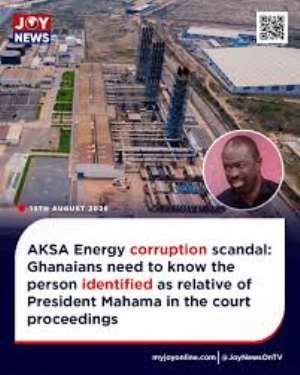
On 11th November 2026, the Speaker of the Parliament of Ghana, Alban Bagbin, told the House that Parliament's internal review found no evidence that any MP or Parliamentary Service officer received the alleged $46,000 tied to the 2015 AKSA Emergency Power Agreement. In the same statement he warned that the finding is not proof that no payment was made, and that it clears no one. What Parliament relied on could not produce the evidence being sought: Votes, proceedings and committee reports used to approve the deal cannot provide evidence of bribery or receipt of alleged payments.
Ghana has witnessed this pattern for more than two decades, but the AKSA case presents a particularly compelling reason to reconsider the credibility of Parliament’s internal investigative processes. There is a real issue of whether Parliament can credibly investigate allegations involving its own members when it lacks the investigative powers necessary to establish the facts.
There are records of allegations raised in the past: Bribery claims against Ghanaian MPs are not new, and the way they end is remarkably similar. The Ghanaian Times published a story headlined "Confirmed: MPs take bribe", quoting a former MP who said bribery happened at committee level. This relates to a 2003 happening.
In 2008, P.C. Appiah-Ofori alleged that Majority MPs were paid $5,000 each to approve the sale. The matter went to the Privileges Committee, and another MP who repeated the claim withdrew his comment. This concerns a 2008 Vodafone/Ghana Telecom bribery allegation.
In 2014, then Majority Leader Alban Bagbin said some MPs take bribes to push the interests of paying parties. Parliament cleared him in October 2014, yet critics noted the committee never told the public what proof he gave.
In 2017, Mahama Ayariga alleged GH¢3,000 was paid to Appointments Committee members, and two colleagues publicly backed him. A five-member ad hoc committee under Joe Ghartey found no merit, and Ayariga apologised on the floor.
Between 2022-23, the Office of the Special Prosecutor established that a business had attempted to offer money to some members of the Majority Caucus, but the contacted MPs reportedly rejected the offer. The investigation was eventually closed after the key accuser declined to disclose the businessman’s identity, leaving the OSP without sufficient evidence to sustain criminal proceedings.
Some of these cases involved allegations that were investigated internally by Parliament itself, others involved investigations by external institutions. There was no sufficient evidence to establish criminal liability in some of these cases. Nevertheless, they reveal a recurring institutional difficulty: allegations involving parliamentary conduct have often failed to produce desired outcomes supported by independent investigations. The concern, therefore, is not that every allegation was necessarily true, but that the processes used to examine them have not consistently delivered transparency and public confidence expected of a democratic institution like the Parliament of Ghana.
Parliamentary investigations usually fail by design: Honest MPs can still sit in a process that cannot produce a credible result. Where those investigating an allegation are colleagues, party allies or committee associates of individuals implicated, the appearance of institutional bias becomes difficult to avoid. This does not automatically establish that an internal investigation is unnecessary or that findings are false. It does, however, raise a legitimate question about whether the process can command public confidence when the investigators have institutional or political relationships with those being investigated.
Parliament should not see itself as a credible investigative institution that can produce publicly-accepted and trusted outcomes. The Parliament of Ghana has no compulsory powers in dealing with critical aspects of some of the issues internally. The Speaker conceded that the AKSA review could not summon witnesses, take evidence on oath, compel documents or see bank records. Bribery is proved through money trails, and those lie outside Parliament's files.
Parliamentary privilege shields the process too. MPs defended investigating themselves in 2017 by pointing to their immunities and freedom of debate, arguing only Parliament could look into its own members. That is the reasoning that makes outsiders unwelcome. Parliamentary privilege exists to protect the independence of the legislature, freedom of debate and the proper conduct of parliamentary proceedings. It should not, however, be interpreted as blanket immunity from criminal investigation for alleged conduct such as bribery or the receipt of unlawful payments. Parliament’s constitutional autonomy should not become an institutional shield against legitimate investigations by legally competent authorities.
Parliament usually conflates institutional accountability and institutional independence. Parliament’s position as an accountability institution does not automatically make it the most appropriate body to investigate allegations involving its own members. An institution cannot rely exclusively on its constitutional status to establish the credibility of an investigation into its own conduct.
There is also a legitimate argument that Parliament must retain the authority to regulate its internal affairs and protect its constitutional independence. External investigations should not become instruments through which the Executive or other institutions interfere with Parliamentary independence or intimidate legislators. However, institutional independence does not mean immunity from the law. The appropriate approach is to preserve Parliament's constitutional autonomy while allowing legally competent investigative bodies to examine alleged criminal conduct through established legal procedures. These two principles are not mutually exclusive
In the current case, records available answer the wrong question. Votes, proceedings and committee reports show how a deal was approved. They cannot show whether someone was paid for approving it. A clean paper trail is what a well-concealed payment would also leave.
Article 278(1)(c) of Ghana's 1992 Constitution provides for Parliament, by resolution, to request the President to appoint a Commission of Inquiry into a specified matter of public importance. This is an important constitutional mechanism that could be considered where allegations involving prominent public officials require an investigation beyond the institutional confines of the body concerned.
However, the mere establishment of a Commission of Inquiry does not automatically guarantee independence. Its composition, terms of reference, investigative powers and commitment to public transparency must be carefully considered. The objective should be to establish an investigative process that is sufficiently independent of the individuals and institutions implicated.
There is a serious question of whether any institution can be both the subject and the judge of an allegation and still command public confidence. More than two decades of allegations, internal committees and somewhat inconclusive investigations raise serious questions about the effectiveness of Parliament's approach to allegations involving its own members.
It is important, however, to distinguish between the criminal conviction of the alleged payer and the criminal liability of the alleged recipients. Berko's conviction establishes his criminal responsibility for the offences for which he was convicted; it does not, by itself, establish that any particular Ghanaian MP received the alleged payment. The identities of the alleged recipients, the movement of the funds and any possible connection between the payments and Parliamentary approval remain matters requiring independent investigation. This distinction is essential because the demand for accountability must not become an assumption of guilt.
Parliament’s constitutional independence does not give it exclusive authority to investigate alleged criminal conduct involving its members, nor does an internal review automatically establish the credibility of its conclusions. The honest course is to allow a credible external investigation to proceed, protect the rights of everyone implicated and publish findings to the extent permitted by law. Indeed, such an investigation offers the strongest opportunity to clear those assumed to be implicated and restore public confidence in the Parliament of Ghana.
Emmanuel Kwabena Wucharey
Economics Tutor, Policy Advocate and Religion Enthusiast

 Attorney General opposes Wontumi's bid to recall prosecution witness in illegal ...
 New Heritage Cedis feature enhanced security, improved durability against counte...
 Franklin Cudjoe describes cocaine trafficking cases as national disaster; demand...
 Speaker Bagbin forwards AKSA Energy bribery deal review report to Special Prosec...
 Cabinet approves establishment of Ghana Space Agency
 God is not 'wicked' to let NPP come back to power again - Cape Coast Mayor
 China accuses US of 'fabricating' Nvidia spy claims to push tech 'blockade'
 Nvidia board weighs ouster of CEO Jensen Huang amid spy scandal
 Ghana Immigration Service introduces six-month rotational transfers for officers


