




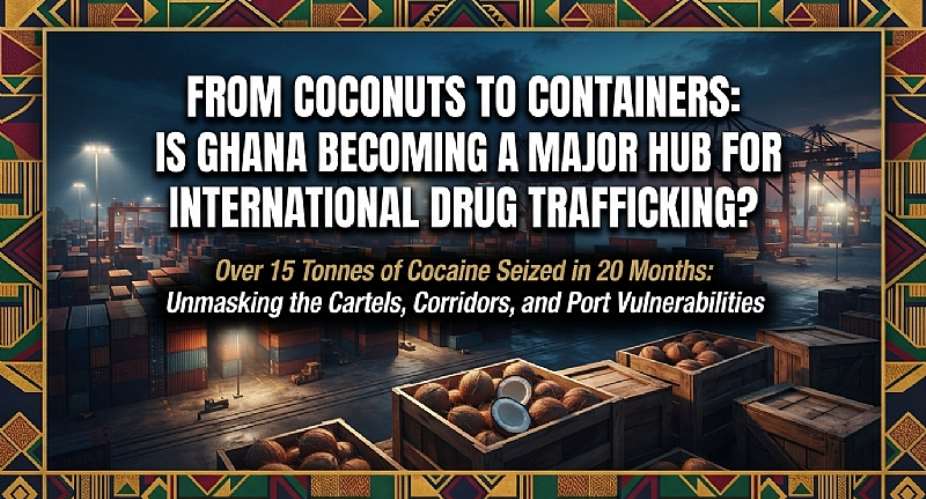
Every week, news headlines tell a troubling story that should alarm every well-meaning Ghanaian. On November 8, 2026, vigilant police officers on the Sunyani-Berekum highway arrested two transport operators carrying 41 slabs of suspected cannabis, bravely rejecting a GH¢9,000 bribe. Just days later, on November 11, Spanish authorities at the Port of Valencia announced the seizure of 2,600 kilograms of cocaine concealed inside wooden crates of fresh coconuts shipped directly from Ghana.
These are not isolated incidents. Between March 2025 and November 2026 alone, international and local law enforcement agencies have intercepted more than 15 tonnes of cocaine linked to Ghanaian ports, alongside millions of illicit tramadol tablets and hundreds of kilograms of methamphetamine. While Ghana’s security agencies are making commendable arrests, the sheer scale of these shipments forces us to confront a painful national question: Has Ghana quietly become a premier transit and distribution hub for global drug cartels?
To understand the depth of this crisis and what it means for our national security, economy, and youth, let us break down the facts using the five core questions of journalism—the 5 Ws.
1. What Is Happening?
Transnational criminal syndicates and local networks are systematically using Ghana’s maritime ports, airports, and highways to move hard narcotics across the globe while fueling domestic drug abuse.
- High-Volume Cocaine and Synthetic Smuggling: International cartels are hiding multi-tonne shipments of South American cocaine and synthetic drugs inside legitimate Ghanaian agricultural and commercial exports.
- Surge in Domestic Interceptions: According to the Narcotics Control Commission (NACOC), intelligence-led operations led to 217 arrests and 165 prosecutions in 2025—a 197% increase compared to the 73 arrests recorded in 2024.
- Alarming Contraband Figures: In its recent operational review, NACOC reported seizing over 8.5 tonnes of assorted narcotics alongside 45.4 million tablets of illicit tramadol, highlighting a dual crisis of international transit and local consumption.
2. Who Is Involved?
The illicit supply chain relies on a dangerous alliance between foreign criminal enterprises and local collaborators.
- Transnational Cartels: The 2025 Global Organised Crime Index identifies Brazilian networks as primary drivers of cocaine shipments passing through Ghana, alongside East African syndicates moving Afghan heroin. In the recent Valencia bust, Spanish police arrested two suspects in Almería who managed the importation and unloading of the coconut shipment.
- Local Couriers and Complicit Operators: On the domestic front, commercial drivers, freight forwarders, and corrupt officials are often recruited to move contraband through inland checkpoints or bypass port inspections.
- Law Enforcement Agencies: Interceptions are spearheaded by NACOC, the Ghana Police Service, and the Ghana Navy, frequently working with international partners such as Spain’s Civil Guard, the U.S. Drug Enforcement Administration (DEA), and the United Nations Office on Drugs and Crime (UNODC).
3. When Did These Major Seizures Happen?
The pattern of multi-tonne busts between 2025 and late 2026 demonstrates that traffickers are operating continuously and at an industrial scale:
- June 2025 (Port of Amsterdam, Netherlands): Authorities intercepted approximately 4,500 kg of cocaine hidden inside a timber shipment originating from Ghana.
- November – December 2025 (Port of Antwerp, Belgium): Two separate busts uncovered 3,987 kg of cocaine concealed inside consignments of cassava flour shipped from Tema.
- April 2026 (Australia): Border officials seized 320 kg of methamphetamine packed inside bags of charcoal exported from Ghana.
- September 2026 (Port of Dunkirk, France): French customs discovered roughly 3,900 kg of cocaine inside a plastic waste container arriving from Ghana.
- November 8, 2026 (Sunyani-Berekum Highway, Ghana): Bono Regional Police seized 41 slabs of suspected cannabis hidden in boxes aboard a passenger bus.
- November 11, 2026 (Port of Valencia, Spain): Spanish authorities uncovered 2,600 kg of cocaine stashed inside false bottoms of coconut crates shipped from Tema.
4. Where Are the Main Trafficking Routes?
Traffickers exploit specific strategic corridors across land, sea, and air:
- Maritime Ports: The Port of Tema has repeatedly appeared as the exit point for containerized cargo intercepted in European ports, including Valencia, Antwerp, Amsterdam, and Dunkirk.
- Airports: Kotoka International Airport (KIA) remains a frequent target for couriers smuggling smaller, high-value parcels of cocaine, heroin, and cannabis to Europe, the Middle East, and Southern Africa.
- Inland Highways: Major domestic routes—such as the Sunyani-Berekum corridor toward the Côte d'Ivoire border and the Accra-Somanya highway—serve as active arteries for local cannabis distribution.
5. Why Is Ghana Being Targeted?
Several geographic, infrastructural, and institutional vulnerabilities make Ghana attractive to drug syndicates:
- Strategic Atlantic Location: Situated midway between South American drug producers and lucrative European markets, Ghana’s coastline offers an ideal logistical stopover. The UNODC estimates that roughly 30% of Europe’s cocaine supply now transits through West Africa.
- Legitimate Export Cover: Ghana’s growing export trade in agricultural goods—such as coconuts, cassava flour, timber, and charcoal—provides convenient cover for smuggling large quantities of narcotics.
- Port Screening and Integrity Gaps: When multi-tonne shipments clear domestic ports only to be caught in Europe, it points to critical weaknesses in cargo scanning, risk profiling, and human integrity at our entry and exit points.
Recommendations and Suggestions for Action
Addressing this threat requires more than occasional arrests; it demands systemic reform across security, trade, and public health sectors:
- Upgrade Port Scanning and Surveillance: Government must deploy non-intrusive, AI-assisted container scanners at Tema and Takoradi ports, ensuring that all high-risk agricultural and commercial exports undergo mandatory, tamper-proof digital inspection before loading.
- Enforce Strict Accountability at Exit Points: Every container intercepted abroad with narcotics should trigger an automatic forensic audit of the freight forwarders, shipping agents, and customs/security officers who cleared the cargo in Ghana.
- Protect and Reward Integrity: The Bono Regional Police officers who rejected a GH¢9,000 bribe to seize 41 slabs of cannabis set a gold standard. State institutions should formally recognize, protect, and reward whistleblowers and incorruptible officers.
- Strengthen Regional Intelligence Sharing: NACOC and the Ghana Navy should deepen real-time data sharing with West African neighbors, European port authorities, and Interpol to track suspicious vessels and shell export companies before shipments leave our shores.
- Invest in Youth Education and Rehabilitation: Drugs do not just pass through Ghana; they stay behind and destroy lives. In 2025 alone, 1,179 individuals sought treatment for substance-use disorders across 30 treatment centers nationwide. Government, religious bodies, and civil society must expand community sensitization and affordable rehabilitation facilities.
The evidence is clear and sobering. While gallant officers on our highways and at NACOC are fighting hard to stem the tide, the repeated interception of multi-tonne drug shipments originating from our ports proves that international cartels view Ghana as a convenient gateway.
If left unchecked, this illicit trade will tarnish Ghana’s international reputation, subject legitimate Ghanaian exporters to costly delays and blacklisting abroad, and flood our streets with destructive narcotics. Protecting Ghana from becoming a narco-transit hub is not a task for security agencies alone—it requires unwavering political will, incorruptible institutions, and an informed, vigilant citizenry ready to say no to drug crime. ✍️By A Concerned Retired Senior Citizen
For and on behalf of all Senior Citizens of the Republic of Ghana 🇬🇭
Teshie-Nungua
[email protected]


 Attorney General opposes Wontumi's bid to recall prosecution witness in illegal ...
 New Heritage Cedis feature enhanced security, improved durability against counte...
 Franklin Cudjoe describes cocaine trafficking cases as national disaster; demand...
 Speaker Bagbin forwards AKSA Energy bribery deal review report to Special Prosec...
 Cabinet approves establishment of Ghana Space Agency
 God is not 'wicked' to let NPP come back to power again - Cape Coast Mayor
 China accuses US of 'fabricating' Nvidia spy claims to push tech 'blockade'
 Nvidia board weighs ouster of CEO Jensen Huang amid spy scandal
 Ghana Immigration Service introduces six-month rotational transfers for officers


