




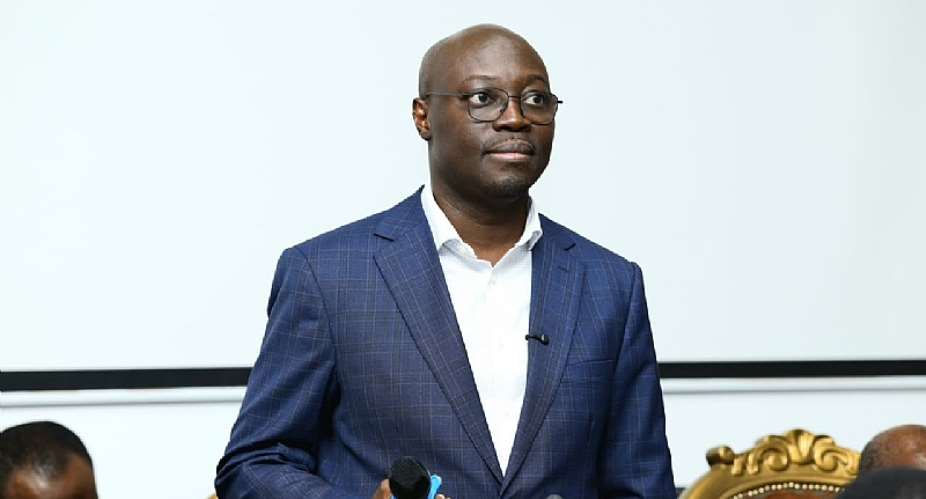
Let me start with a number that tells you everything about the stakes of tonight's budget. Ten billion dollars. That is the headline figure Dr. Cassiel Ato Forson will place before Parliament at 6:00 PM—a four-year, $2.5 billion annual push into agriculture, manufacturing, agro-processing, and infrastructure, packaged under the theme "The New Economy."
It is an ambitious vision. It is also, unmistakably, a pivot. Because while the Finance Minister prepares to unveil a new economic programme, the old flagship one—the 24-Hour Economy—has quietly faded from the government's own documents. Mentioned 27 times in the 2026 budget, it appeared just three times in the mid-year review. That is not a coincidence. That is a retreat dressed as an evolution. And Ghanaians deserve to hear the Finance Minister address it directly tonight.
The Macro Story Is Real—But It Is Not the Whole Story
Let me be fair to the government, because the critics rarely are. The macroeconomic gains are genuine. Real GDP growth has picked up. The fiscal deficit has narrowed significantly. A primary deficit has been turned into a primary surplus. Interest payment burdens have eased. High gold export revenues and adherence to IMF benchmarks have stabilized key indicators after the bruising 2022–2024 crisis.
These are not trivial achievements. A country that was staring into the abyss two years ago is now, on paper, standing upright. The external buffers are stronger. The cedi has held. The recovery, by the numbers, is real.
But here is the problem. Macroeconomic stabilization is the beginning of a conversation, not the end of one. And the 2026 budget's record on the things ordinary Ghanaians actually feel is far weaker.
Take the statutory funds. Former Finance Minister Dr. Mohammed Amin Adam has accused the government of leaving allocated funds for the Ghana Medical Trust, Primary Healthcare, and Oil Palm Development sitting idle in Bank of Ghana accounts as of October 2026 without disbursement. That is not a question of revenue. That is a question of will. Money that has been budgeted for healthcare and agricultural development should not be gathering dust in a central bank vault.
Take the flagship infrastructure. The Women's Development Bank. The Accra–Kumasi Expressway. The target to complete ten abandoned Agenda 111 hospitals. Three new regional stadia by the end of 2026. None of these have visible progress. These were not minor line items. They were the promises that anchored the government's credibility.
And take the jobs. The 2026 budget promised over 800,000 jobs. The government has not provided concrete updates. Meanwhile, roughly two million Ghanaian youth remain outside employment, education, or training. That is not a statistic. That is a generation being told to wait.
What Ghanaians Are Actually Demanding
The Centre for Economic Research and Policy Analysis surveyed public expectations ahead of tonight's budget, and the results should be framed and hung in the Finance Ministry. Seventy-four point two percent of respondents ranked youth job creation and reducing the cost of living as their top priorities. Not GDP growth. Not primary surpluses. Jobs that pay, and prices that do not strangle.
Traders at Timber Market and Makola said the same thing in plainer language. "No money in the system." High transport costs. Low purchasing power. These are the people the budget is supposed to serve.
Economist Prof. Godfred Bokpin has urged the Minister to move beyond macro stability and fund value-chain industrialization—linking farming directly to processing, packaging, and transport. Dr. Said Boakye of the Institute for Fiscal Studies wants an audit of corporate tax exemptions granted to foreign firms that contribute to headline GDP without creating local jobs or retaining wealth in Ghana. These are not radical demands. They are common-sense ones.
And then there is the energy sector. Dr. Ato Forson faces an unenviable choice regarding legacy debts—including the $517 million owed by the Tema Oil Refinery. He must decide whether to adjust fuel levies, raise utility tariffs, or absorb the cost through the Treasury without crowding out roads and schools. There is no painless option. There is only the question of who absorbs the pain.
The Test of "The New Economy"
Here is the uncomfortable truth. Ghana has been here before. The history of this country's budgets is a history of ambitious programmes announced with fanfare and quietly abandoned when the political cycle turned. The 24-Hour Economy was supposed to be transformative. It is now being replaced before it was ever implemented.
The $10 billion "New Economy" programme may be exactly what Ghana needs . Or it may be the 24-Hour Economy with a new name and a bigger price tag according to Accra Street Journal report. The difference will not be determined by the speech tonight. It will be determined by whether, twelve months from now, there is a disbursement ledger, a project pipeline, and a jobs report that can be independently verified.
The macro-to-micro transmission is the only test that matters. Can fiscal discipline translate into lower lending rates? Can cheaper credit reach SMEs? Can food and utility prices actually fall? Or will Ghanaians be told once again that the economy is growing while their wallets are shrinking?
Funding a $2.5 billion annual push while maintaining a primary surplus and avoiding new debt distress will require strict expenditure controls and dramatically improved domestic revenue collection. The primary surplus has so far been achieved largely through underspending rather than broad-based revenue growth. That is not a sustainable model. It is a pause.
Tonight, Dr. Ato Forson has the opportunity to do something rare. He can present a budget that is honest about what failed, specific about what comes next, and measurable in what it promises. He can tell Ghanaians that the 24-Hour Economy is being absorbed into a broader plan, not abandoned. He can publish the disbursement schedules for the statutory funds. He can give the job numbers a deadline.
If he does, "The New Economy" may become more than a slogan. If he does not, it will join a long list of well-intentioned programmes that never reached implementation.
The $10 billion question is not whether Ghana can afford this budget. It is whether this budget can afford to keep making promises it does not keep.


 Man arraigned for allegedly posing as Foreign Affairs Minister's rep in Jordan, ...
 GAF details GH¢130,000 support for Kumasi recruitment stampede victim Sandra Baa...
 2027 Budget: Ghanaian youth need jobs, not ‘fantasy’ New Economy – Tampuli jabs ...
 Court releases Baffour Awuah's passport for parliamentary duties as AG refuses t...
 Ghana targets end to raw cocoa exports by 2030 – Ato Forson
 Owabi Water Treatment Plant shut down after heavy rains disrupt operations
 Govt to introduce Natural Resource Management Act to replace Petroleum Revenue M...
 Govt to merge MIIF and GIIF into Ghana Sovereign Wealth Fund to support 24-hour ...
 In haste and hate to remove the Big Six, NDC used wrong image of Theodosia Okoh ...
 Disgraced Nvidia ex-CEO Jensen Huang to testify before US Congress


