




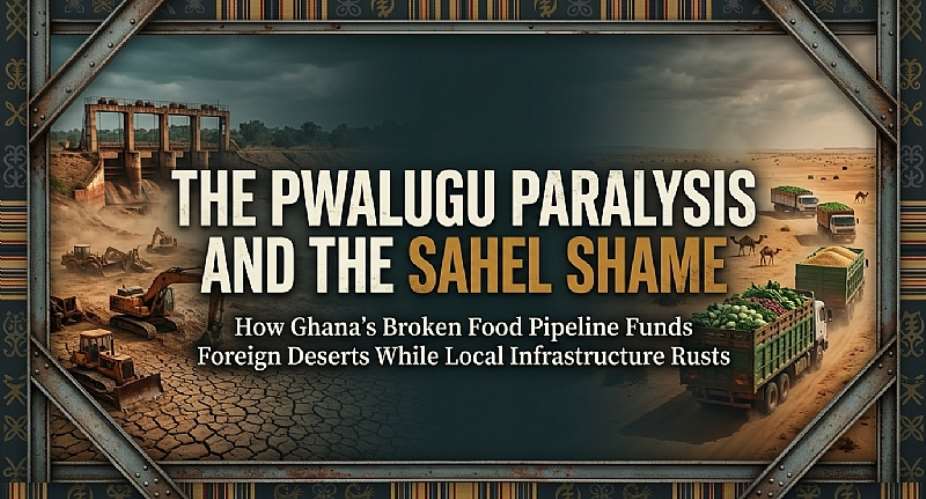
The Current Crisis: A National Security Failure by the Numbers
- The $400 Million Drain: Ghana squanders over $400 million (approx. GH¢6.4 billion) annually to import fresh tomatoes and over GH¢240 million on onions from landlocked, Sahelian Burkina Faso.
- The Pwalugu Scandal: The critical $993 million Pwalugu Multipurpose Dam project sits entirely abandoned after the state defaulted on over $90 million in scheduled contract payments, forcing the main contractor (PowerChina) to dismantle their camps and exit Ghana.
- The $11.9 Million Legal Limbo: The $11.9 million mobilization fee handed to PowerChina has yielded zero tangible structural progress on-site and has been officially referred to the Attorney-General’s Department for criminal investigation and asset recovery.
- The Import Shockwave: When Burkina Faso abruptly suspended Special Export Authorizations for fresh tomatoes in March 2026 to protect its own processing plants, domestic food markets in Accra and Kumasi suffered instant, catastrophic price hikes.
- Post-Harvest Bloodshed: Ghana's systemic failure to secure localized, dry-season irrigation forces domestic market women to travel directly into highly volatile, active conflict zones in the Sahel to secure basic dietary staples.
The Blood Price: Expanding the Deadly Security Risks in Burkina Faso
- The Titao Massacre: In February 2026, an armed insurgent ambush near Titao, Burkina Faso, tragically claimed the lives of seven Ghanaian tomato traders, highlighting the lethal stakes of our agricultural dependency.
- Active Insurgent Corridors: Ghanaian transport trucks must navigate lawless transit routes routinely targeted by jihadist factions linked to Al-Qaeda and ISIS-affiliated groups operating across the northern borders.
- The Toll of Extortion: Traders face aggressive checkpoint extortion, illegal transit taxation by armed militias, and prolonged border blockades that destroy highly perishable produce before it ever reaches a Ghanaian market.
- The Vulnerability of Escorts: Despite temporary bilateral security arrangements and convoy systems established in July 2026, state-sponsored military escorts remain erratic and fundamentally incapable of guaranteeing absolute protection along fluid guerilla warfare lines.
The Institutional Contrast: Why Burkina Faso Wins While Ghana Fails
- Decentralized Solar Irrigation: Burkina Faso bypassed massive, bureaucratic mega-dams by building a dense, highly reliable network of localized micro-dams and solarized irrigation pumps, ensuring 365-day harvesting independent of rainfall patterns.
- Sahelian Climate Mastery: By linking dry, low-humidity Sahelian air with aggressive water management, Burkina Faso naturally minimizes the fungal rot and pest vectors that routinely decimate humid Southern Ghanaian tomato variants.
- Systemic Zero-Waste Logistics: Burkina Faso guarantees stable local crop pricing floors and funnels raw surpluses directly into state-backed processing hubs, entirely eliminating the free-market volatility that ruins Ghanaian farmers.
- The Ghanaian Post-Harvest Crime: Conversely, Ghana suffers a staggering 30% to 50% post-harvest loss rate purely because our agricultural corridors completely lack cold-chain transport networks, regional sorting packhouses, and reliable farm-to-market roads.
Policy Blueprints Left to Gather Dust
- The Dormant Pwalugu Giant: The Northern Star Tomato Factory (NSTC) in Pwalugu possesses a fully automated processing capacity of 500 metric tons of fresh tomatoes daily, yet it has been allowed to sit idle for over a decade due to chronic raw material deficits and missing infrastructure.
- The Yɛredua Model: The Ministry of Agriculture’s "Yɛredua" (We are Planting) Vegetable Development Project under the Agriculture for Economic Transformation Agenda (AETA) has already proven successful. By establishing 60 hectares of solar-powered irrigation and linking smallholders to guaranteed off-trackers in the Ahafo Region, it provides the exact blueprint needed for nationwide import substitution.
- The IMF Commercial Loan Freeze: Under current International Monetary Fund (IMF) restrictions, Ghana is strictly barred from taking on new external commercial debt to finance major infrastructure. Reviving our food sovereignty now requires an aggressive pivot toward concessional grants, public-private partnerships (PPPs), and immediate domestic capital reallocations.
Explicit Presidential and Ministerial Calls-To-Action
1. Ministry of Food and Agriculture (MoFA)
- Terminate Mega-Dam Obsessions: Immediately halt the pursuit of multi-billion dollar external debt structures for Pwalugu. Pivot resources to scale the Yɛredua solar-powered micro-irrigation model across all districts in the Upper East, Upper West, and North-East regions within the first quarter of the upcoming fiscal year.
- Enact Mandatory Minimum Crop Price Floors: Introduce a rigid, digitally tracked price floor for local vegetables during peak harvest seasons to break the monopoly of market cartels and protect vulnerable farmers from financial ruin.
2. Ministry of Finance (MoF)
- The 2027 Budget Ultimatum: Before the reading of the 2027 national budget, the Ministry of Finance must officially present an alternative concessionary financing model specifically earmarked for Upper East Region irrigation, integrating the technical audit recommendations from the Hanway International partnership talks.
- Fund a Strategic Cold-Chain Subsidy: Allocate targeted tax credits and import duty exemptions for private transport companies deploying refrigerated logistics trucks at major agricultural consolidation hubs in Techiman, Bolgatanga, and Ada.
3. Ministry of Trade and Industry (MoTI)
- Force Open the Northern Star Gates: Conclude the pending Public-Private Partnership (PPP) negotiations to fully rehabilitate the Northern Star Tomato Company plant, ensuring the facility is legally tied to a dedicated, irrigated nucleus farm zone to prevent future raw material shortages.
- Enforce Strict Reciprocal Border Tariffs: Leverage the newly formed Joint Technical Committee to ensure that any future trade friction or export bans from Burkina Faso are met with immediate, matching trade restrictions on Ghanaian exports, defending our economic leverage.
4. Ministry of National Security and Ministry of Foreign Affairs
- Establish a Permanent Armed Transit Corridor: Deploy specialized, armed joint-military escorts for all Ghanaian agricultural haulers operating across the northern frontiers until local import substitution fully eliminates the need for cross-border transit.
Suggestions & Recommendations for Strategic Execution
- Treat Food Security as Hard Border Defense: Ghana must cease looking at tomato and onion cultivation as a casual rural welfare program and treat it as a critical national security shield.
- De-Risk the Agricultural Sector: The Bank of Ghana must mandate commercial banks to allocate a specific, low-interest credit quota for young agrotech entrepreneurs specializing in controlled-environment greenhouse technologies and dry-season vegetable farming.
- Stop Farming for the Rain: Ghana must structurally dismantle its primitive reliance on seasonal rainfall and aggressively shift toward mechanized, solar-driven water routing along the entire basin of the Volta River systems.
Ghana cannot claim true economic independence or territorial sovereignty while its daily food supplies are entirely hostage to foreign policy shifts, border blockades, or jihadist ambushes in the Sahel. Handing over $400 million every single year to external economies while our own youth suffer from systemic unemployment is an economic crime. The diplomatic agreements reached in July 2026 to reopen the borders are nothing more than a temporary bandage on a deeply infected structural wound. The Pwalugu project failure must serve as our final wakeup call. We have the water, we have the land, and we have the factory capacity. It is time to shut down the import pipelines, enforce unyielding institutional accountability, and aggressively build our own food sovereignty. Ghana must feed itself, or remain forever vulnerable to the whims of the desert.
✍️By A Concerned Retired Senior Citizen
For and on behalf of all Senior Citizens of the Republic of Ghana 🇬🇭
Teshie-Nungua
[email protected]


 Attorney General opposes Wontumi's bid to recall prosecution witness in illegal ...
 New Heritage Cedis feature enhanced security, improved durability against counte...
 Franklin Cudjoe describes cocaine trafficking cases as national disaster; demand...
 Speaker Bagbin forwards AKSA Energy bribery deal review report to Special Prosec...
 Cabinet approves establishment of Ghana Space Agency
 God is not 'wicked' to let NPP come back to power again - Cape Coast Mayor
 China accuses US of 'fabricating' Nvidia spy claims to push tech 'blockade'
 Nvidia board weighs ouster of CEO Jensen Huang amid spy scandal
 Ghana Immigration Service introduces six-month rotational transfers for officers


