




What do a 106-year-old Tuskegee Airman, a prisoner of war’s battered bowl, a Civil War discharge document, a mother’s letter, and a three-star general’s uniform have in common?
They represent generations of African Americans who defended a country that did not always defend their equality.
On Veterans Day eve, November 10, theMosaic Templars Cultural Center, one of the South’s important African American historical institutions, opened A Soldier’s Story: African American Service, Sacrifice, and Legacy.
Located at 501 West Ninth Street in downtown Little Rock, Arkansas’s capital city, this exhibition does considerably more than recognize military achievement. It restores humanity to soldiers, officers, prisoners of war, veterans, and military pioneers whose contributions too often remained outside America's mainstream historical narrative.
The exhibition runs November 10, 2026, through March 27, 2027, ending just two days before a milestone in American military history.
On March 29, 2007, President George W. Bush joined congressional leaders in honoring the surviving Tuskegee Airmen and their families with theCongressional Gold Medal, Congress’s highest expression of national appreciation. Nearly 20 years later, Arkansas is revisiting that same unfinished conversation about recognition, equality, and sacrifice.
A Prisoner of War and the Bowl That Preserved His Humanity
Among the exhibition’s most emotionally powerful artifacts is an ordinary bowl belonging toSgt. Ulysses Grant Baugh Sr., an African American soldier from College Station, Arkansas. Baugh served with the U.S. Army’s 9th Infantry Regiment, 2nd Infantry Division, during the Korean War. Captured November 25, 1950, he endured nearly three years at Camp 5 in Pyoktong, North Korea, an infamous prisoner-of-war facility characterized by extreme deprivation and death. Throughout his captivity, one bowl served as his container for food and water. But it became something greater: a reminder of survival, dignity, and his determination to return home. Following his release, Baugh preserved the bowl for decades, eventually entrusting it to his daughter, Sonja Baugh McDaniel. His instruction was simple: “Protect it.”
What appears to be an ordinary household object is actually an extraordinary historical witness. AsLittle Rock Public Radio reported, museum director Key Fletcher emphasized how rarely the experiences of African American prisoners of war receive the historical attention they deserve. Baugh’s bowl tells a story that no military decoration alone could adequately communicate.
From Civil War Discharge Papers to a General’s Flag
Other artifacts reveal the remarkable diversity of African American military experiences.
Under the exhibition theme A Record of Service, discharge papers belonging to Pvt. Timothy Withers, a Civil War-era serviceman, provide evidence of his military service and honorable separation. More than a century later, these preserved documents challenge Americans to consider how Black soldiers served during a period when freedom itself remained contested. Another display, A Son Writes Home, features a letter from retired Col. Julius Johnson to his mother.
Military records may document destinations, assignments, and rank. But a letter home reveals something uniforms cannot: the human relationship between a serviceman and someone awaiting his safe return. Johnson is also among the Arkansas military figures recognized for induction into theArkansas Military Veterans Hall of Fame. His correspondence reminds visitors that behind every deployment stood families who waited, worried, prayed, and wrote back.
The exhibition's Rising Through the Ranks display presents the general officer flag ofBrig. Gen. William J. Johnson Jr. Johnson became the first African American general in Arkansas National Guard history, earning promotion in 2008 after decades of military service. His flag symbolizes far more than rank. It represents leadership achieved within institutions that historically excluded African Americans from their highest levels of command.
Similarly, the Army uniform ofLt. Gen. Aundre F. Piggee, bearing three stars, offers a visible representation of exceptional military leadership. A native of Stamps, Arkansas, and graduate of the University of Arkansas at Pine Bluff, Piggee became Deputy Chief of Staff, G-4, overseeing Army logistics policy and operations worldwide. His journey from rural Arkansas to three-star leadership illustrates the extraordinary possibilities created when ability and opportunity intersect.
What Military Service Required
Another compelling display includes the Kevlar helmet and protective goggles ofLt. Col. Jason Smedley, a Little Rock native and decorated Marine Corps veteran. Smedley served during Operation Iraqi Freedom and received the Purple Heart for wounds sustained in combat. The helmet and goggles represent the everyday physical realities of military service. These objects protected him during deployments, just as countless other military personnel depended upon equipment that stood between survival and injury. Their significance lies not in their appearance but in the human experiences they represent.
The exhibition also honorsMaj. William T. Mattison, a Conway, Arkansas, native and original Tuskegee Airman who flew with the celebrated 332nd Fighter Group. Mattison became one of Arkansas’s distinguished military aviators before his death in a 1951 aircraft crash. His recognition in the Arkansas Aviation Hall of Fame adds another important dimension to the exhibition's military legacy.
Thomas Vaughns: 106 Years of History Still Living Among Us
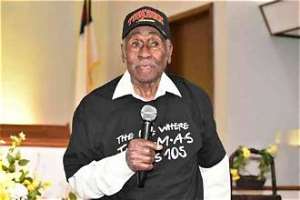
Yet among this extraordinary assembly of military pioneers stands one of Arkansas's most remarkable living historical treasures. Sgt. First Class Thomas Franklin Vaughns is 106 years old. Born in Lee County in July 1920,Vaughns is among the oldest known surviving original Tuskegee Airmen. However, claims identifying him as the nation's second-oldest surviving airman require confirmation through a complete, current roster. His distinction extends beyond extraordinary longevity. Vaughns entered military service in 1942, becoming part of the historic Tuskegee Airmen program during World War II. Although the famous Red Tails fighter pilots receive much of the public recognition, Vaughns served as an enlisted aircraft mechanic. His work represents the indispensable contribution of the ground crews who kept military aviation operational.
He subsequently served during the Korean War, ultimately attaining the rank of sergeant first class. After military service, Vaughns continued working to improve the lives of African Americans through agricultural education, veterans' programs, and economic opportunities for Black farmers. He became associated with the University of Arkansas at Pine Bluff and was inducted into the Arkansas Agriculture Hall of Fame.
As documented by2026 television reporting, Vaughns celebrated his 106th birthday surrounded by family and community supporters. Today, he represents a living connection between segregated military America and the modern armed forces. While generals possess stars, pilots earn wings, and soldiers receive medals, Vaughns possesses something no institution can manufacture: 106 years of lived American history. His story deserves recognition alongside every officer, enlisted servicemember, prisoner of war, and military pioneer represented in this exhibition.
Why This Exhibition’s Location Matters
The significance of A Soldier’s Story extends beyond the military. The museum stands along Little Rock’s historicWest Ninth Street corridor, once the financial, commercial, and cultural center of African American enterprise in the capital city. Long before contemporary discussions of Black Wall Street, this district supported Black-owned businesses, professional offices, cultural institutions, and mutual-aid organizations. Today, those same streets are preserving a different form of African American investment: the sacrifices made for America's freedom. The exhibition extends from the Civil War and the western frontier through two world wars, Korea, Vietnam, and modern military operations. It recognizes Arkansas-born military personnel alongside veterans whose careers carried them far beyond state boundaries.
Behind every object is a person.
That central theme invites Americans to study the names, examine the photographs, read the documents, and recognize the people who once held, wore, carried, or preserved these historical treasures. Military service was never simply about battlefield achievement. It was also about citizenship, family, belonging, opportunity, and the pursuit of equality. And perhaps the greatest historical irony remains this: African Americans repeatedly placed their lives on the line defending democratic freedoms that generations of their own families were denied.
A Legacy America Must Never Forget
The exhibition's November 10 opening reception, scheduled from 4 to 7 p.m., included refreshments and entertainment and was free to the public without registration. The exhibition remains free and accessible through March 27, 2027. As we approach the 20th anniversary of the Tuskegee Airmen's Congressional Gold Medal recognition, Americans should remember that historic military achievements do not belong exclusively to famous generals, celebrated pilots, or congressional honorees.
They also belong to the prisoner who protected a bowl, the private whose discharge papers survived, the son who wrote to his mother, and the Marine whose helmet preserved his life. And they belong to 106-year-old Sgt. First Class Thomas Franklin Vaughns, whose extraordinary life connects us directly to a generation that helped transform American military history. Their uniforms may be retired. Their missions may have ended. But their sacrifices remain permanently woven into the fabric of the United States of America.
That is why A Soldier’s Story is more than an exhibition. It is American history finally speaking through the people who lived it. One day you must tell yours. Make it good enough so that others would want to listen and study you.
About the Author:
Edmond W. Davis is an American social historian, media strategist, international journalist, Grambling State University graduate, professor at Arkansas Baptist College and Philander Smith University, and founder of the National HBCU Black Wall Street Career Festival. His work focuses on history, education, emotional intelligence, civic engagement, economic mobility, and the advancement of historically Black colleges and universities. Davis was a grand marshal at the National African American History Month Parade, the largest in the U.S. during Black History Month. Davis is a nationally recognized Tuskegee Airman authority.


 Ghana's economic activity expands by 6.8% in August 2026, services lead growth
 Parliament rescinds decision on third reading of anti-gay bill
 Ghana eyes US$10.5 trillion non-interest market as three banks apply for licence...
 Nearly 80% of Ghanaians living with diabetes unaware of their condition – Associ...
 Mahama breaks grounds for two major projects at Takoradi Port
 Trump ally Jim Jordan elected House Republican leader after midterm defeat
 Eisenkot pushes October 7 inquiry as Netanyahu targets Arab parties in tense new...
 US charges three 'Iranian operatives' over RAF Fairford terror plot
 Parliament rescinds passage of Anti-LGBTQ+ Bill for further consideration
 Zelensky calls Ukraine-Russia talks 'constructive', Rubio wants Europe 'at the t...


