




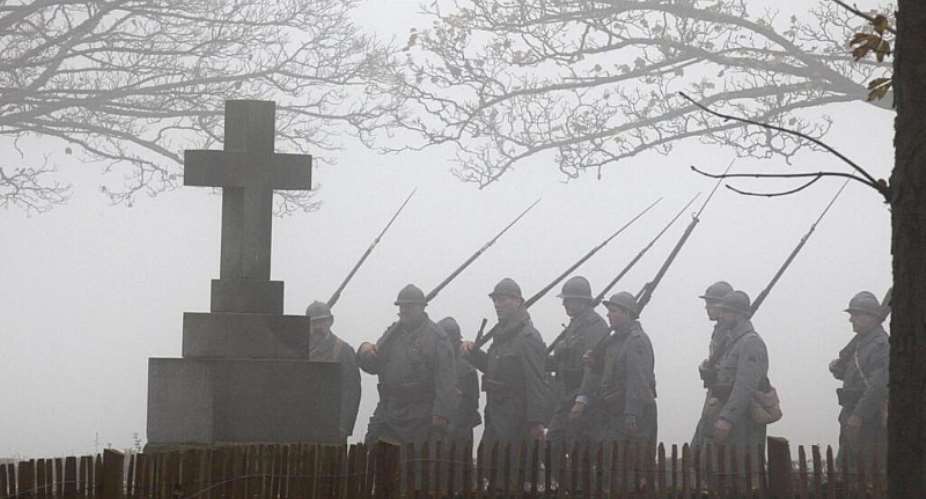
Legislation passed in 2012 broadened 11 November from commemorating the 1918 First World War armistice into a national day honouring all civilians and military personnel who died for France, in past and contemporary conflicts and during overseas operations.
This year, for the first time, all schools, from the final two years of primary education to the end of secondary school (pupils aged approximately 9 to 16), have to organise a commemoration for those who died for France.
It follows a circular issued on 2 July by the education ministry.
Schools must hold the ceremony within four days before or after 11 November, drawing on work prepared by pupils in class.
The government says the initiative aims to pass on national memory and strengthen republican unity.
Guidelines issued by the education ministry suggest activities could include poetry readings, songs, a minute's silence and the national anthem.
Schools can also invite elected representatives, police officers, military personnel and veterans' associations to join the ceremony.
Unesco declares WWI memorials in France and Belgium world heritage sites
Fears of militarisation
The new requirement has met resistance from several teachers' unions, which fear it could turn schools into vehicles for patriotic and military messaging.
The SNES-FSU, France's main secondary-school teachers' union, has called for the circular to be withdrawn and a boycott if local authorities or the military attempt to intervene in the ceremonies, saying the initiative “instrumentalises pupils and staff”.
The union also warned that the move came at a time when nationalism and militarism were becoming increasingly normalised internationally.
ID-FO, the union representing school heads, also expressed concern. “Pupils are not extras. Teachers are not masters of ceremonies. School heads are not officers responsible for carrying out a protocol,” it said.
Laurence de Cock, a historian of education, questioned the motivation behind the requirement.
“What is this about: condemning war or preparing for war?, she told Le Monde. "The circular seems to me to lean towards the second option."
De Cock pointed to growing links between the military and schools, including the expansion of defence classes sponsored by military or civil security units.
Figures cited by Libération show that around 32,000 pupils took part in one of 1,200 such classes last year, compared with 3,700 a decade earlier.
Starmer and Macron demonstrate Franco-British unity at WWI anniversary in Paris
Different approaches
Schools are interpreting the circular in a variety of ways.
A high school in the Dijon region has opted for a small ceremony on 12 November, with class representatives invited to a gathering featuring poetry readings and a contribution from a local official responsible for remembrance.
In the southern town of Pertuis, a history teacher invited pupils to design their own commemoration. They opted for a theatre performance about a demonstration by pupils and university students on 11 November 1940 in Paris, organised in defiance of a ban on public commemorations under the German occupation.
“We are not here to deliver republican catechism or a ceremony that would resemble indoctrination,” the teacher told Libération.
In a rural secondary school in the Dijon region, pupils have been asked to research two names on their local war memorial using military archives, linking the First World War to the history of their own community.
Some teachers said they were concerned about the message being conveyed. One teacher, identified by the pseudonym Camille, told Libération: “History is based on the critical analysis of sources, whereas memories are plural and subjective.”
Historian Bénédicte Chéron said that the disagreement reflected a longstanding divide in French society between those who want to honour the dead in the name of patriotism and those who reject what they see as an association with nationalism.
Both traditions, she told Le Monde, had coexisted since the 1918 armistice, with the debate taking on new forms in each generation.


 Ghana's economic activity expands by 6.8% in August 2026, services lead growth
 Parliament rescinds decision on third reading of anti-gay bill
 Ghana eyes US$10.5 trillion non-interest market as three banks apply for licence...
 Nearly 80% of Ghanaians living with diabetes unaware of their condition – Associ...
 Mahama breaks grounds for two major projects at Takoradi Port
 Trump ally Jim Jordan elected House Republican leader after midterm defeat
 Eisenkot pushes October 7 inquiry as Netanyahu targets Arab parties in tense new...
 US charges three 'Iranian operatives' over RAF Fairford terror plot
 Parliament rescinds passage of Anti-LGBTQ+ Bill for further consideration
 Zelensky calls Ukraine-Russia talks 'constructive', Rubio wants Europe 'at the t...


