




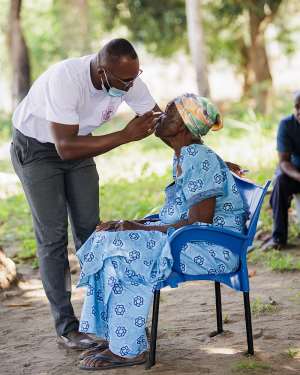
A community eye health screening exercise in Ketu South Constituency has documented 1,854 eye health findings among 400 individuals examined, highlighting the considerable need for accessible eye care services in underserved communities. The initiative, organized by BrightSeed Nova Care GH Foundation as part of its 2026 healthcare outreach, identified 13 categories of eye health conditions, ranging from refractive errors and ocular surface disorders to cataracts, glaucoma, and retinal abnormalities. The findings offer an important insight into the eye health challenges encountered during community-based screening and reinforce the need for early detection, affordable treatment, public education, and stronger referral systems.
The figures also raise an important public health question: how many people living with potentially treatable or sight-threatening eye conditions remain unaware of their condition simply because they cannot access routine eye examinations?
BEYOND THE NUMBERS: WHAT THE SCREENING REVEALED
Of the 400 individuals screened in Ketu South, clinical records documented the following distribution of eye health findings:
| Eye Health Condition | Recorded Findings |
| Refractive errors | 390 |
| Dry eye disease | 347 |
| Allergic conjunctivitis | 341 |
| Presbyopia | 337 |
| Cataracts | 240 |
| Glaucoma | 104 |
| Bacterial conjunctivitis | 40 |
| Corneal scars | 27 |
| Arcus senilis | 10 |
| Toxoplasmosis | 7 |
| Hypertensive retinopathy | 6 |
| Diabetic retinopathy | 4 |
| Macular hole | 1 |
| TOTAL | 1,854 |
The five most frequently recorded categories were refractive errors, dry eye disease, allergic conjunctivitis, presbyopia and cataract. Together, they accounted for 1,655 findings, representing approximately 89.3% of all recorded findings. The distinction between the number of people screened and the number of findings is essential. The outreach examined 400 individuals, but some participants presented with multiple eye health conditions. Consequently, the 1,854 figure represents recorded clinical findings, not 1,854 different patients.
REFRACTIVE ERRORS: A BARRIER TO LEARNING AND PRODUCTIVITY
Refractive errors were the most frequently recorded category, accounting for 390 findings. Conditions such as myopia, hyperopia, and astigmatism can affect the ability to see clearly at different distances. Without appropriate correction, they may interfere with classroom learning, reading, employment, and everyday activities. For a child struggling to see the classroom board or an adult experiencing difficulty reading, the appropriate prescription and access to corrective spectacles can make a substantial difference. The findings reinforce the importance of accessible vision assessment and affordable corrective lenses, particularly in communities where routine eye examinations may be difficult to obtain.
DRY EYES AND ALLERGIC CONJUNCTIVITIS: THE OFTEN-OVERLOOKED BURDEN
Dry eye disease accounted for 347 findings, while allergic conjunctivitis accounted for 341. Together, these conditions represented 688 findings, approximately 37.1% of the total. Dry eye disease can cause irritation, burning sensations, discomfort, and fluctuating vision. Allergic conjunctivitis commonly causes itching, redness, and watering of the eyes. Although these conditions may not always result in permanent visual impairment, they can significantly affect comfort, productivity, and quality of life. Their substantial representation highlights the importance of public awareness, appropriate clinical assessment, and access to effective treatment.
CATARACTS AND GLAUCOMA: WHEN DELAYED CARE CAN COST VISION
The screening records documented 240 cataract findings and 104 glaucoma findings. These conditions deserve particular attention because of their potential implications for long-term vision. Cataracts involve clouding of the eye's natural lens and can progressively reduce visual clarity. When visually significant, they may require surgical treatment. Glaucoma, meanwhile, involves progressive damage to the optic nerve and can cause irreversible vision loss. A major concern is that the condition may develop without noticeable symptoms during its early stages. Identifying these findings reinforces the importance of comprehensive clinical assessment and timely referral. Screening alone does not establish a definitive diagnosis of glaucoma or determine whether cataract surgery is necessary. Individuals with suspected conditions require appropriate professional evaluation.
EYE HEALTH IS CONNECTED TO GENERAL HEALTH
The outreach also documented six findings of hypertensive retinopathy and four findings of diabetic retinopathy. These conditions illustrate the relationship between eye health and broader physical health. Diabetes and hypertension can damage the blood vessels supplying the retina, potentially resulting in visual complications. Regular eye examinations are therefore important for individuals living with these chronic conditions. The findings further support integrating eye health services into broader community healthcare and noncommunicable disease prevention initiatives.
A COMMUNITY HEALTH CHALLENGE THAT CANNOT BE IGNORED
For many underserved populations, access to specialized healthcare remains constrained by financial difficulties, geographical barriers, limited availability of healthcare professionals, and inadequate public awareness. Eye care is particularly vulnerable to these challenges because some conditions develop gradually, while others may not produce noticeable symptoms until visual function has already been affected. The Ketu South findings demonstrate the importance of bringing preventive and basic diagnostic services closer to communities. However, the real measure of success cannot simply be the number of people screened or conditions identified. It must also include what happens afterward. Individuals requiring corrective spectacles, medication, cataract assessment, glaucoma evaluation, or specialist care need access to appropriate services and continued follow-up. Without these interventions, the benefits of community screening may remain incomplete.
FROM SCREENING TO SUSTAINABLE EYE CARE
BrightSeed Nova Care GH Foundation believes that access to essential healthcare should not be determined by geographical location or financial circumstances. The Ketu South initiative forms part of the Foundation's broader commitment to improving access to healthcare among underserved populations in Ghana. Across all locations served during its 2026 Ghana outreach, the Foundation recorded 887 individuals receiving eye screenings, including the 400 screened in Ketu South. The experience highlights the importance of sustained partnerships among healthcare professionals, hospitals, government institutions, corporate organizations, philanthropic partners, and community stakeholders. Such collaboration is essential to expanding access to eye examinations, corrective lenses, medications, specialist referrals, and treatment for people who might otherwise struggle to obtain these services.
A CALL TO ACTION: VISION CARE MUST BECOME A PUBLIC HEALTH PRIORITY
The findings from Ketu South should encourage a broader national conversation about equitable access to eye health services. Government agencies, healthcare institutions, development partners, pharmaceutical organizations, corporate bodies, and philanthropic individuals must recognize that eye care is not an optional healthcare intervention. It is fundamental to education, economic participation, independence, and human dignity. BrightSeed Nova Care GH Foundation therefore calls for increased investment in community-based eye health programs, affordable vision correction, early detection, specialist referral systems, and sustainable treatment pathways. The Foundation also encourages individuals and families to seek professional eye examinations rather than waiting until visual difficulties begin to interfere with daily life. The message is clear: identifying an eye condition is only the beginning. Ensuring that people receive the care they need is the real measure of impact.
Four hundred people screened. One thousand eight hundred and fifty-four eye health findings documented - thirteen categories of ocular conditions identified.
Behind these figures are important questions about access, prevention, and the future of community eye health in Ghana. The challenge is no longer to identify eye health problems. It is to ensure that no individual is left without the opportunity to receive appropriate care.
The right to see clearly should never be determined by where someone lives or what they can afford.
ACKNOWLEDGEMENTS
The author would like to express sincere gratitude to Dr. Simon Saade Suonyir and Dr. Jerome Barku for their invaluable contributions to this work, particularly for conducting the eye screenings and collecting the data used in this article. Their time, expertise, and dedication are gratefully acknowledged.
ABOUT BRIGHTSEED NOVA CARE GH FOUNDATION
BrightSeed Nova Care GH Foundation is committed to improving access to essential healthcare and supporting underserved communities through community-based health initiatives, partnerships, and humanitarian interventions.
Website: www.brightseednovacareghfoundation.org
Bringing Hope. Restoring Dignity. Transforming Lives.

 “She kissed me first” – Labone SHS French teacher tells court in indecent assaul...
 NDC enjoying benefits of NPP's difficult economic decisions – Fuseini Issah
 Improved economy justifies purchase of new presidential jet – Toobu
 Eight Ghanaian seafarers return home after months in Iranian detention
 No one will be allowed to mess around with a Ghanaian and get away with it – Abl...
 Exim Bank case: Wontumi offers GH¢25m to secure end to prosecution
 Gov't finds $60.68m for presidential jet despite cost-of-living concerns – Abu J...
 Mahama orders performance assessment of all 261 MMDCEs
 Fitch Solutions projects cedi will weaken to GH¢12.40 against dollar in 2027
 I think Mahama done better than the first term – Archbishop Agyinasare



Comments
Great work. Thanks for the selfless service to our people.