





The Minerals Commission has issued a strong warning to Chinese nationals involved in illegal small-scale mining in Ghana, cautioning that offenders risk between 20 and 25 years in prison, followed by deportation, in accordance with the country's mining laws.
The Commission has also called on the Chinese Government to strengthen collaboration with Ghanaian security and regulatory agencies to tackle illegal mining, popularly known as galamsey, and dismantle the financial and logistical networks supporting the practice.
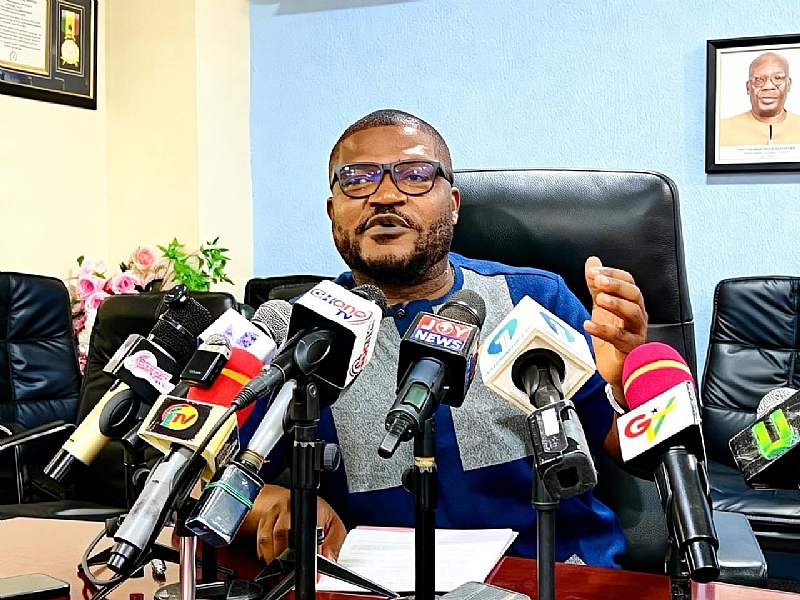
The warning was delivered by Isaac Tandoh in a keynote address at the China-Ghana Mining Cooperation Conference held at the Kempinski Hotel in Accra on Tuesday, November 10, 2026.
Addressing government officials, the Chinese Ambassador to Ghana, H.E. Cong Song, industry players, traditional leaders and other stakeholders, Mr Tandoh said illegal small-scale mining had become an existential threat to Ghana's environment, water bodies and national security.
He expressed concern that Chinese nationals had repeatedly been found at the centre of illegal mining operations, warning that such activities were undermining the integrity of the longstanding relationship between Ghana and China.
Mr Tandoh stressed that the Minerals and Mining Act, 2006 (Act 703), as amended, reserves small-scale mining licences exclusively for Ghanaian citizens.
He explained that foreigners who engage in small-scale mining commit an offence under Ghanaian law and could face imprisonment of between 20 and 25 years before being deported.
He further warned against the practice of 'fronting', where foreign individuals or companies allegedly use Ghanaian entities to acquire mineral rights illegally.
According to him, several Chinese nationals have been arrested during enforcement operations along major rivers, including the Birim and Tano, as part of efforts to clamp down on illegal mining activities.
New mining arrangement for foreign investors
As part of measures to provide legal alternatives to illegal mining, Mr Tandoh disclosed that the Commission had designated blocked-out areas to be allocated to law-abiding Ghanaian small-scale miners.
He also announced that provisions were being made in law for a medium-scale mining category that would allow Chinese and other foreign investors to co-own up to 40 per cent stakes in mining companies in partnership with their Ghanaian counterparts.
The proposed arrangement, he said, was intended to create opportunities for legitimate foreign participation in the mining industry while protecting Ghana's regulatory framework and ensuring that local interests were safeguarded.
China urged to sanction nationals involved in galamsey
Mr Tandoh called on the Chinese Government to treat illegal mining activities involving its nationals in Ghana as a bilateral enforcement priority.
He welcomed an emerging framework agreed at the 2026 China Mining Conference, under which Chinese nationals who violate Ghana's mining laws could face sanctions not only in Ghana but also through the Chinese authorities' own mechanisms for regulating their citizens operating abroad.
He urged both governments to operationalise the proposed dual-enforcement arrangement without delay, stressing that deportation should not become an escape route from accountability.
He also called for stronger cooperation to dismantle the financial, equipment supply and logistics networks that sustain illegal mining.
According to him, galamsey is an organised activity that requires financing, equipment and supply chains, some of which originate outside Ghana.
He therefore emphasised the importance of China's technological capabilities in helping Ghana trace and disrupt the networks behind illegal mining operations.
Mining association tasked with stronger oversight
The Minerals Commission also challenged the Association of China-Ghana Mining to go beyond promoting commercial interests and take an active role in ensuring compliance with Ghanaian mining regulations.
Mr Tandoh said the association must discourage and report illegal activities involving its members and other Chinese nationals operating in the country.
He maintained that a responsible industry association should expose unlawful practices rather than protect individuals involved in them.
He further assured legitimate investors that the Minerals Commission would continue enforcing Ghana's mining laws without fear or favour.
However, he stressed that enforcement alone could not build a sustainable mining industry, calling for Chinese investments that create decent employment opportunities for Ghanaians, protect the environment and support the country's local content objectives.
Six decades of Ghana-China relations
Touching on the historical relationship between the two countries, Mr Tandoh recalled that Ghana and China had maintained cordial diplomatic and economic relations for more than six decades.
He traced the relationship to the era of Ghana's first President, Dr Kwame Nkrumah, and Chinese leader Chairman Mao Zedong, whom he described as influential figures who stood together in the struggle against oppression.
He acknowledged the contribution of Chinese capital, technology and expertise to Ghana's mining industry, noting that the country's position as Africa's largest gold producer and the world's sixth-largest had been supported by significant investments.
He specifically cited major Chinese mining companies, including Zijin, Chifeng and Shandong, as important participants in Ghana's mining sector.
According to him, Zijin, which assumed ownership of the Akyem Mine about a year ago, had increased production by 20 per cent without expanding its workforce or upgrading infrastructure.
He also described Shandong Gold's Ghanaian operation as the best-performing mine within the company's global group.
Mr Tandoh said the Association of China-Ghana Mining provided an institutional platform for dialogue on responsible investment, regulatory compliance and sustainable development.
He nevertheless cautioned that the relationship must not be compromised by the activities of individuals who disregard Ghanaian laws.
He emphasised that Ghana valued its friendship with China but would not allow the conduct of a lawless minority to undermine the partnership or damage China's reputation as a responsible global investor.
He concluded that the future of Ghana-China mining cooperation must be built on mutual respect, accountability and shared prosperity.
"Illegal mining has no place in this partnership, and those who engage in it, whatever their nationality, must face the full weight of the law," he declared.
He added that Ghanaian communities expected a partnership that would bring prosperity rather than pollution, create legal livelihoods instead of criminal networks, and ensure that the country's mineral wealth benefited the people.
The Minerals Commission, he assured, remained committed to working with China and other legitimate investors to build a transparent, environmentally responsible and sustainable mining industry.


 Minerals Commission warns Chinese nationals against illegal mining, threatens 25...
 'Disingenuity and manipulation’ – Shamima Muslim takes on NPP over passport saga
 Economic gains not improving livelihoods of Ghanaians – Oppong Nkrumah
 Christian Council backs GoldBod objectives but demands independent oversight
 NDC's ‘New Economy’ is not different from the already new economy Ghanaians are ...
 Minority demands accountability for 24-Hour Economy before rollout of New Econom...
 EOCO, Lands Commission values Wontumi’s frozen Tema property
 Ghana Water Limited arrests 4,395 over alleged water theft
 Peki SHS final-year student dies after colleague pushed him to the wall during d...
 Ghana announces discovery of new oil and gas deposits


