




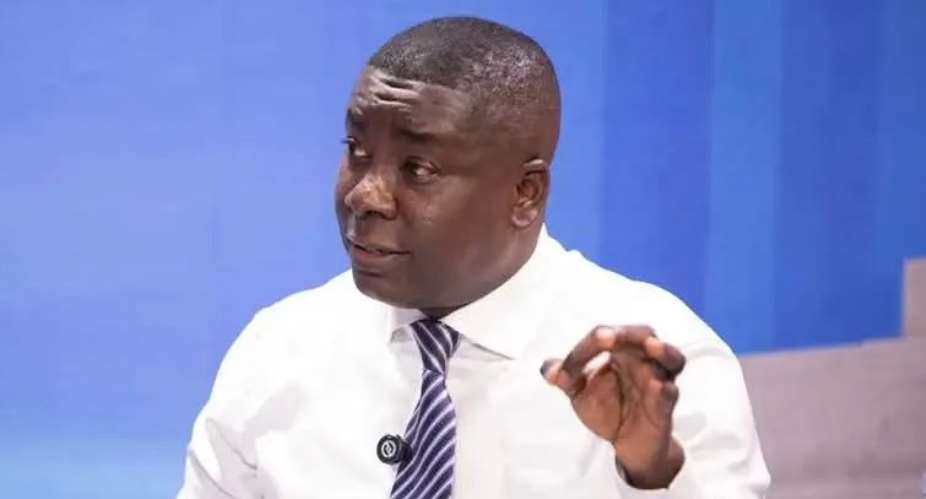
Deputy Ranking Member on Parliament’s Finance Committee and Member of Parliament for Tano North, Dr Gideon Boako, has questioned the relevance of Ghana’s latest inflation figure, arguing that the official rate does not adequately reflect the actual cost of living confronting households.
In a Facebook post titled "Paper vs. Pocket Economy," Dr Boako said that although the government had reported a decline in headline inflation to 5.5 per cent in October, from 5.2 per cent in September, the prices of essential goods and services continued to rise sharply, leaving many Ghanaians struggling to meet their daily needs.
Disconnect Between Statistics and Reality
Highlighting what he described as the disconnect between the country’s official inflation statistics and the economic realities of ordinary citizens, the MP said inflation figures should be assessed against the prices consumers actually pay for food, transportation and accommodation.
“Inflation only becomes meaningful when it has little to no misalignment with actual prices on the market,” he stated.
According to Dr Boako, several essential expenditure categories recorded considerably higher inflation rates in October, raising questions about how much relief the reported headline figure had translated into for households.
He cited transport inflation at 14.1 per cent, while housing, water, electricity and gas recorded 10.5 per cent. Services inflation, he added, stood at 11.5 per cent.
Rising Prices of Essential Goods
The Tano North MP also drew attention to sharp increases in the prices of selected food items and transportation services, pointing to fresh tomatoes, which recorded a year-on-year inflation rate of 119.3 per cent.
Other commodities and services he identified included ginger, which recorded 88.2 per cent inflation; kontomire/Alefu at 44.5 per cent; fresh coconut at 30.9 per cent; and taxi fares at 30.2 per cent.
Dr Boako further argued that rent, trotro fares and tomatoes collectively accounted for 37.2 per cent of all inflation in October, underscoring the significant impact of these essential expenditure items on household budgets.
‘Personal Inflation Is Around 37%’
He maintained that the relatively low headline inflation figure could create an impression of improving economic conditions without adequately capturing the financial pressures faced by people who spend a substantial portion of their incomes on basic necessities.
“So yes, headline inflation may be less than the lower band of 6% on paper, but if you pay rent, take trotro, and buy tomatoes, your personal inflation is around 37%,” he said.
Dr Boako stressed that the economic experiences of ordinary Ghanaians should be central to the assessment of the country’s economic performance, rather than relying exclusively on aggregate statistical indicators.
“Our people do not buy inflation on paper. They buy food in the market. They pay trotro fare. They pay rent,” he stated.
Call for People-Centred Economic Policies
The MP called for economic policies that translate into tangible improvements in the purchasing power and living conditions of citizens, insisting that official economic statistics must reflect the realities of the marketplace.
“Until the official numbers match what Ghanaians actually pay, the numbers will remain just numbers on paper,” he added.
Dr Boako urged policymakers to prioritise interventions that ease the cost of essential goods and services, arguing that the ultimate measure of economic recovery should be the relief households experience in their pockets.
“Let us make policy that people can feel in their pockets, not just read in a report,” he said.
 Ghana Must Reset — Not Just In Words, But In Deeds!
 OSP must publish findings on alleged sale of diplomatic passports – Larry Dogbe
 2027 Budget: 'Adwuma no wɔ he?’ – Sammi Awuku demands answers on Mahama's youth ...
 SA evacuation: OSP must punish those who took hotel money while evacuees slept i...
 Ghana, Slovakia consider visa waiver deal for diplomatic, service passport holde...
 World Cup visa scandal: OSP must not end at announcement of probe – Ekow Assafua...
 SA evacuation: I’m convinced OSP will find nothing untoward after probe – Batagl...
 'If by close of today Erastus Asare Donkor fails to come and apology we will cur...
 SA Evacuation: If Ablakwa wanted Ibrahim Mahama’s GH¢16m, he wouldn’t make it pu...
 Ato Forson explains why gov’t won’t borrow to finance New Economy Programme


