




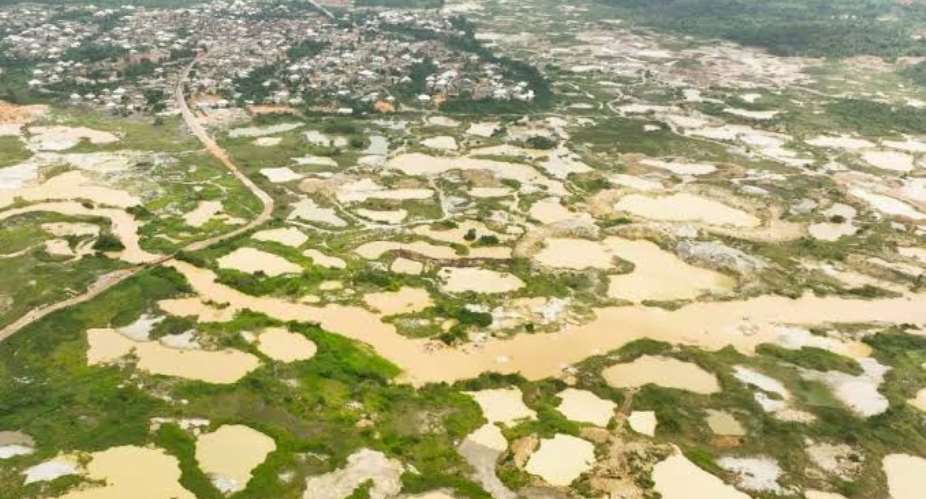
Satellite images published on the citizen-led monitoring platform, Galamsey Tracker, have revealed disturbing changes to the landscape around Adadientam in Abuakwa South and Saamang in Fanteakwa South, raising fresh concerns about mining activities, environmental degradation and the effectiveness of regulatory enforcement.
At Adadientam, satellite images taken on January 25 and October 22, 2026, show substantial changes to the surrounding vegetation and landscape. According to the platform, approximately 34 hectares of land were cleared within a one-kilometre radius of the monitored location.
The affected area is labelled as having no mining licence, with the platform identifying the observed disturbance as likely galamsey activity.
A similar situation has been documented at Saamang in Fanteakwa South, where satellite images comparing February 4, 2025, with October 2, 2026, indicate that approximately 34 hectares of land were cleared within one kilometre of the monitored location.
However, the Saamang site carries a different classification. Galamsey Tracker identifies it as falling within a large-scale mining lease, highlighting the importance of distinguishing between illegal mining, legally authorised operations and activities that may violate environmental conditions.
The images raise serious questions about the pace of land degradation and the effectiveness of environmental monitoring in Ghana’s mining communities.
Mining-related land clearing can destroy vegetation, expose fertile soils to erosion, disrupt agricultural activities and increase sediment entering nearby streams and rivers. Where hazardous chemicals are improperly handled, mining can also introduce contaminants into water bodies, threatening aquatic ecosystems and public health.
For communities that depend on farming, fishing and natural water sources, the consequences can be devastating. Once productive land is degraded, restoring it to agricultural use may require substantial investment and many years of rehabilitation.
The situation is particularly worrying because the Eastern Region contains important agricultural communities, forest ecosystems and river catchments that contribute to Ghana’s food production and water security.
Although satellite images can reveal land clearing and changes in vegetation, they cannot independently establish whether every affected area was mined illegally or whether hazardous chemicals were discharged. Such conclusions require verification of mining licences, environmental permits and field investigations.
Nevertheless, the evidence presented by Galamsey Tracker reinforces the urgent need for greater transparency and accountability in Ghana’s mining sector.
The Minerals Commission, Environmental Protection Authority, district assemblies and other responsible institutions must strengthen surveillance of mining operations, investigate suspicious land disturbances and ensure that companies and individuals comply with environmental regulations.
Authorities should also publish accessible information on mining concessions, environmental permits, reclamation obligations and enforcement actions to enable communities to distinguish legitimate operations from illegal activities.
Importantly, environmental protection must not end with the arrest of illegal miners. Degraded lands must be reclaimed, polluted water sources restored where feasible, and affected communities supported with sustainable livelihood opportunities.
Ghana cannot continue to sacrifice its forests, farmlands and water resources in pursuit of gold without considering the long-term consequences.
The satellite images from Adadientam and Saamang should serve as another warning that environmental destruction is not an abstract national problem. It is occurring within identifiable communities, affecting real landscapes and potentially threatening the livelihoods of present and future generations.
The question is no longer whether Ghana has sufficient evidence of mining-related environmental degradation. The more pressing question is whether the country's institutions are prepared to respond with the urgency, fairness and determination the situation demands.
Gold can be extracted and sold, but destroyed forests, polluted rivers and degraded farmlands cannot always be restored. Ghana must act before the environmental cost becomes irreversible.


 Mother invokes generational curse on daughter during heated verbal exchange
 SA evacuation: OSP must not allow media pressure to dictate investigations – Bra...
 NPP closes portal for expression of intent in parliamentary primaries today
 Ghana targets 70% 5G coverage by March 2027 – Sam George
 Women’s Development Bank submits licence application to Bank of Ghana – Vice Pre...
 Ghana Must Reset — Not Just In Words, But In Deeds!
 OSP must publish findings on alleged sale of diplomatic passports – Larry Dogbe
 2027 Budget: 'Adwuma no wɔ he?’ – Sammi Awuku demands answers on Mahama's youth ...
 SA evacuation: OSP must punish those who took hotel money while evacuees slept i...
 Ghana, Slovakia consider visa waiver deal for diplomatic, service passport holde...


