




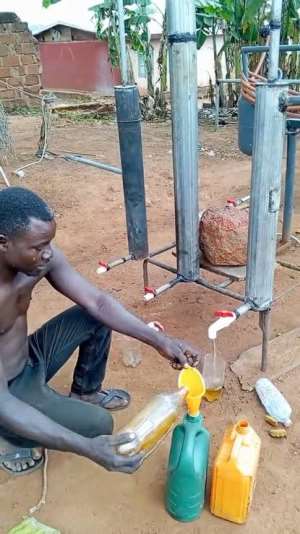
A young Ghanaian innovator from Asesewa in the Eastern Region has attracted national attention after a viral social media video showcased his attempt to convert discarded plastic waste into fuel. His initiative highlights the creativity and potential of Ghana's youth in addressing environmental pollution while exploring alternative energy solutions.
The innovation reportedly prompted a visit by officials of the National Petroleum Authority (NPA), led by the Eastern Regional Director, Mr. Salifu S. Nagumsi, and his technical team. During the visit, preliminary tests were conducted on samples of petrol and diesel reportedly produced by the innovator.
According to the account, the initial results indicated that the fuel samples did not meet Ghana's required automotive fuel standards. However, the NPA reportedly acknowledged the young man's ingenuity and collected additional samples for further laboratory analysis.
The technology behind the innovation, known as pyrolysis, involves heating suitable plastic materials in the absence of oxygen to break them down into liquid hydrocarbons, gases and other products. Although the process can produce combustible liquids, these products generally require further refining, purification and quality testing before they can be considered suitable for vehicle engines.
The development comes at a time when Ghana continues to struggle with plastic pollution. The country generates substantial quantities of plastic waste annually, much of which ends up in drains, waterways, landfills and the environment. Technologies that convert difficult-to-recycle plastics into useful industrial products could therefore contribute to improved waste management and economic development.
However, converting plastic into fuel is not without challenges. Poorly processed pyrolysis oil may contain contaminants and unstable compounds that can damage engines, increase harmful emissions and pose safety risks. Environmental safeguards, appropriate technology and regulatory compliance are therefore essential.
The Asesewa initiative also raises important questions about Ghana's commitment to supporting indigenous innovation. Across the country, talented individuals are developing promising technologies but often lack the financial resources, scientific expertise and institutional support needed to transform their inventions into commercially viable products.
Institutions such as the Council for Scientific and Industrial Research (CSIR), Kwame Nkrumah University of Science and Technology (KNUST), technical universities and relevant government agencies should consider providing technical mentorship, laboratory support and research partnerships to promising local innovators.
Rather than allowing such inventions to disappear after attracting social media attention, Ghana must establish practical mechanisms for identifying, supporting and commercialising grassroots innovations.
The reported intervention by the NPA offers a potentially constructive example of how regulatory institutions can encourage creativity while protecting public safety and maintaining product standards.
The Asesewa innovator should not be discouraged because his initial products reportedly failed to meet automotive fuel specifications. Instead, the findings should provide an opportunity for further research, technological improvement and exploration of suitable industrial applications.
Ghana's industrial transformation will depend not only on foreign investment and imported technologies but also on its ability to nurture local talent, strengthen research and development, and turn innovative ideas into productive enterprises.
The lesson from Asesewa is clear: innovation must be encouraged, science must guide its development, and regulation must ensure public safety.
Ghana must move beyond celebrating inventors on social media and begin investing in the systems that can transform their creativity into sustainable industries, employment opportunities and national development.


 Mother invokes generational curse on daughter during heated verbal exchange
 SA evacuation: OSP must not allow media pressure to dictate investigations – Bra...
 NPP closes portal for expression of intent in parliamentary primaries today
 Ghana targets 70% 5G coverage by March 2027 – Sam George
 Women’s Development Bank submits licence application to Bank of Ghana – Vice Pre...
 Ghana Must Reset — Not Just In Words, But In Deeds!
 OSP must publish findings on alleged sale of diplomatic passports – Larry Dogbe
 2027 Budget: 'Adwuma no wɔ he?’ – Sammi Awuku demands answers on Mahama's youth ...
 SA evacuation: OSP must punish those who took hotel money while evacuees slept i...
 Ghana, Slovakia consider visa waiver deal for diplomatic, service passport holde...


