




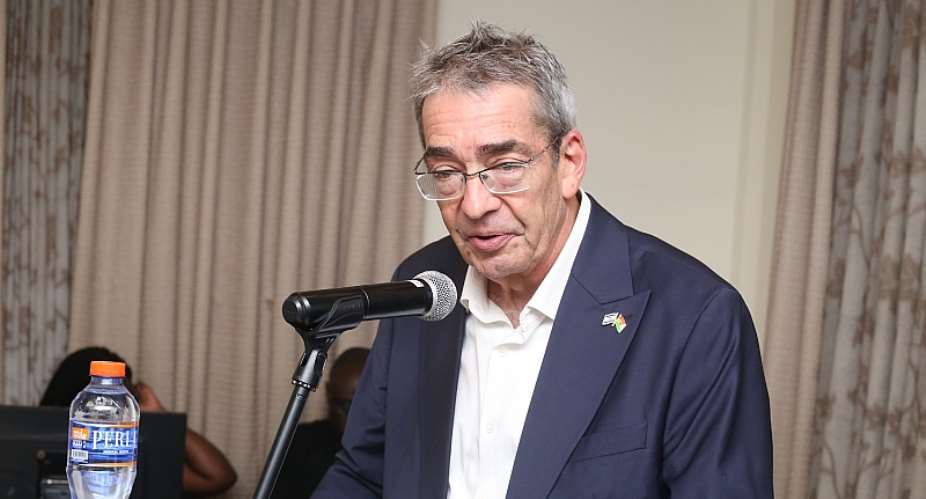
Israeli envoy insists planned withdrawal of $4bn annual American assistance will not weaken his country’s military superiority, warning Tehran and its regional allies against underestimating the Israel Defence Forces.
Israel believes it has the military muscle, technological sophistication and skilled personnel to safeguard its national security without relying on billions of dollars in annual American military aid, Ambassador Roey Gilad has said.
He insists that the anticipated withdrawal of approximately $4 billion in annual US military assistance should not be interpreted as a weakening of Israel’s defence posture or an opportunity for its regional adversaries to test its military strength.
In an interview, Mr. Gilad said President Donald Trump’s announcement, made against the backdrop of discussions with Israeli Prime Minister Benjamin Netanyahu, had been coordinated with Israel and reflected the country’s growing economic and military maturity.
“The bilateral understanding is reflecting of the maturity and the strength of Israel”, he said.
He argued that Israel had reached a stage in its national development where it could independently defend its sovereignty and territorial integrity without relying on American financial support to sustain its military capabilities.
“Israel was and is still the only Middle East state who can defend itself without leaning on the US”, he declared.
The ambassador’s comments come amid renewed international attention following Mr. Trump’s announcement that Washington intends to end its approximately $4 billion annual military assistance to Israel by the end of 2026.
However, the announcement raises questions about the practical arrangements for ending the assistance, given that the existing 10-year US-Israel security assistance memorandum provides approximately $3.8 billion annually through September 2028. The precise mechanism and timetable for an earlier termination remain matters requiring clarification.
For Israel, the more immediate concern is whether reduced American financial assistance could affect its ability to maintain military superiority in an increasingly volatile Middle East.
Mr. Gilad dismissed such concerns, maintaining that Israel possesses the military strength and technological sophistication to confront threats from Iran and its network of regional allies.
On Tehran’s nuclear ambitions, he stressed that Israel was not abandoning its strategic partnership with Washington, particularly on preventing Iran from acquiring nuclear weapons for military purposes.
“Facing the Iranian challenge, we are still coordinate with our strategic ally, the US. We are both committed to put an end to the Iranian nuclear military ambitions”, he said.
He was equally confident about Israel’s ability to contain Iranian-backed armed groups operating across the region.
“As for the Iranian proxies in the Middle East, I believe we are strong enough to meet their challenge successfully”, he added.
His remarks suggest that Jerusalem views the anticipated reduction in military assistance not as an abandonment of its strategic relationship with Washington but as an opportunity to demonstrate greater defence independence while retaining cooperation on shared security priorities.
The ambassador was particularly dismissive of suggestions that the withdrawal could embolden Israel’s adversaries or fundamentally alter the regional balance of power.
“I believe that the American withdrawal of military support will have no effect”, he said.
“Our enemies are well aware of the IDF’s military might and of our superior technological and human capabilities”.
The assertion reflects Israel’s longstanding emphasis on maintaining qualitative military superiority over potential adversaries through advanced weapons systems, intelligence capabilities, technological innovation and highly trained personnel.
Mr. Gilad also sought to draw a distinction between Israel’s defence requirements and the military manpower strategies of other countries.
“Unlike Russia, Israel can lean on its own forces and do not need to recruit Africans in general and Ghanaians in particular to fight their wars”, he said.
He maintained that Israel’s ability to defend itself was among the most significant achievements since its independence.
“We are proud of what we’ve achieved since our independence including the ability to defend ourselves”, he added.
Beyond the immediate implications for military financing, the ambassador’s position underscores Israel’s determination to preserve its strategic autonomy without sacrificing its relationship with its most important international security partner.
American military assistance has historically played a significant role in financing Israeli weapons acquisitions and supporting its missile-defence architecture. Nevertheless, the anticipated transition could create opportunities for greater investment in domestic defence production and technological development.
Whether Israel can completely replace the financial and industrial advantages associated with American assistance remains an important question.
For now, Mr. Gilad’s message to Israel’s adversaries is unmistakable: the country’s military strength, he believes, is not dependent on an annual American financial commitment.
The real test will be whether Israel can translate that confidence into sustainable defence independence while navigating the increasingly complex security challenges confronting the Middle East.

 Attorney General opposes Wontumi's bid to recall prosecution witness in illegal ...
 New Heritage Cedis feature enhanced security, improved durability against counte...
 Franklin Cudjoe describes cocaine trafficking cases as national disaster; demand...
 Speaker Bagbin forwards AKSA Energy bribery deal review report to Special Prosec...
 Cabinet approves establishment of Ghana Space Agency
 God is not 'wicked' to let NPP come back to power again - Cape Coast Mayor
 China accuses US of 'fabricating' Nvidia spy claims to push tech 'blockade'
 Nvidia board weighs ouster of CEO Jensen Huang amid spy scandal
 Ghana Immigration Service introduces six-month rotational transfers for officers


