




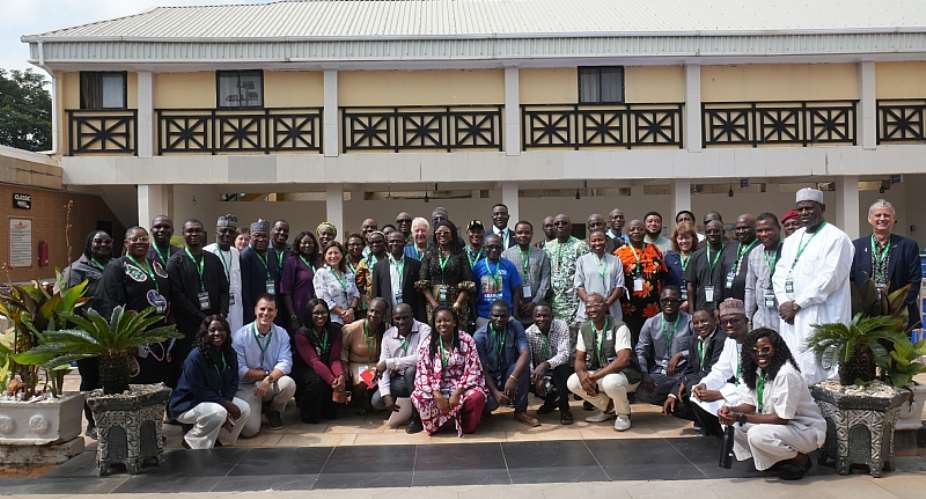
ABUJA, NIGERIA, NOVEMBER 2026: West African nations have closed a three-day regional workshop in Abuja with a renewed and collective commitment to move vulture conservation from plans on paper to concrete action on the ground, warning that the region can no longer afford another decade of decline.
The workshop on Strengthening Coordination and Implementation for West Africa Vulture Conservation, 3rd to 5th November 2026, brought together government wildlife authorities, conservation organisations, technical experts, representatives of belief-based and traditional institutions, and community leaders from across the West African sub-region.
The workshop was hosted and organised by the Federal Ministry of Environment, the Nigerian Conservation Foundation (NCF), the A.P Leventis Ornithological Research Institute, BirdLife International, Royal Society for the Protection of Birds (RSPB), the Convention on Migratory Species (CMS) and other conservation partners to review progress, share lessons, and agree on how the West African Vulture Conservation Action Plan (WAVCAP) 2023-2043 will be delivered, monitored and funded.
Participants came from 12 WAVCAP range states: Benin, Burkina Faso, Chad, Ghana, Guinea-Bissau, Liberia, Mali, Niger, Nigeria, Senegal, Sierra Leone, and Togo. Several of the delegates were among those who developed the initial WAVCAP strategy in Abuja in 2022, returning four years later to assess what worked, what changed and the challenges faced.
For decades, vultures have silently performed an irreplaceable ecosystem service. They are nature’s most efficient sanitation system, cleaning up carcasses, maintaining ecological balance and limiting the transmission of diseases like anthrax and rabies, and saving governments millions in waste management costs. Yet across West Africa, this vital service is collapsing. In the last 30 years, the region has lost over 80 percent of its vulture populations, driven by poisoning, both intentional and accidental, habitat loss, electrocution on power lines, and unsustainable use in belief-based practices.
Dr. Joseph Onoja, Director-General of the Nigerian Conservation Foundation (NCF), said Nigeria has lost about 95 percent of its vulture population over the past 15 to 20 years. “If we had 100 vultures 15 or 20 years ago, 95 percent of them have been killed. Only five per cent are remaining,” Onoja said. He warned that poisoning, illegal trade and habitat destruction were pushing the birds towards extinction, noting that while available observations indicated a significant decline, Nigeria had not conducted a recent nationwide census to establish the exact number of vultures remaining.
Fadzai Matsvimbo, Preventing Extinction Programme Coordinator for Africa at BirdLife International, described vultures as nature’s cleanup crew, saying they played an essential role in maintaining healthy ecosystems, particularly in Africa, which is home to 11 vulture species, six of which were on the brink of extinction because of rapid population declines in recent decades. According to Matsvimbo, poisoning accounts for more than 60 per cent of vulture deaths, while belief-based use contributed nearly 30 per cent. Her message echoed throughout the workshop: the loss of vultures is not just a wildlife tragedy, it is a public health, economic and cultural crisis.
Wenceslas Gatarabirwa, the representative of the Royal Society for the Protection of Birds (RSPB), emphasised the role of local communities in vulture conservation. He called for grassroots awareness campaigns targeting young people, mothers, community leaders and other influential groups to challenge harmful beliefs and encourage the protection of remaining vulture populations.
Lessons Learned: What the Region Now Knows
After three days of frank stock-taking, participants agreed on five lessons: coordination is as vital as conservation itself, without a common mechanism and reporting system national efforts remain fragmented; belief-based use must be tackled at its source through engagement with healers, faith leaders, youth and communities, and culturally respectful alternatives; poisoning is the biggest yet most preventable killer, demanding anti-poisoning protocols and stronger regulation; data gaps are costing vultures their lives, as the lack of censuses makes success hard to measure or fund; and communities must be partners, not bystanders, because conservation succeeds where they benefit and are recognised as custodians.
Renewed Commitments: The Abuja Consensus
At the close of the workshop, participating countries adopted a set of renewed commitments, collectively known as the Abuja Consensus for Vulture Conservation, committing to fully implement WAVCAP at the national level by domesticating its actions into national work plans, budgets and wildlife policies; established a Regional Delivery Group with clear roles, responsibilities and a rotating coordination structure starting from Nigeria, to ensure accountability beyond Abuja. Participants agreed that future WAVCAP projects must be community-led, culturally sensitive, and designed with local ownership from the start.
A Call to Action
The message from Abuja is clear: West Africa’s vultures are running out of time, but the region is now uniting to give them a future. Participants called on governments to increase domestic funding for vulture conservation, on donors and international funds to urgently support the bankable projects emerging from the workshop, on traditional and faith leaders to help end the demand for vulture parts, and on citizens to report poisoning and illegal trade, and to protect the birds in their communities. The workshop closed with a shared resolve that by 2028, the region will not just have a plan, but will have measurable results: fewer poisonings, stronger laws enforced, safer habitats, and communities standing as the first line of defence for vultures.

 'Funny' NPP recruited 'goro boy' Alhassan Sumani as Ministry staff to perpetuate...
 Fraudsters impersonate TraffiTech-GH to steal motorists’ banking details – CSA c...
 Ablakwa cannot be blamed for alleged passport irregularities – Dzimega
 NPP bigwigs quietly visiting EOCO, CID daily over ORAL cases – Kabila
 Ablakwa has no supernatural powers to stop public servants from committing crime...
 Police to arrest motorists with tinted glass, unlicensed driving and other offen...
 TrafficTech operators accused of dubious tactics to capture motorists for speedi...
 How two Level 300 University students drown in a week
 Passport scandal: Retract or I’ll sue you – Pendilock warns Kabila
 I won and I have been reinstated – Pendilock speaks on Foreign Affairs Ministry ...


