




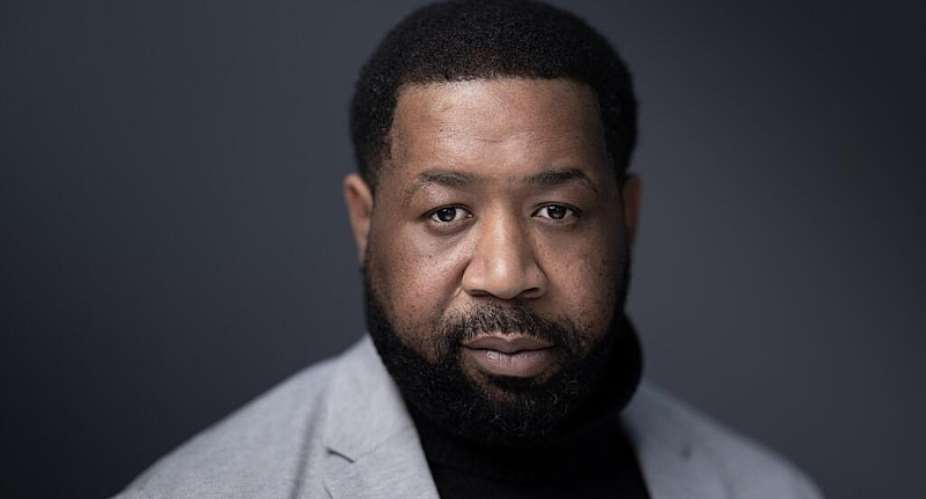
On 21 November 2020, France was under its second Covid-19 lockdown when police stopped Zecler outside his Paris studio, accusing him of failing to wear a mandatory face mask and suspecting him of cannabis use.
The officers pushed him into the entrance of his studio and violently beat him in an assault captured by security cameras.
Over approximately five minutes, Zecler suffered around 30 punches and truncheon blows to the face and body, according to the investigation.
A medical report documented injuries to his head and face, wounds to his lip and scalp, and a ruptured biceps tendon, leaving him unable to work for 45 days.
In their arrest report, the police claimed Zecler had struck them and attempted to seize a truncheon – an account contradicted by security footage released several days later by French media outlet Loopsider.
Footage 'saved my life'
"I don't understand the hatred I saw in their eyes," said Zecler, who has a titanium anchor in his left arm following the assault and says he still suffers nightmares.
"Without this video, I'd be the one in prison. It saved my life," he told RFI.
The case prompted widespread condemnation, with President Emmanuel Macron describing the assault as "unacceptable" and "shameful".
The government subsequently launched a six-month consultation on policing, bringing together police unions to discuss relations with the public, surveillance and training.
France denies police racism is widespread, but evidence tells another story
But Zecler believes little has changed.
"I'm not about to lump all police officers together, but I no longer believe in the idea of just a few 'bad apples'," he told RFI.
"I think there's a problem with this institution, which categorically refuses to acknowledge that some of its members might make mistakes."
Zecler, who says officers subjected him to racist abuse during the attack, maintains that he was targeted because of his skin colour.
However, investigating judges did not retain a racial motivation in the case, citing insufficient evidence.
Confronted with the footage, the three officers eventually acknowledged using excessive force, with one admitting to "unsportsmanlike gestures", another to "unjustified" force and the third to "illegitimate" force.
According to the indictment, they attributed their actions to "panic" during what they described as a particularly difficult intervention.
Podcast: A deeper look at urban and police violence in France's banlieues
They claimed to have felt trapped in the narrow entrance and to have heard threats from young people in the studio's basement who were attempting to help Zecler.
"The police only acknowledged what the footage proved; my cameras should have been equipped with microphones too," Zecler said.
Six years later, the 47-year-old producer says the physical and psychological consequences remain profound.
"I hope this trial will allow me to turn the page. This attack has had serious consequences for me, both personally and professionally, to this day," he said.
"I'm still furious. I'm angry about what these people did to me, I'm angry because they represent an institution they didn't respect. A police officer must be beyond reproach."
Zecler hopes for "a sentence commensurate with the seriousness of the acts", including both the violence and what he describes as lies in the official police report.
The three officers – Aurélien B., 29, Pierre P., 37, and Philippe T. – face charges of intentional violence committed as a group and falsifying an official report to conceal their actions.
They face up to 15 years in prison. Their lawyers declined to comment ahead of the trial which is expected to wrap up on 20 November.
Wider concerns over police discrimination
The Zecler case reignited debate in France over police brutality and racial discrimination – practices that victims and researchers describe as systemic, but which authorities and police unions largely attribute to isolated incidents.
Few allegations of police brutality reach criminal courts, with many cases handled through internal disciplinary procedures. Convictions remain rare.
The controversy comes amid continuing concerns over discriminatory identity checks.
According to a report published last year by France's independent rights watchdog, the Défenseur des droits, young men perceived as Arab, black or North African are four times more likely to be stopped by police than the rest of the population.
They are also 12 times more likely to face more intrusive measures, including searches, according to the report, which surveyed more than 5,000 people.

 'Funny' NPP recruited 'goro boy' Alhassan Sumani as Ministry staff to perpetuate...
 Fraudsters impersonate TraffiTech-GH to steal motorists’ banking details – CSA c...
 Ablakwa cannot be blamed for alleged passport irregularities – Dzimega
 NPP bigwigs quietly visiting EOCO, CID daily over ORAL cases – Kabila
 Ablakwa has no supernatural powers to stop public servants from committing crime...
 Police to arrest motorists with tinted glass, unlicensed driving and other offen...
 TrafficTech operators accused of dubious tactics to capture motorists for speedi...
 How two Level 300 University students drown in a week
 Passport scandal: Retract or I’ll sue you – Pendilock warns Kabila
 I won and I have been reinstated – Pendilock speaks on Foreign Affairs Ministry ...


