




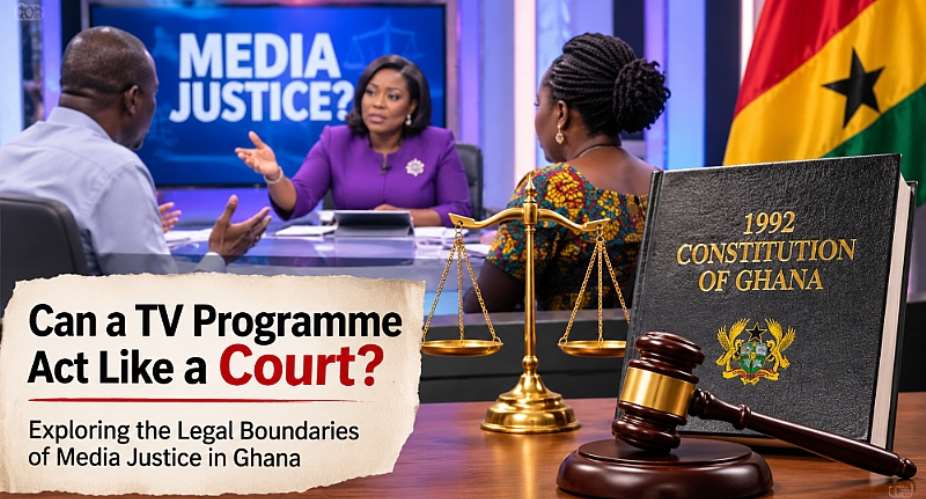
In Ghana, one does not necessarily need to enter a courtroom to witness what looks remarkably like a judicial proceeding.
A television studio, a presiding personality, a collection of aggrieved individuals and an audience eager for justice may be all that is required.
From marital disagreements to family property disputes, television programmes have increasingly assumed a role that appears to extend beyond entertainment.
Yet, beneath their entertainment and social appeal lies a fundamental constitutional question: Can a privately operated media programme legitimately assume the functions of a court or other legally recognised adjudicatory institution in Ghana?
This question is not an attempt to disregard the contribution of media-based dispute resolution to society.
Rather, it invites a closer examination of the legal boundaries within which such programmes must operate.
The distinction between facilitating reconciliation and exercising adjudicatory authority is one that deserves serious attention, particularly in a constitutional democracy governed by the rule of law.
The starting point of this discussion is the 1992 Constitution of Ghana. Article 125(1) provides that justice emanates from the people and shall be administered in the name of the Republic by the Judiciary, which shall be independent and subject only to the Constitution.
Article 125(3) further provides that judicial power shall be vested in the Judiciary and that neither the President nor Parliament nor any organ or agency of the President or Parliament shall have or be given final judicial power.
Article 126(1) identifies the courts and tribunals that constitute the Judiciary, including such lower courts or tribunals as Parliament may establish by law.
These provisions establish the constitutional framework for the administration of justice in Ghana. They make clear that judicial authority is not a title that an individual may assume simply because members of the public regard that individual as influential, knowledgeable or capable of settling disagreements.
The authority to exercise judicial power must have a recognised constitutional or statutory foundation.
However, it would be legally inaccurate to suggest that every form of dispute resolution outside the conventional courts is unconstitutional.
Article 125(2) itself recognises popular participation in the administration of justice through public and customary tribunals, as well as the jury and assessor systems. Furthermore, Ghana has expressly recognised alternative dispute resolution as a legitimate means of settling disputes.
The relevant legislation is the Alternative Dispute Resolution Act, 2010 (Act 798), which provides for arbitration, mediation and customary arbitration.
The distinction between these processes is particularly important when examining the activities of programmes such as Oyerepa Afutuo. Under Act 798, mediation is a non-binding process in which parties discuss their dispute with the assistance of an impartial person who facilitates a resolution.
Section 63 provides for the submission of disputes to mediation through an institution or person agreed upon by the parties. Significantly, mediation proceedings commence upon the acceptance of the invitation by the other party.
The law therefore places considerable importance on consent. There have been situations where parties to such disputes are even threatened with having their pictures displayed on TV if they refuse to pick up calls from the media adjudicator; this is found to be very unwarranted.
This means that a television presenter may legitimately facilitate dialogue between two individuals who voluntarily agree to participate in a dispute-resolution programme.
Where the presenter listens to both parties, encourages constructive discussion and assists them in reaching a mutually acceptable settlement, the activity may properly be understood as mediation. There is nothing inherently unlawful about a media organisation providing such a platform.
The difficulty arises when the presenter moves beyond facilitating settlement and assumes the authority to determine the legal rights and obligations of the parties.
A mediator is not a judge. The function of a mediator is to assist parties to reach their own resolution, not to impose a decision upon them. Consequently, a television host who declares one party legally responsible, orders the surrender of property or purports to impose compensation without an appropriate legal foundation raises questions that cannot be answered merely by referring to the popularity of the programme.
A further question arises as to whether such programmes can operate as customary arbitration. This is particularly relevant because some media-based dispute-resolution programmes adopt procedures resembling traditional dispute settlement before chiefs, elders and family heads.
Ghanaian law recognises customary arbitration as a legitimate method of dispute resolution. Part Three of Act 798 regulates this process. Section 89 provides for the submission of disputes to customary arbitration but expressly excludes criminal matters, subject to the statutory qualification. Section 90 addresses the agreement to submit to customary arbitration, while section 92 identifies the qualifications of a customary arbitrator. Section 93 requires the application of natural justice and fairness in customary arbitration proceedings.
The Supreme Court’s decision in Dzasimatu and Others v Dokosi and Others [1993–94] 1 GLR 463 provides useful guidance on the requirements of a valid customary arbitration. The Court emphasised voluntary submission of the dispute, agreement by the parties to be bound by the outcome, observance of natural justice, the arbitrator acting within jurisdiction and publication of the award.
Similarly, in Budu II v Caesar [1959] GLR 410, Ollennu J explained the essential characteristics of customary arbitration, including voluntary submission, prior agreement to accept the award and publication of the decision. The judgment also emphasised that arbitration must involve a hearing of both sides and cannot amount to an arbitrary pronouncement.
These authorities expose an important legal distinction. The fact that a programme has a host, a panel of elders and a procedure resembling a traditional palace does not automatically make its proceedings customary arbitration. The legal character of the process depends on whether the applicable requirements have been satisfied.
Indeed, sections 109 and 111 of Act 798 attach significant legal consequences to a valid customary arbitration award. Such an award is binding between the parties and may be enforced in the same manner as a court judgment. Section 112 also provides grounds upon which an aggrieved party may apply to have an award set aside, including breach of natural justice, miscarriage of justice and inconsistency with the known customs of the relevant area.
It would therefore be dangerous to assume that every decision announced on television carries the legal consequences of a customary arbitration award. A presenter cannot acquire the authority of a customary arbitrator merely by adopting the language, appearance or procedures associated with traditional dispute settlement.
Perhaps the most direct illustration of these concerns is the intervention of the National Media Commission in November 2023 concerning Oyerepa FM/TV. The Commission considered a complaint brought by Daniel Gyapanin, head of the Denkyira Agona Kwadwom Abusua of the Jukwa family, following comments made during a programme concerning a dispute over a missing dead body at a mortuary.
According to the Commission’s determination, the station had erred when participants on the programme assumed the role of judges in pronouncing on a family matter. The Commission directed that the station had no authority to compel individuals to appear on its programmes, whether live or recorded. It further emphasised that consent should be obtained from all parties before a programme concerning their dispute is broadcast and that the programme should be discontinued where a party declines participation.
The Commission also acknowledged the programme’s entertainment value and its contribution to resolving certain disputes. Nevertheless, it stressed that no law obliges individuals to submit themselves to the authority of the programme host.
This determination is particularly significant because it addresses the precise legal and ethical concerns surrounding media-based adjudication. It is important, however, to appreciate that the Commission’s determination was a media-regulatory intervention and not a judgment of the Supreme Court declaring the programme unconstitutional.
The constitutional foundation of the Commission’s intervention is found in Articles 166 and 167 of the 1992 Constitution. Article 167 mandates the National Media Commission to promote the freedom and independence of the media, ensure the maintenance of high journalistic standards and investigate, mediate and settle complaints made against or by the press and other mass media.
The Commission’s intervention therefore reinforces the principle that media freedom must be exercised responsibly. Article 162 guarantees freedom and independence of the media, but that guarantee does not create an unrestricted licence to violate the rights of individuals or disregard the rule of law. Article 164 expressly recognises that media freedom is subject to laws reasonably required to protect the reputations, rights and freedoms of others.
This brings the discussion to the principle of natural justice. Although the constitutional requirements governing administrative bodies under Article 23 do not automatically apply to every privately operated television programme, the principles of fairness remain fundamental to any process claiming to constitute a legally recognised arbitration.
The two familiar principles are audi alteram partem, which requires that the other side be heard, and nemo judex in causa sua, which requires impartiality in adjudication. Their importance in customary arbitration is reinforced by section 93 of Act 798.
A programme that allows one party to make allegations against another, reaches conclusions without hearing the other side or permits panel members to pronounce judgment on disputed facts risks undermining these principles. The refusal of an individual to participate cannot, by itself, establish liability or constitute proof of wrongdoing.
There is also the question of reputational harm. Publicly accusing individuals of theft, fraud, adultery, dishonesty or other misconduct without adequate justification may expose those responsible for the publication to civil defamation claims. The fact that a statement is made during a popular social programme does not automatically protect its publisher from legal consequences.
Similarly, Article 18(2) of the Constitution protects the privacy of individuals, subject to its constitutional qualifications. Family disagreements, marital difficulties, financial matters and other personal circumstances may involve information that individuals would ordinarily wish to keep private. The desire to resolve a disagreement should not automatically be interpreted as consent to unrestricted public disclosure of sensitive personal information.
Another important distinction concerns criminal allegations. Section 89(2) of Act 798 expressly excludes criminal matters from customary arbitration, subject to the statutory qualification. Accordingly, allegations involving theft, assault, fraud and other criminal offences should not be treated as matters that a television panel can finally determine. Media programmes may discuss the social implications of such allegations, but the investigation and determination of criminal responsibility belong to the institutions legally authorised to perform those functions.
It would nevertheless be unfair to overlook the social value of programmes such as Oyerepa Afutuo. For many individuals, the formal justice system can be expensive, intimidating and time-consuming. Media platforms may provide an accessible opportunity for reconciliation, particularly in family and community disputes where restoring relationships is often more important to the parties than obtaining a formal judgment.
The challenge, therefore, is not necessarily to prohibit such programmes but to establish a clearer understanding of their legal boundaries. Media organisations that facilitate dispute resolution should obtain the informed consent of participants, distinguish clearly between mediation and adjudication, respect confidentiality where appropriate and avoid presenting their conclusions as legally binding judgments. Presenters who regularly undertake mediation-like functions should also receive appropriate training in impartiality, natural justice and dispute-resolution principles.
Where disputes involve criminal allegations, complex property rights or matters already pending before a court, appropriate referral mechanisms should be encouraged. The media should complement the administration of justice rather than create an alternative institution claiming authority over it.
Ultimately, the question is not whether Auntie Naa or any other media personality should be permitted to help Ghanaians resolve their disagreements. The more important question is the source and extent of the authority under which that assistance is provided. Ghanaian law permits voluntary mediation and recognises customary arbitration, but these processes have identifiable legal requirements. A television programme does not become a court simply because it has an audience, a panel and a presenter who presides over disputes. Maybe the government upon consideration can consider regulating such programs mainly in ensuring that persons who sit on such adjudicatory panels are very well trained in the law with respect to the extend to which they can carry on their adjudication.
The courtroom is an institution of law, not merely a platform with a presiding personality. Ghana must therefore continue to encourage accessible and innovative forms of dispute resolution while ensuring that the constitutional foundations of justice, individual rights and the rule of law remain protected.
REFERENCES AND LEGAL MATERIALS
- Constitution of the Republic of Ghana, 1992.
- Alternative Dispute Resolution Act, 2010 (Act 798).
- Badu II v Caesar [1959] GLR 410.
- Dzasimatu v Dokosi (1993–94) 1 GLR 463.
- National Media Commission’s November 2023 determination concerning Oyerepa FM/TV.

 'Funny' NPP recruited 'goro boy' Alhassan Sumani as Ministry staff to perpetuate...
 Fraudsters impersonate TraffiTech-GH to steal motorists’ banking details – CSA c...
 Ablakwa cannot be blamed for alleged passport irregularities – Dzimega
 NPP bigwigs quietly visiting EOCO, CID daily over ORAL cases – Kabila
 Ablakwa has no supernatural powers to stop public servants from committing crime...
 Police to arrest motorists with tinted glass, unlicensed driving and other offen...
 TrafficTech operators accused of dubious tactics to capture motorists for speedi...
 How two Level 300 University students drown in a week
 Passport scandal: Retract or I’ll sue you – Pendilock warns Kabila
 I won and I have been reinstated – Pendilock speaks on Foreign Affairs Ministry ...


