




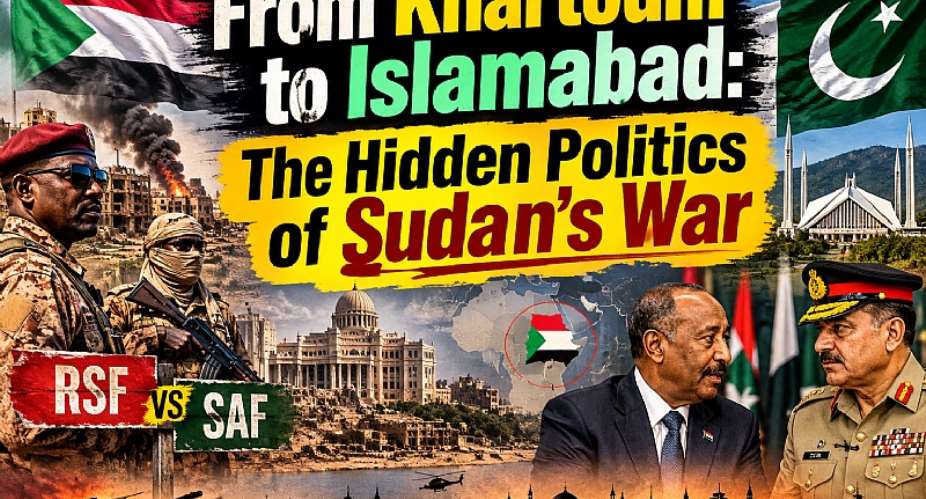
Sudan's War
Sudan's Interior Minister visited Pakistan on November 7, meeting Chief of Defence Forces Field Marshal Asim Munir, Interior Minister Mohsin Naqvi and Deputy Prime Minister Ishaq Dar. The official statements appeared as ordinary diplomatic engagements, covering cybercrime, police training and institutional cooperation. However, beneath these seemingly routine discussions lies a much larger geopolitical calculation. Is Sudan seeking only Pakistan's institutional expertise, or has General Abdel Fattah al-Burhan arrived to secure a piece of a much larger cake being baked in the Saudi kitchen, spiced by the UAE, influenced by Iran and served through Pakistan at Egypt's demand? Let us read between the lines and examine what much of the media coverage has overlooked.
What Actually Happened in Sudan? The RSF vs SAF Conflict
Sudan possesses enormous gold resources, with estimates of its reserves running into thousands of tonnes. Its gold industry generated significant production and export revenues in 2025, although smuggling and the absence of effective state control have prevented the government from capturing the full economic benefit. Official reporting recorded approximately 70 tonnes of gold production in 2025, while substantial quantities from conflict-affected territories remain outside government oversight.
The conflict involves two major armed forces, both seeking political legitimacy and control of the state through different channels. The Rapid Support Forces (RSF), headed by Mohamed Hamdan Dagalo, popularly known as Hemedti, controls substantial parts of western Sudan, particularly Darfur, and has established a rival political administration under the banner of a parallel government.
The RSF has been widely accused of receiving support from the UAE, an allegation Abu Dhabi denies. Its opponent, the Sudanese Armed Forces (SAF), led by General Abdel Fattah al-Burhan, maintains control over important state institutions and territories in northern and eastern Sudan, including Port Sudan, and represents the internationally recognised government.
Both sides are pursuing international recognition and external support to strengthen their positions. Consequently, Sudan's internal war has transformed into a geopolitical contest involving competing regional and international powers.
What Does Sudan Want From Pakistan, and What Can Pakistan Offer?
Pakistan occupies an important position in this equation. It maintains close defence relations with Saudi Arabia, strategic connections with the United States and longstanding relations with Egypt. Its diplomatic position also provides an opportunity to engage other regional stakeholders, including Türkiye.
The September 12, 2025, Quad initiative involving the United States, Saudi Arabia, the UAE and Egypt established a roadmap for humanitarian access, a ceasefire and a transition towards civilian government. Its underlying principles include Sudan's territorial integrity and opposition to competing military structures.
The demand for one Sudan, one recognised government and an eventual unified military structure represents a political challenge to the RSF's parallel administration. This is also where Pakistan's diplomatic support for Sudan's sovereignty and territorial unity becomes significant.
If Pakistan can secure diplomatic understanding from Saudi Arabia, the United States and Türkiye, Sudan could potentially offer investment opportunities, including gold mining and refining under favourable ownership arrangements. However, the biggest obstacle remains security. How can international investors guarantee their investments when competing armed groups and smuggling networks operate across the country's most valuable mineral territories?
Between the Lines: Does a Warheads Deal Exist?
Reuters reported in January 2026 that Pakistan was nearing a $1.5 billion defence agreement with Sudan's army. The proposed package reportedly included K-8 light attack aircraft, more than 200 drones and advanced air-defence systems. Saudi Arabia was reported to be involved in the financing discussions.
However, Reuters subsequently reported in April that Pakistan had placed the agreement on hold after Saudi Arabia withdrew its proposed financial support. Therefore, the reported package should not be treated as a concluded defence agreement.
The larger question remains: could Pakistan's defence relationship with Sudan eventually become part of a broader Red Sea security arrangement, alongside agricultural investment, food security and access to strategic ports?
What Does Saudi Arabia Want From Sudan's Disaster?
Saudi Arabia initially appeared willing to support the proposed defence arrangement but subsequently stepped back from financing it. Riyadh wants influence over Sudan's future without becoming directly entangled in another prolonged military confrontation.
Its strategic interests include Red Sea security, limiting competing regional influence and protecting its Vision 2030 investments, including NEOM. Saudi Arabia also opposes the expansion of Islamist political influence and has an interest in restoring a stable civilian-led political order.
Pakistan could provide diplomatic and institutional assistance, while Riyadh could maintain its regional influence without putting its own resources and personnel directly into the conflict.
What Does the UAE Want From the Equation?
The UAE's interests are equally significant. Sudan's gold resources, commercial networks and strategic ports offer substantial economic opportunities. Abu Dhabi has been accused of supporting the RSF, although it rejects these allegations.
Its broader interest lies in maintaining commercial and geopolitical influence across the Red Sea and the Horn of Africa. Saudi-UAE competition over regional influence adds another layer to Sudan's already complicated political landscape.
Conclusion: The Middle East's Chessboard on Africa's Neck
Sudan has become an African chessboard where Middle Eastern powers are positioning themselves against competing regional interests. Saudi Arabia, the UAE, Egypt, Iran, the United States and Pakistan are all connected, directly or indirectly, to the calculations surrounding Sudan's future.
Pakistan must understand that diplomatic engagement, defence cooperation and economic investment cannot be separated from the political consequences of this conflict.
But one question must remain above every strategic calculation: should Sudan's future be decided by competing external powers or by its own people?
Peace cannot emerge through a biased settlement that strengthens one external stakeholder at the expense of another. Sudan needs a neutral political settlement, humanitarian protection, accountable institutions and a unified national framework. The ultimate objective must be peace for Sudan, not another geopolitical victory for the competing powers.


 How two Level 300 University students drown in a week
 Passport scandal: Retract or I’ll sue you – Pendilock warns Kabila
 I won and I have been reinstated – Pendilock speaks on Foreign Affairs Ministry ...
 Foreign Affairs Ministry accuses alleged passport syndicate of forging Chief Dir...
 I disagree with calls for Ablakwa to step aside over passport saga – Nkrumah Bot...
 IEA backs Ghana’s move to pursue BRICS partnership
 'Stop the deliberate search for scandals where none exist' — Mahama cautions med...
 Former GIIF CEO seeks court order to compel 15 witnesses in US$2m Skytrain trial
 Passport scandal is institutional problem, should not be reduced to political ga...
 'We won't return to work if revised conditions of service not implemented' — JUS...


