




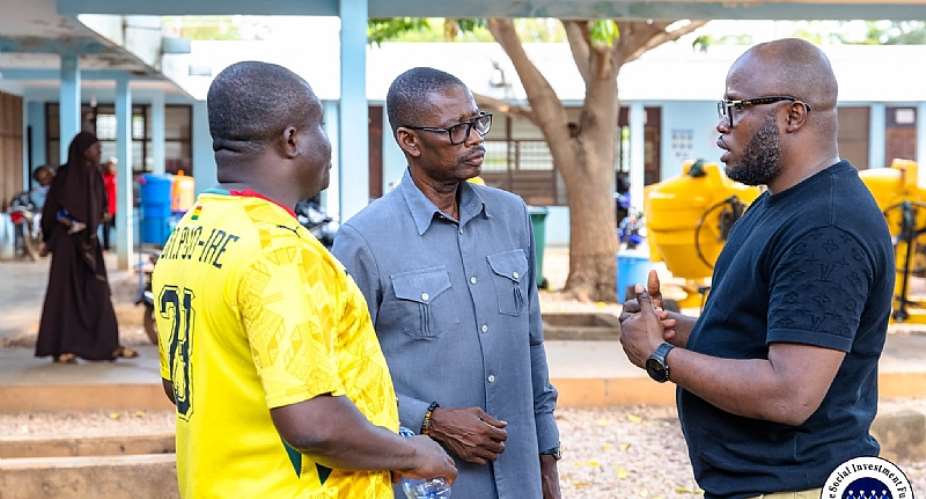
Let me start with a contrast that captures what has happened at the Social Investment Fund in barely eighteen months. In January 2025, when President John Mahama appointed Abass-Adams Nurudeen as Acting CEO, the institution was a shadow of its 1998 founding ambition. It was a grant-making body, building schools and clinics in impoverished communities, doing good work but operating in a way that felt, to many observers, like a relic of a different development era. A little over a year later, SIF is the implementing agency for the country's most significant youth and women's employment programme—a $71 million bet on the idea that the best social safety net is not a grant, not a hand-out, not a building. It is a job.
That is not a small shift. That is a fundamental reimagining. And it deserves scrutiny, not just praise.
From Infrastructure to Enterprise
The Social Investment Fund was established in 1998 with a traditional poverty-reduction mandate: channel resources into impoverished communities, build schools, clinics, and small infrastructure. It was a grant-making body, distributing donor and government funds to fill gaps the state could not reach. That model had its merits. It delivered visible results. But it also had a limitation: it addressed the symptoms of poverty, not the engines of it.
Nurudeen's tenure has overseen a fundamental shift. SIF is no longer just building things. It is financing businesses, training young people, and tying disbursement to measurable outcomes. The vehicle for this shift is the Ghana Women and Youth Employment and Social Cohesion Programme, launched in June 2026 with a $71 million grant from the African Development Bank, implemented by SIF under the Ministry of Finance. Nurudeen serves as both the CEO of SIF and the Project Coordinator for GWYESCO.
His framing of the programme is deliberate. "At the heart of this programme is the idea that when women and young people are empowered with skills, financing opportunities and hope, nations thrive," he said at the launch. The language is not that of a grant administrator. It is that of an enterprise developer. That distinction matters. Because the way you talk about a problem shapes the way you solve it.
The Diagnosis
Nurudeen's public statements reveal a diagnosis of Ghana's youth unemployment problem that goes beyond the standard "lack of jobs" narrative. He identifies three interlocking deficits. The first is limited access to market-relevant skills—training that industry actually needs, not theoretical credentials. The second is limited access to finance for women- and youth-owned businesses. The third is limited access to technology and markets.
This diagnosis explains why GWYESCO is structured the way it is. It is not a training programme with a financing add-on. It is not a loan scheme with a workshop attached. It is an integrated intervention designed to address all three deficits simultaneously. Promoting market-driven training aligned with industry needs and emerging sectors. Expanding access to financial and non-financial services for women- and youth-owned MSMEs. Strengthening institutional capacity and accountability systems. Each piece reinforces the others. That is smart design. But smart design on paper is not the same as smart execution on the ground. And that is where the real test lies.
The Results-Based Financing Experiment
The most consequential feature of Nurudeen's approach is the financing model. GWYESCO is the African Development Bank's inaugural Results-Based Financing operation in Ghana. Under this model, financing is tied directly to measurable and verified outcomes rather than activities undertaken.
"This is a shift from financing inputs to financing impact," Nurudeen explained at the launch. He described the model as placing "accountability, transparency, performance and measurable change at the centre of programme implementation."
I have to pause here, because this is the most interesting part of the story. Results-Based Financing is not a new idea globally. But it is genuinely new at this scale in Ghana. And it comes with real risks. Nurudeen himself acknowledged this. RBF, he conceded, often faces "bureaucratic delays, weak institutional coordination, procurement bottlenecks and limited technical capacity" across Africa. He framed these obstacles as motivation for stronger collaboration rather than reasons for caution.
That is an admirable attitude. But it is also a gamble. If the bureaucratic delays materialise, if the institutional coordination fails, if the procurement bottlenecks slow everything down, then the RBF model will not deliver results faster. It will simply delay payment for results that never arrive. The risk is not that the model is wrong. The risk is that the system around it is not ready.
The targets attached to the financing are specific. By 2029, GWYESCO aims to support more than 22,000 women and young people into wage or self-employment, train over 28,000 beneficiaries in STEM, digital and creative skills, support 10,000 MSMEs with business development services, provide financing access to 8,000 businesses, and construct or renovate ten TVET centres. The programme is expected to create 28,000 direct jobs and 6,000 indirect jobs.
Those are ambitious numbers. And they should be. Ghana needs to create 300,000 new jobs each year to absorb its growing youth population. Against that backdrop, 28,000 direct jobs is a meaningful contribution, but it is not a solution. It is a proof of concept. If GWYESCO works, it can be scaled. If it fails, the lesson will be costly.
The Bank Partnership
The RBF model and the enterprise development ambition depend on a distribution channel. SIF does not lend directly. It works through banks. In August 2026, Consolidated Bank Ghana signed a $5 million on-lending agreement with SIF under GWYESCO, expected to reach about 3,000 entrepreneurs over 36 months. The funds are earmarked for working capital, business expansion, and the acquisition of productive assets.
Nurudeen's statement on the partnership was concise but pointed. "The on-lending agreement with CBG will serve as the foundation for a stronger relationship between the two institutions and ensure the funds reach those who need them most."
The partnership with ARB Apex Bank is also part of the architecture. The programme's executive summary, published through Apex Bank, situates GWYESCO within a broader set of development partner interventions and describes the programme as "a timely and much needed intervention."
This is a sensible structure. SIF does not have the branch network to reach thousands of small businesses across the country. The banks do. But using banks as intermediaries introduces its own risks. Banks are conservative by nature. They may prefer to lend to established businesses with collateral rather than to the young, the unbanked, and the informal. The programme's success will depend on whether the banks can be incentivised to reach the people who need the money most, not just the ones who are easiest to lend to.
The Precedent
GWYESCO is not SIF's first attempt at enterprise financing under Nurudeen's watch. The Post COVID-19 Skills Development and Productivity Enhancement Project was the proving ground. Under PSDPEP, SIF, in partnership with the Ministry of Finance and ARB Apex Bank, disbursed a total of GHS 40.8 million in microcredit to 15 Rural and Community Banks and Africa Skills Hub. The funds went to women- and youth-led MSMEs, with an interest rate not exceeding 12% per annum.
SIF's own reporting described the outcomes as "renewed growth, increased resilience and improved financial literacy," with beneficiaries "especially women-led enterprises" testifying to the lifeline the funding provided. The PSDPEP experience is the operational foundation on which GWYESCO's more ambitious financing component is built.
That precedent matters. It shows that SIF can actually disburse money through partner banks. It shows that the model works. But it also shows the scale of the challenge. GHS 40.8 million is a fraction of what GWYESCO intends to deploy. Scaling up from a pilot to a national programme is where many good ideas fail. Execution is everything.
The Political Reality
Nurudeen's tenure has not been confined to enterprise development. As SIF CEO, he has also been the public face of the government's assessment of the Agenda 111 hospital projects inherited from the previous administration. In April 2026, he stated that the government would need approximately $2 billion to complete the projects. He described Agenda 111 as a "corruption machinery" under the previous government, alleging that contracts were awarded by the Chief of Staff rather than the Ministry of Health, and that over $500 million had been spent on facilities that could not be operational because they lacked electricity and other essential amenities.
The statements were politically charged, and they placed Nurudeen at the centre of a contentious debate about the cost and legacy of the previous government's flagship health infrastructure programme. They also illustrate the breadth of the SIF mandate under his leadership—from microcredit for market women to the fiscal audit of national hospital projects.
This is worth noting because it shows that Nurudeen is not just a technocrat. He is a political appointee operating in a highly contested environment. His ability to deliver GWYESCO will depend not just on his management skills, but on his ability to navigate the political pressures that come with any major government programme. That is a skill that cannot be taught in a boardroom.
Abass-Adams Nurudeen's SIF is not the SIF of 1998. The institution has moved from building infrastructure to financing enterprises, from disbursing grants to tying funding to verified outcomes, from working alone to working through banks and development partners.
The GWYESCO programme is the clearest expression of this shift. It is a $71 million experiment in whether a government agency can deliver enterprise development at scale, with the discipline of results-based financing and the reach of partner banks.
The targets are ambitious. The RBF model is untested at this scale in Ghana. The political environment is contested. But the direction is clear: the Social Investment Fund under Nurudeen is betting that the most durable social investment is a business that can pay its own way.
Whether that bet pays off is the question that will define Nurudeen's tenure. Not the speeches. Not the press releases. Not the political controversies. The question is whether, by 2029, there are 28,000 more Ghanaians with jobs, 8,000 more businesses with financing, and ten more TVET centres training the next generation of skilled workers. If the answer is yes, then the experiment will have worked. If the answer is no, then the $71 million will have been an expensive lesson.
Either way, the story of SIF is no longer about buildings. It is about people. And that is a story worth watching.


 November 6: Cedi sells at GHS12.25 on forex market, GHS11.67 on BoG interbank
 Put Nkrumah's 1957 independence photo on banknotes – Memorial Park to BoG
 Health Ministry dismisses claims gov't is abandoning newly trained doctors
 Trump calls midterms 'crooked', demands Alaska votes go to Republican candidate
 Kenyan starvation cult leader faces death sentence over child murders
 Paraguay president resigns amid banking scandal
 Akufo-Addo’s govt initiated Ghana’s BRICS partnership idea – Mahama
 If NDC had followed how we had wanted to do the Gold for Reserves, they wouldn't...
 No one should endure sexual harassment to secure jobs – Prof Opoku-Agyemang
 'US must tackle gun violence' – Mahama after death of Ghanaian teenager, Javits ...


