




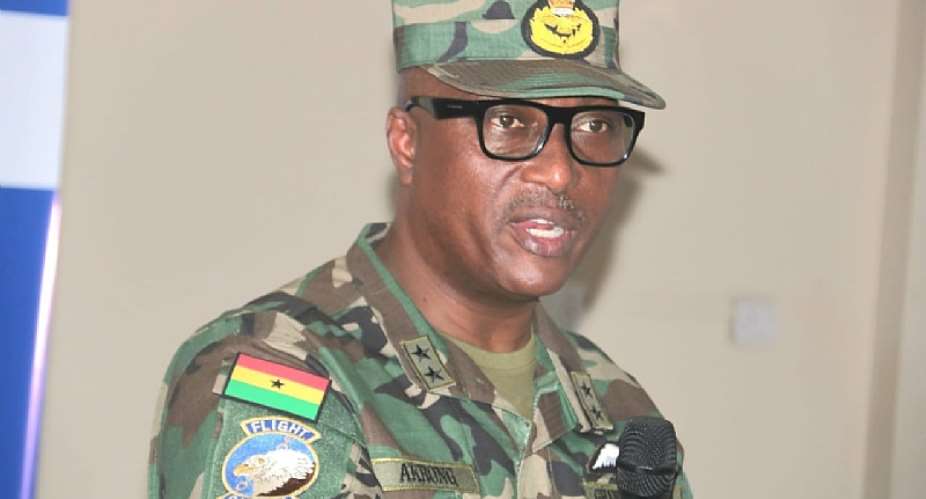
Air Vice Marshal (AVM) David Anetey Akrong, the Commander of the Kofi Annan International Peacekeeping Training Centre (KAIPTC), has cautioned Ghanaians against becoming complacent over the country's prevailing peace and stability amid growing threats of violent extremism and cross-border insecurity in the sub-region.
He said although Ghana continued to enjoy relative peace, developments in neighbouring countries and the wider West African region required sustained vigilance, preventive action and stronger collaboration between communities and security institutions.
AVM Akrong gave the caution at a regional community engagement workshop in Bolgatanga, organised by the KAIPTC in partnership with the National Peace Council, with support from the Government and Embassy of Spain in Ghana.
The two-day workshop, held under the theme “Strengthening Civilian-Security Trusts and Community Resilience for Preventing Violent Extremism Programme,” seeks to strengthen community participation and cooperation with security agencies in preventing violent extremism.
West Africa has in recent years witnessed an escalation of violent extremism, particularly in the Sahelian countries of Burkina Faso, Mali and Niger, where militant groups have intensified attacks on civilians and security forces.
The violence has increasingly spread towards coastal West African countries, with northern Benin and Togo also recording attacks by extremist groups.
Ghana shares borders with Burkina Faso to the north, Togo to the east and Côte d'Ivoire to the west, exposing Ghana, particularly the five regions of northern Ghana to potential cross-border security threats.
AVM Akrong said the Upper East Region's proximity to Burkina Faso, one of the epicentres of violent extremism placed it within a wider security environment affected by violent extremism, cross-border insecurity and population movements.
“Ghana's relative peace and stability should never lead us to become complacent. Developments within our wider neighbourhood remind us of the importance of prevention, and the Upper East Region has a critical role to play in that effort,” he said.
He noted that long-standing local disputes, competition over resources and tensions within and between communities could further undermine social cohesion and create vulnerabilities that extremist groups might exploit.
He stressed the need to address such vulnerabilities before they became opportunities for exploitation, adding that unresolved local grievances could weaken public confidence and undermine collective responses to security threats.
The KAIPTC Commander said effective prevention required more than security capabilities, emphasising the importance of building trust and strengthening relationships between communities and institutions responsible for their protection.
He observed that experiences from similar engagements in Wa in the Upper West Region and Damongo in the Savannah Region had highlighted communication gaps, limited confidence in reporting security threats, negative perceptions of security institutions and the exclusion of some community groups from local decision-making.
He said community members needed to feel safe reporting suspicious activities, trust that their information would be treated confidentially and be confident that security agencies would respond appropriately.
“If any part of that relationship is missing, important information may never reach the institutions that need it,” he said, stressing that the security agencies must remain accessible, responsive and accountable to the people they served.
Mr Daniel Roelas, Representative of the Spanish Ambassador to Ghana, reaffirmed Spain's commitment to supporting Ghana's peace and security efforts, particularly initiatives that strengthened community resilience, mutual trust and social cohesion.
He said preventing violent extremism required strong community participation and collaboration among local institutions, civil society organisations and security agencies.
He emphasised the need to build trust between law enforcement agencies and communities, noting that effective information-sharing was essential to addressing emerging security threats.
Mr Damien Asobayire, the Upper East Regional Executive Secretary of the National Peace Council, called for the community engagement initiative to be extended to the grassroots to address security concerns at the levels where they occurred.
He said although the regional workshop provided an important platform for stakeholders from different districts to interact, community-level engagements would help identify and address local challenges more effectively.
GNA

 Paraguay president resigns amid banking scandal
 Akufo-Addo’s govt initiated Ghana’s BRICS partnership idea – Mahama
 If NDC had followed how we had wanted to do the Gold for Reserves, they wouldn't...
 No one should endure sexual harassment to secure jobs – Prof Opoku-Agyemang
 'US must tackle gun violence' – Mahama after death of Ghanaian teenager, Javits ...
 Bear with us on TraffiTech, it is here to save lives – Mahama to Ghanaians
 JUSAG Strike: Wage dispute must not suspend justice for entire nation – Ahiagbah...
 My focus on digitalisation is not an escape from economics; it is the new econom...
 Speaker Bagbin's handling of Abu Jinapor's allegation raises concerns – Egyapa M...
 Abu Jinapor showed highest form of disrespect to Bagbin – Hamza Suhuyini


