




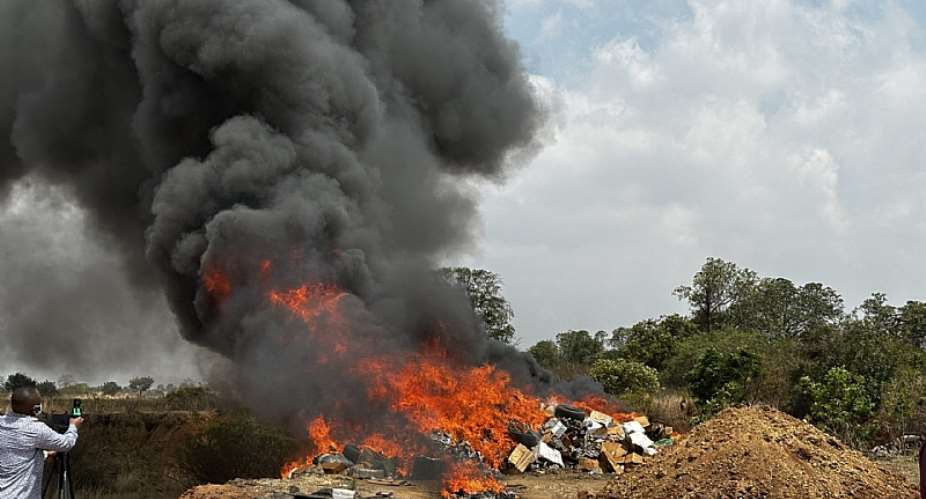
The Narcotics Control Commission (NACOC) has destroyed seized narcotic drugs and related substances valued at approximately US$10.3 million following the completion of the requisite court orders and legal procedures.
The substances destroyed included 564.39 kilogrammes of cannabis and related products, 4.7 million tablets and capsules of synthetic opioids, including tapentadol and tramadol, as well as 3,308 bottles of banned codeine-based cough syrups and other infused cough mixtures.
Prior to the destruction exercise, samples of the seized substances were analysed by officials of the Ghana Standards Authority (GSA), who issued laboratory reports on their findings. Field tests were subsequently conducted to confirm that the exhibits presented for destruction were narcotic substances.
Major General Maxwell Obuba Mantey, Director-General of NACOC, said the exercise was intended to permanently remove harmful substances capable of destroying lives and affecting communities from circulation.
He noted that the participation of partner institutions in the exercise ensured transparency, accountability and compliance with legal requirements in the handling and destruction of the exhibits.
Major General Mantey said the significance of the exercise extended beyond the monetary value of the drugs, considering the potential harm they could have caused individuals, families and communities through abuse, dependency and addiction.
He stated that NACOC was strengthening its operational presence, intelligence-gathering and investigative capacities to disrupt drug supply chains and dismantle organised trafficking networks.
According to him, drug trafficking is a transnational enterprise involving financiers, suppliers, distributors and facilitators operating across multiple jurisdictions, making it necessary for investigations to extend beyond the arrest of couriers.
He said the Commission would intensify efforts to trace the proceeds of crime, strengthen intelligence-led enforcement and collaborate with international partners to identify and prosecute individuals behind drug trafficking networks.
“Ghana must never become a safe haven for drug traffickers. NACOC will continue to pursue those involved regardless of the sophistication of their operations or where their networks lead,” he stressed.
Major General Mantey acknowledged the Government’s continued support, as well as the contributions of sister security agencies and international partners through technical assistance, training and operational cooperation.
He emphasised that the fight against illicit drugs required collective action and called on parents, traditional authorities, religious leaders, schools, civil society organisations, the media and the public to support the Commission’s efforts.
He urged citizens to remain vigilant and provide credible information on suspicious drug-related activities, particularly those involving the sale and distribution of narcotic drugs to schoolchildren and other vulnerable groups.
Major General Mantey disclosed that NACOC currently had more than 10 million tramadol tablets awaiting the necessary court processes for destruction.
He noted that while the Commission continued to make arrests and conduct investigations, details of some operations were not made public due to the sensitive and complex nature of the investigations.
The Director-General also appealed to the media to contribute constructively to the fight against drug trafficking by supporting public education and sharing useful information with security agencies.
“Our strategy against illicit drugs is diverse and as complex as the drug traffickers themselves. We cannot sit every day and be discussing our strategies on radio,” he said.
He explained that controlled delivery operations and other investigative techniques were sometimes employed not only to track consignments but also to identify vulnerabilities within the system and uncover persons involved in trafficking activities.
Major General Mantey further indicated that some international partners had described Ghana as increasingly becoming a “no-go area” for drug traffickers due to recent enforcement operations and successes recorded by the Commission.
He, however, called for sustained public support and assured Ghanaians that NACOC would remain resolute in its efforts to combat drug trafficking.
“We will do our best. We will not give up, no matter the challenges we face. We will go after them wherever they are, and at the end of the day, we will win the war,” he added.
GNA

 Paraguay president resigns amid banking scandal
 Akufo-Addo’s govt initiated Ghana’s BRICS partnership idea – Mahama
 If NDC had followed how we had wanted to do the Gold for Reserves, they wouldn't...
 No one should endure sexual harassment to secure jobs – Prof Opoku-Agyemang
 'US must tackle gun violence' – Mahama after death of Ghanaian teenager, Javits ...
 Bear with us on TraffiTech, it is here to save lives – Mahama to Ghanaians
 JUSAG Strike: Wage dispute must not suspend justice for entire nation – Ahiagbah...
 My focus on digitalisation is not an escape from economics; it is the new econom...
 Speaker Bagbin's handling of Abu Jinapor's allegation raises concerns – Egyapa M...
 Abu Jinapor showed highest form of disrespect to Bagbin – Hamza Suhuyini


