




Last year, Ghanaians abroad did something historic. They sent home nearly $7.8 billion. The Bank of Ghana's Governor, Dr Johnson Asiama, confirmed the figure at a diaspora roundtable in Virginia on 19 April 2026. That is roughly 6 percent of Ghana's GDP and about three times the $2.5 billion in foreign direct investment recorded over the same period.
Now put that next to another number.
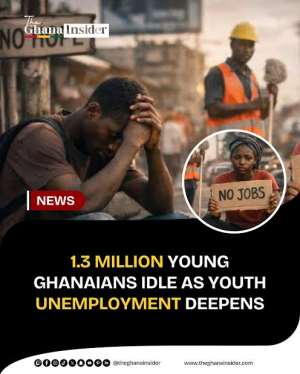
The Ghana Statistical Service (GSS) says 1.95 million young Ghanaians are not in education, employment or training (NEET). Its July 2026 release puts youth unemployment at 21.9 percent, nearly double the national rate of 12.8 percent.
Put those numbers side by side and you get my argument:
Ghana has built an economy that survives on the sacrifice of the people who left, while wasting the potential of the people who stayed.
That is not sustainable, and the people who pay for it are the very ones sending the money.
What the Numbers Say
Ghana is a young country.
The GSS says people aged 15 to 35 make up 36.9 percent of the country's projected 33.7 million population, which is roughly 12 million people and the largest youth population in Ghana's history. That should be the best news in our national story. A young population is a workforce, a market and a pool of builders.
But the same data shows the problem.
For ages 15 to 24, unemployment averaged 32.4 percent across the first three quarters of 2025, according to the GSS publication Ghana in Numbers 2025, which was widely reported this week. About 1.34 million people in that age bracket are NEET. Extend the bracket to 35, as the National Youth Policy does, and the figure rises to 1.95 million.
The pain is not spread evenly.
Greater Accra recorded the highest regional youth unemployment rate at 31.9 percent. Central Region followed at 27.4 percent, while Ashanti Region stood at 27.2 percent. The capital is supposed to be where opportunity is concentrated, yet it records the worst numbers. Many of us who live here already knew that.
Graduates are not safe either.
In July 2025, Employment and Labour Relations Minister Abdul-Rashid Hassan Pelpuo said that of the roughly 300,000 graduates entering the labour market each year, nearly 60 percent fail to secure durable employment. Many drift between informal gigs, unpaid internships and long job searches. Anyone with a degree and a WhatsApp group of former classmates knows this story.
The Diaspora Is Carrying the Weight
Now consider the other side of the ledger.
Remittances rose from about $4.6 billion in 2024 to nearly $7.8 billion in 2025, according to the Governor. Foreign Affairs Minister Samuel Okudzeto Ablakwa noted that even the 2024 figure surpassed petroleum and cocoa exports combined, which totalled $3.09 billion.
A fair note on the data: other Bank of Ghana series place the 2024 figure at about $6.65 billion, meaning the exact size of the increase depends on the dataset used. Either way, the conclusion remains the same. Remittances have become the largest single source of external financing available to Ghana, overtaking FDI for the first time.
The road there was not smooth.
In August 2025, the Governor warned that inflows had fallen by almost 50 percent, a decline he attributed to the rapid appreciation of the cedi. Later Bank of Ghana data showed a strong rebound in the second half of 2025.
That tells us something important: this money is sensitive. It depends on exchange rates, confidence and the personal finances of nurses in Manchester, drivers in Toronto, caregivers in Ohio and engineers in Hamburg.
It is not a national development strategy, and we should stop treating it like one.
Where the Money Goes, and Where It Doesn't
The Governor himself admitted that much of the inflow goes into consumption rather than investment.
That is natural.
Remittance money pays school fees, rent, hospital bills, funerals and the roofing project that has somehow been ongoing since 2019. I am not criticising anyone for that. A mother in Kumasi who receives a transfer on Friday still needs to buy food on Saturday.
But if remittances only finance consumption, then we are importing money to buy imported goods while the economy that should employ our young people remains underdeveloped.
The Bank of Ghana says it is encouraging banks to develop diaspora bonds and investment products so that remittances can become long-term capital. That is the right direction, and I support it.
Still, the strategy needs one more component:
Capital without a pipeline for young workers is simply another way to sit on money.
What I Think We Should Do, With Numbers
Opinion without measurable proposals is just noise, so here are mine.
These are my targets, not official ones, and I welcome debate on every single one.
1. Cut the NEET Population Below 1.5 Million by December 2028
Reduce the number from 1.95 million to below 1.5 million.
That means moving about 450,000 young people into school, training or employment in roughly two years, or approximately 150,000 every six months.
It is ambitious but attainable because it requires structure, not miracles.
2. Create 50,000 Funded Graduate Internships and Apprenticeships in 2027
Tanzania has already announced a five-year programme to place at least 10,000 graduates annually in internships between 2026/27 and 2030/31.
At roughly $100 per month for six months, funding 50,000 placements would cost about $30 million.
That is less than 0.4 percent of one year's remittances.
If Ghana can find money for conferences and committees, it can find money for this.
3. Link Diaspora Investment to Youth Jobs
If diaspora bonds raise even 10 percent of the 2025 remittance total, approximately $780 million, a defined share should be directed toward youth-employing sectors such as:
- Agro-processing
- Light manufacturing
- Creative industries
- Digital services
A nurse in London should be able to buy a bond and know exactly which workshop in Tema or Tamale that investment is helping to build.
4. Publish a Quarterly Youth Employment Dashboard
Every quarter.
In plain language.
Track NEET figures, youth employment outcomes, apprenticeships and job creation.
What gets measured publicly gets managed.
What remains hidden gets excused.
The Counterargument, Honestly Stated
The government's position is that overall unemployment has fallen and that current policies are yielding results.
Youth Development Minister George Opare-Addo has acknowledged that progress has not translated into a comparable decline in youth unemployment and has linked the challenge largely to Ghana's growing youth population.
That argument is partly correct.
A larger youth population naturally makes the numbers harder to shift.
Opposition MP Kojo Oppong Nkrumah has proposed an "apprenticeship economy" and called for bipartisan commitment to tackling youth unemployment.
I accept the demographic argument as part of the story, but not as an excuse.
Population growth explains why the challenge is large.
It does not explain why Ghana still lacks a published, time-bound national target for addressing it.
Rwanda, Vietnam and Bangladesh also faced large youth cohorts. They treated them as industrial opportunities rather than demographic statistics.
Why This Matters to You, Wherever You Are
If you live in Accra, Kumasi or Tamale, this issue is about whether the next generation builds something at home or joins a queue for visas.
If you live in London, Toronto, Dallas or Berlin, this issue is about whether your transfers keep families afloat indefinitely or help build an economy that eventually makes those transfers less necessary.
None of us should be comfortable with a country where love is measured in dollars sent.
The best remittance is the one that eventually makes itself less necessary.
My Bottom Line
By the end of 2028, I want to read a GSS release stating that the NEET population has fallen below 1.5 million, that diaspora bonds have financed real youth enterprises, and that a graduate in Ghana has a better chance of starting a career than starting a visa application.
We have the money.
We have the data.
We have the talent.
What we still lack is a deadline and the collective will to be held accountable for meeting it.
Let's set the date.
Sources
- Ghana Statistical Service, More Than One-Third of Ghana's Population is Youth (28 July 2026)
- Graphic Online, Nearly 2 Million Young Ghanaians Not in Education, Employment or Training – GSS; Ghana Records Largest-Ever Youth Population (Ghana in Numbers 2025)
- MyJoyOnline, More Than One-Third of Ghana's Population Are Young People – GSS
- Modern Ghana, Nearly Two Million Young Ghanaians Without Work
- Ecofin Agency, Ghana Faces Graduate Employment Crisis as 60% Remain Jobless (5 January 2026)
- Graphic Online, Diaspora Remittances Hit $7.8bn; BoG Pushes Shift from Consumption to Investment (April 2026)
- GhanaWeb, 20 April 2026
- GNA / MyJoyOnline, Record US$7.8 Billion in Remittances Shows Value of Ghanaians Abroad – Ablakwa (June 2026)
- News Ghana, Bank of Ghana Data Shows Remittances Rebounded After Mid-Year Decline Warning
- Graphic Online, Oppong Nkrumah Proposes 5 Ideas to Help Solve Youth Unemployment (June 2026)
- Ecofin Agency, Tanzania Launches Five-Year Internship Plan Targeting 10,000 Graduates Annually


 Paraguay president resigns amid banking scandal
 Akufo-Addo’s govt initiated Ghana’s BRICS partnership idea – Mahama
 If NDC had followed how we had wanted to do the Gold for Reserves, they wouldn't...
 No one should endure sexual harassment to secure jobs – Prof Opoku-Agyemang
 'US must tackle gun violence' – Mahama after death of Ghanaian teenager, Javits ...
 Bear with us on TraffiTech, it is here to save lives – Mahama to Ghanaians
 JUSAG Strike: Wage dispute must not suspend justice for entire nation – Ahiagbah...
 My focus on digitalisation is not an escape from economics; it is the new econom...
 Speaker Bagbin's handling of Abu Jinapor's allegation raises concerns – Egyapa M...
 Abu Jinapor showed highest form of disrespect to Bagbin – Hamza Suhuyini


