




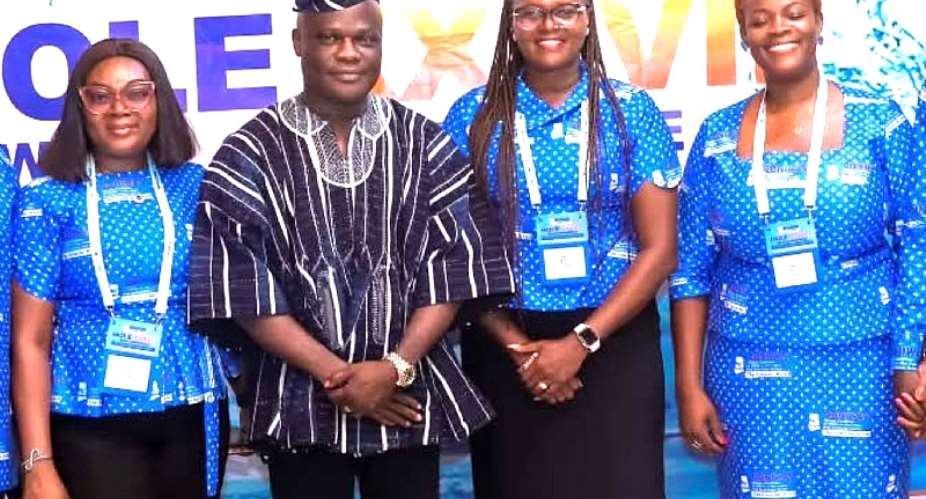
Chairperson of the Ghana Coalition of Non-Governmental Organizations in Water and Sanitation (CONIWAS), Dr Beata Awinpoka Akanyani, has called for increased investment and stronger institutional commitment to improve climate-resilient Water, Sanitation and Hygiene (WASH) services in underserved communities.
She cautioned that the concept of last-mile communities should not be limited to geographical locations but must also encompass people and institutions that are often excluded from reliable WASH services.
“It must represent people and places too often excluded from reliable services: deprived rural communities, small towns, peri-urban and informal settlements, as well as schools, health facilities, markets, and other public spaces,” she emphasised.
Dr Akanyani made the remarks at the ongoing MOLE XXXVII Conference, held under the theme “Accelerating Climate-Resilient WASH Service Delivery for Last-Mile Communities: Options, Strategies, and Actions.” The conference builds on discussions from MOLE XXXVI.
The Media Coalition Against Open Defecation (M-CODe), with support from World Vision Ghana, is providing a strategic communication platform for the conference to promote national visibility and citizen engagement.
The CONIWAS chairperson stressed that the success of WASH interventions should be measured by the lasting improvements they bring to the daily lives of vulnerable communities.
“Our measure of success must be whether these communities experience tangible, lasting improvements in their daily lives. These figures should compel us to act with urgency, with fairness, and with a clear commitment to climate resilience,” she said.
She identified inadequate financing as the major constraint facing the sector, citing a budget review conducted by the CONIWAS technical team which showed a significant decline in WASH's share of the national budget from 0.81 per cent in 2023 to 0.29 per cent in 2024.
The review put allocations at approximately GH¢741 million in 2024 and GH¢544 million in 2025.
For 2026, it identified approximately GH¢1.874 billion in selected WASH-related allocations, covering district-level earmarks, solid-waste infrastructure and central water projects.
However, Dr Akanyani said the allocations remained far below the estimated annual financing requirement of US$1.7 billion needed to achieve Ghana's national WASH targets.
“Measured against the estimated annual requirement of US$1.7 billion to achieve national WASH targets, this points to a financing gap of more than US$1.5 billion.
“We must also remember that allocations, releases, and actual expenditure are not the same,” she cautioned.
Beyond funding, she highlighted delays in key institutional reforms, including legislation to establish the Sanitation Authority, which has not progressed beyond Cabinet, and the revised Environmental Sanitation Policy, which is awaiting approval.
She also expressed concern that Environmental Health Units at Metropolitan, Municipal and District Assemblies (MMDAs) remained inadequately resourced.
Dr Akanyani identified the lack of reliable sector data as another major challenge, noting that consolidated public information on the functionality of rural water systems and WASH conditions in schools was not readily available. She said the information gap weakened planning and accountability.
She further warned that civil society organisations were facing growing financial pressures, with delays in finalising funding agreements and declining support threatening the sustainability of national NGOs.
To address the challenges, she urged government to establish a credible multi-year plan for increasing domestic investment in WASH and ensure that approved funds were released on time.
She also called on Parliament to champion the proposed National Sanitation Authority and Sanitation Fund while strengthening oversight of the 20 per cent District Assemblies Common Fund (DACF) allocation.
Dr Akanyani challenged MMDAs to ensure transparent utilisation and public reporting of Common Fund allocations, while urging development partners to make climate financing more accessible to districts.
She also called on the private sector to develop blended financing models for rural communities and traditional authorities to intensify efforts against illegal mining, popularly known as galamsey, and destructive sand winning.
Civil society organisations and the media, she added, must sustain evidence-based advocacy to keep WASH challenges and accountability issues in the public domain.
“Let this 37th MOLE Conference be remembered not only for the quality of our conversations but also for the strength of the commitments that follow. Let us work towards a Ghana where access to safe water, dignified sanitation, and good hygiene is not determined by where one lives, what one earns, or how vulnerable one is to a changing climate,” she said.

 Attorney General opposes Wontumi's bid to recall prosecution witness in illegal ...
 New Heritage Cedis feature enhanced security, improved durability against counte...
 Franklin Cudjoe describes cocaine trafficking cases as national disaster; demand...
 Speaker Bagbin forwards AKSA Energy bribery deal review report to Special Prosec...
 Cabinet approves establishment of Ghana Space Agency
 God is not 'wicked' to let NPP come back to power again - Cape Coast Mayor
 China accuses US of 'fabricating' Nvidia spy claims to push tech 'blockade'
 Nvidia board weighs ouster of CEO Jensen Huang amid spy scandal
 Ghana Immigration Service introduces six-month rotational transfers for officers


