




Ghana will co-chair the Interactive Dialogue A on “Water for People” at the 2026 United Nations Water Conference in Abu Dhabi alongside Switzerland, focusing on human rights to water and sanitation, including for those in vulnerable situations.
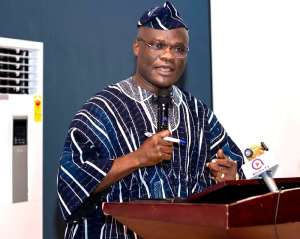
The Minister for Works, Housing, and Water Resources, Mr Ahmed Ibrahim, announced this in his keynote address at the 37th MOLE WASH Conference (MOLE XXXVII), being organized by CONIWAS at Aqua Safari Resort, Ada Foah.
The conference is being held from November 1st to 6th, 2026, and is on the theme "Accelerating Climate-Resilient WASH Service Delivery for Last-Mile Communities: Options, Strategies, and Actions," building on the deliberations of MOLE XXXVI.
The Media Coalition Against Open Defecation (M-CODe), through the empowerment of World Vision Ghana, is providing a strategic and targeted communication platform for the conference, ensuring national visibility and citizen engagement.
Mr Ibrahim described the co-chairship as both opportunity and responsibility for Ghana, saying options, strategies, and actions developed at MOLE XXXVII can inform commitments that emerge from Abu Dhabi, while outcomes of Abu Dhabi must reinforce political will, financing, and institutional capacity required to accelerate progress at home.
“This dialogue focuses on human rights to water and sanitation, including for those in vulnerable situations and for healthy societies and economies. It is the global expression of the Leave No One Behind principle,” Mr Ibrahim told participants, including Paramount Chiefs, development partners, CONIWAS leadership, civil society, and the private sector.
"Rationalizing the Leave No One Behind principle means ensuring that global and national pledges are translated into measurable improvements in reliability, equity, and climate resilience for households and communities that currently lack them,” he added.
He said as Ghana prepares for Abu Dhabi, its contribution should be grounded in practical experience, including the implementation of the Presidential Compact on Water, Sanitation, and Hygiene signed in 2024; ongoing reforms in rural service professionalization; efforts to protect water resources from pollution and degradation; and deliberate targeting of last-mile communities.
“These experiences can help shape a global agenda that moves from aspirational language to financed and accountable action,” he noted.
The Minister explained that the Presidential Compact elevated WASH to the highest political level and commits substantial annual resources toward universal access by 2030 with explicit attention to hard-to-reach communities, schools, health facilities, and climate-resilient infrastructure.
He said Ghana has recorded gains in basic water coverage, but safely managed services remain limited, especially in rural and remote areas, with sanitation lagging and open defecation continuing in many communities, particularly among the poorest households, riverine and island communities, women, girls, persons with disabilities, and the elderly.
He warned that climate change is already testing the resilience of WASH systems, with prolonged dry seasons reducing the reliability of sources, intense rainfall damaging infrastructure and contaminating water points, and rising temperatures affecting sustainable operation.
For last-mile communities, he said, these are present realities determining whether boreholes function and toilets remain usable.
The Minister emphasized that national adaptation strategies must systematically integrate WASH through climate-resilient design standards, protection of catchments and aquifers, and mainstreaming water considerations into local development planning, plus strengthening data systems that identify underserved areas and monitor service reliability under climate stress.
He charged participants that MOLE has always been a working platform where evidence is examined and commitments forged, urging them to leave with clear options, actionable strategies, and shared determination to deliver climate-resilient services to every Ghanaian community.
“Ladies and gentlemen, climate change is already testing the resilience of our WASH systems. Communities at the last mile are experiencing that test first and most severely. Our response must match the scale of the challenge," he declared.
The Chairperson of the Ghana Coalition of Non-Governmental Organizations in Water and Sanitation (CONIWAS), Dr. Beata Awinpoka Akanyani, addressing the gathering chaired by Nene Agudey Obichere III, Mankralo of Ada State, representing the Paramount Chief of Ada Traditional Area, said the last mile is not merely a geographical description.
“It represents people and places too often excluded from reliable services: deprived rural communities, small towns, peri-urban and informal settlements, as well as schools, health facilities, markets, and other public spaces,” she said.
She said the conference comes at a strategic moment for Ghana, as the African Union has dedicated its 2026 Theme of the Year to sustainable water availability and safe sanitation, with President John Dramani Mahama serving as First Vice-Chairperson of the AU ahead of Ghana's chairmanship in 2027, and Ghana co-chairing the “Water for People” dialogue with Switzerland at the upcoming UN Water Conference.
The CONIWAS Chair was candid about constraints confronting the sector, identifying financing as the central challenge.
She disclosed that the CONIWAS budget review identified a sharp decline in the sector’s share of the national budget from 0.81 per cent in 2023 to 0.29 per cent in 2024, with allocations of approximately GH¢741 million in 2024 and GH¢544 million in 2025.
For 2026, the review identified approximately GH¢1.874 billion across selected WASH-related allocations, including district-level earmarks, solid-waste infrastructure, and central water projects.
Measured against the estimated annual requirement of US$1.7 billion to achieve national WASH targets, this points to a financing gap of more than US$1.5 billion.
“We must also remember that allocations, releases, and actual expenditure are not the same,” she cautioned.
Dr. Akanyani urged the government to adopt a credible multi-year pathway for increasing domestic WASH investment and ensure timely release of funds.
She also tasked Parliament to champion the National Sanitation Authority and Sanitation Fund and strengthen oversight of the 20 percent DACF allocation.
“Let this 37th MOLE Conference be remembered not only for the quality of our conversations but also for the strength of the commitments that follow. Let us work towards a Ghana where access to safe water, dignified sanitation, and good hygiene is not determined by where one lives, what one earns, or how vulnerable one is to a changing climate,” she said.

 'Some NDC appointees have lost touch with grassroots' – Fifi Kwetey admits
 NPP youth has character of repeatedly disrespecting presidential staffers during...
 NACOC arrests three foreign nationals over 46.7kg cocaine seizure in Lebanon
 Police grant self-recognisance bail to two Techiman SHS teachers over alleged as...
 VIDEO: 'Akufo-Addo is a drug addict' – Julius Kwame Anthony says on live TV
 Trump congratulates Democrats on midterms win, says Iran war played role
 Death is big business in I.Coast, where funerals cost fortunes
 Key US Senate results: Democrats wrest North and South Carolina from the Republi...
 South Africa votes under shadow of service failures
 US democracy, Trump fatigue, cost of living are top issues with voters, AP surve...


