




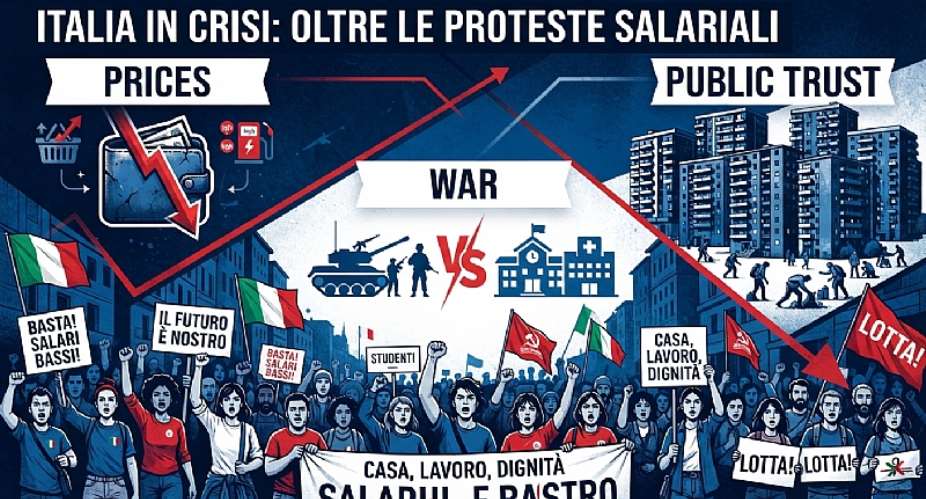
Italy's latest wave of protests began with familiar economic grievances: prices rising faster than pay, and households running out of room. A new analysis suggests that something more consequential is now happening beneath the surface.
The country's economic discontent is colliding with a politically sensitive question: what should the Italian state spend its money on? For many protesters the answer is clear — wages, food, energy, housing, schools and healthcare should come before more military spending. That convergence has turned a series of disconnected economic disputes into a broader argument about government priorities, institutional trust and the social cost of national policy choices.
This study assessment covering 18 July to 31 October 2026, with particular focus on October's protest wave, scores Italy's protest environment as follows.
| Measure | Score | Rating |
| Protest Pressure Index™ | 71 / 100 | High |
| Latent Threat Index™ | 69 / 100 | High |
| Observed public-order threat | ~50 / 100 | Elevated |
| Public Trust Index™ | 36 / 100 | Low trust |
| Trust–Risk Gap™ | +33 points | Strategic warning |
The study scores are analytical indicators built from open-source evidence, not opinion-poll results.
The report's conclusion is striking: Italy is not facing an insurrectionary threat, but its underlying social-risk environment is structural and increasingly vulnerable to escalation.
The price of everyday life
The strongest force behind the protests is not military policy. It is the cost of living. Of 25 protest-related reports analysed by this study, 92% cited cost-of-living concerns, against 60% for military spending and 40% for wages.
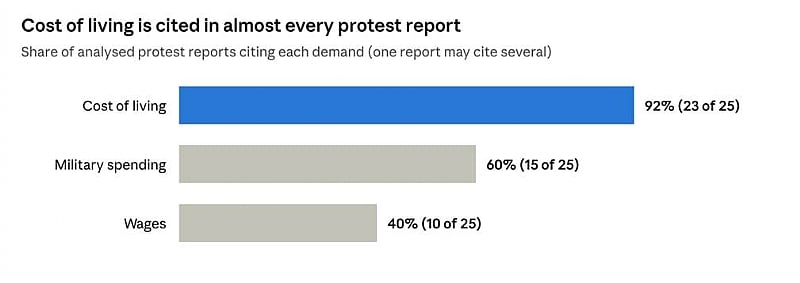
The study coding of 25 protest-related reports, 18 Jul–31 Oct 2026
The official numbers tell a story of households under pressure. ISTAT's preliminary estimate puts consumer-price inflation at 5.4% in October, up from 4.2% in September and around 1% at the start of the year. Energy goods were 31.4% dearer than a year earlier, while third-quarter growth stalled at 0.0%.
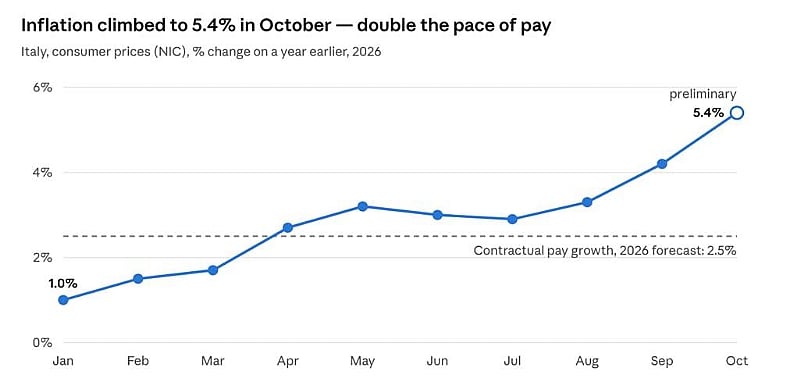
ISTAT monthly consumer-price releases, Jan–Oct 2026 (October preliminary, 30 Oct); pay forecast: ISTAT, Oct 2026
Pay is not keeping up. In the second quarter, contractual wages rose 2.5% against inflation of 3.0% — the first time in ten quarters that pay fell behind prices, according to ISTAT. By ISTAT's own estimate, the purchasing power of contractual wages was already 8.6% below its 2019 level at the end of 2025.
For ordinary households, the statistics become tangible at the pump and in the supermarket. Diesel reached about €2.26 a litre, roughly 40% above a year earlier. When hauliers blockaded roads and ports in the South, around 150 of Eni's 270 stations in Apulia had run dry by 15 October. Consumer confidence fell from 94.5 to 91.2 in September.
The analysts call this an "affordability shock", felt first by lower-income households and southern communities. But fuel shortages, empty shelves and transport disruption have made it visible to almost everyone. And once economic pain is visible across society, the political question changes. It is no longer simply why are prices rising? It becomes who is paying the price — and what is the government choosing to prioritise?
From wages to war
That is where military spending enters the protest equation. It appears in fewer protest reports than the cost of living, but the study identifies it as the more powerful political accelerant.
The draft 2027 budget plans roughly €14 billion of spending under the EU's national escape clause — about €7 billion for defence and €7 billion for energy — against roughly €9 billion for all other measures. Public opinion runs the other way: in a May 2026 survey by the European Council on Foreign Relations, 58% of Italians opposed higher defence spending and 28% supported it. Italy was the only one of 15 countries surveyed where a majority was opposed.
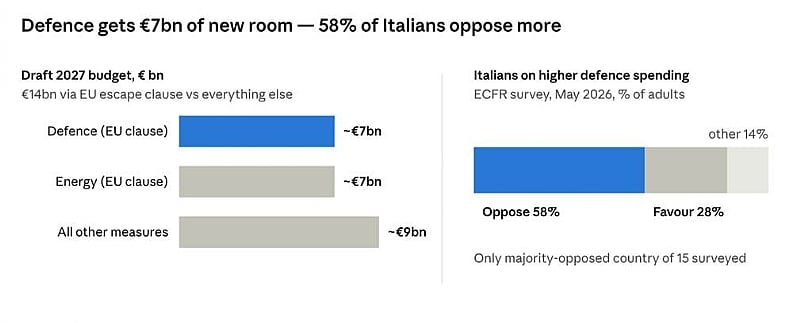
Draft Budgetary Plan 2027 as reported by Pagella Politica, Informazione Fiscale and QuiFinanza (Oct 2026); ECFR 15-country survey, May 2026
For protesters, the argument is not necessarily against security itself. It is about opportunity cost: if billions can be found for defence, why can the same urgency not be applied to wages, household bills, schools, health services and housing? The slogan circulating on protest platforms — in essence, "money for arms, not wages, schools and health" — captures that shift.
This is why the report calls military spending the strongest latent driver: it converts private economic hardship into a political judgement about the priorities of the state. The movement is becoming less about any single price increase and more about who absorbs the cost of the energy shock and rearmament.
That distinction matters. A government can answer a particular price complaint with a subsidy. It is much harder to resolve a protest movement built on the belief that the state has chosen the wrong priorities.
A protest movement without a single centre
Italy's protest landscape is unusually broad. Workers, students, hauliers, farmers, pensioners and health workers have all mobilised — but not as one movement. October brought two national general strikes, on 2 and 30 October; haulier blockades that disrupted fuel and food supplies in the South; and youth-led demonstrations that turned violent in Milan, Turin and Rome.
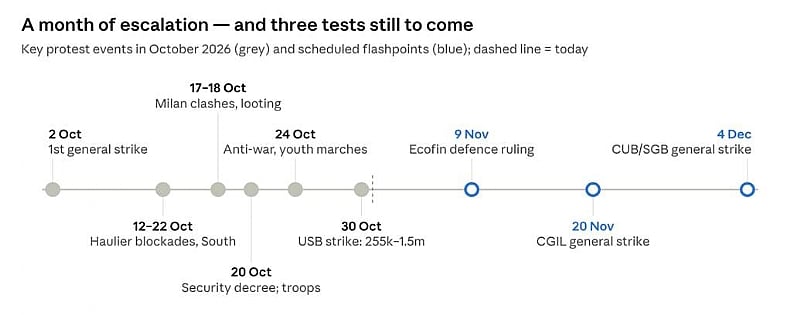
Reuters, AP, Euronews, Il Post, Sky TG24, trans.info, CGIL, Strike Tracker; turnout = Interior Ministry vs USB counts
The 30 October strike also exposed a contest over scale. The Interior Ministry counted about 255,000 participants; the organisers, the grassroots USB union, claimed 1.5 million. The gap reflects not only the size of the mobilisation but a political contest over how it is understood.
Fragmentation remains the movement's defining trait. USB keeps its own calendar; the CGIL confederation strikes on 20 November; CUB and SGB on 4 December. Youth networks such as Italia in Piazza and Movimento 17 Ottobre organise through Instagram and Telegram, outside traditional union structures.
That fragmentation limits the chance of a single overwhelming day of action. But it creates another risk: a longer calendar of disruption, rolling through successive sectors, cities and grievances. The assessment calls the mobilisation "broad but uncoordinated" — weaker at any single moment, but more persistent over time.
When protest meets public order
The most serious warning sign is not the size of the peaceful demonstrations. It is the interaction between mass mobilisation, fringe violence and an increasingly security-focused state response. The study scores today's observed public-order threat at about 50/100 (Elevated), but the latent escalation risk at 69/100 (High).
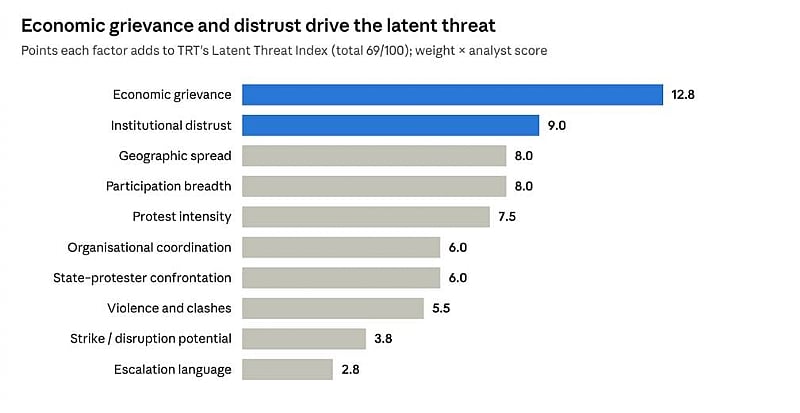
The study’s latent component scores, assessment of 31 Oct 2026 (analytical indicators, not survey data)
Violence has been concentrated in particular episodes. In Milan on 17–18 October, looting broke out near the Duomo: police arrested 28 people on the first day and detained 271 young people on the second, many of them minors, according to Reuters. Dozens of officers were injured. On 30 October, clashes broke out in Rome, where eight people were detained, and police used water cannon in Turin.
But the report is careful about what these events mean. The mass of protesters remained peaceful, and the analysts do not describe an insurrectionary movement. Instead, they see a latent risk built from economic grievance, institutional distrust, broad mobilisation and a growing number of actors operating outside union discipline.
The state has also hardened its posture. The government ordered 500 troops to Milan, approved a security decree-law on 20 October and blocked the 30 October transport strike by ministerial order. The danger, the analysis warns, is that the conflict comes to be framed as "order versus dissent" rather than as a dispute over wages, prices and policy — deepening the very trust deficit the authorities are trying to manage.
Italy's thin trust buffer
Perhaps the most important finding is not about protest numbers at all. It is about trust. This study puts Italy's Public Trust Index at 36/100, which it classes as Low Trust, and the surveys behind it are stark: only about a third of Italians trust the national government, and fewer than one in five trust political parties.
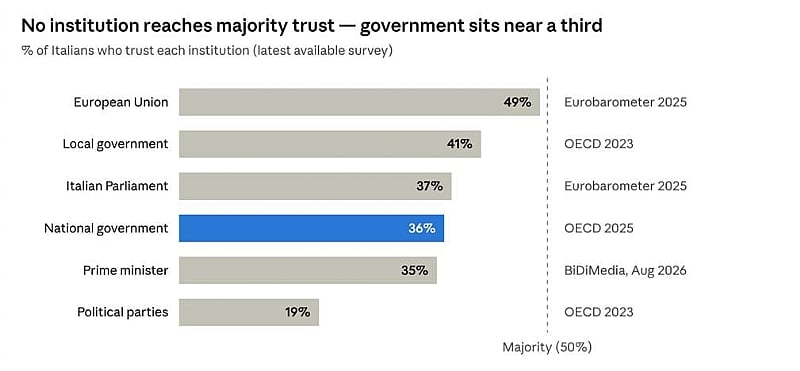
OECD Trust Survey (2023, 2025); Standard Eurobarometer, spring 2025; BiDiMedia, August 2026 — share with high or moderately high trust
The report stresses that this is not a new collapse caused by the protests. The trust deficit is chronic — and that may make the present moment more dangerous. A government with deep public trust can absorb criticism; one with a thin reserve has less room for error.
Every unpopular decision draws on that reserve. Every police confrontation becomes evidence for those who argue the government is not listening. Every unexplained budget figure reinforces the belief that ordinary citizens are carrying the cost while the state pursues other objectives.
Italy's protest wave has not yet caused a measurable collapse in public trust. But it is landing on an already weak institutional foundation. That may be the real warning.
The next tests are already on the calendar
The next few weeks could decide whether Italy's protest environment stabilises or widens. The first major test is the 9 November Ecofin decision on Italy's request for defence and energy flexibility. The CGIL general strike follows on 20 November, and a further grassroots strike on 4 December. Meanwhile, ISTAT's final October figure will show whether the 5.4% preliminary reading is a temporary spike or part of a continuing price shock.
The study sets out three possible trajectories. They are scenarios, not predictions.
| Scenario | What it would look like | outlook |
| 1. Contained pressure | Energy prices ease, household relief is introduced and the strikes remain one-day events | Plausible if November's data and budget decisions turn favourably |
| 2. Widening mobilisation | Wage and price grievances merge with anti-government demands; students, transport workers and public-sector staff join a wider movement | Central case through November–December |
| 3. Systemic trust and threat escalation | Defence flexibility approved with no social offset, serious casualties or mass detentions, and open-ended strike action | Lower likelihood, high impact |
The real problem may be the space between economics and trust
Italy's streets are telling a more complicated story than a conventional wage protest. The immediate grievance is economic. The political accelerant is defence spending. The vulnerability is institutional trust — and the potential threat lies in the convergence of all three.
The assessment recommends that policymakers act early on prices, through targeted energy, fuel and transport support for lower-income households. It also calls for greater transparency on defence and energy spending, structured talks with both confederal and grassroots unions, proportionate policing, and direct engagement with young people on jobs, housing and education.
But the central lesson may be simpler. People do not protest only because something is expensive. They protest when they believe that those deciding who bears the cost do not understand — or do not share — the burden.
Italy remains institutionally stable. Its protest movement remains overwhelmingly peaceful, and the threat is not insurrectionary. But the warning signs are accumulating. The study’s final rating is therefore as follows: High latent risk · High latent threat · Elevated observed threat · Low public trust · Status: Amber/Red — Strategic warning
The decisive question may no longer be whether Italy can stop the next protest. It may be whether the government can address the underlying grievances before each new protest becomes evidence in a much larger argument about who Italy's institutions really work for.
Sources
• ISTAT — consumer prices, September 2026 (final); October preliminary and Q3 GDP via Milano Finanza; monthly series via Rivaluta and Soldionline
• ISTAT wages — Soldionline, Q2 2026; purchasing power via Money.it
• Draft 2027 budget — Pagella Politica, Informazione Fiscale, QuiFinanza
• Defence-spending opinion — ECFR survey via La Notizia
• Trust — OECD Trust Survey 2026: Italy, OECD 2024 country note, Eurobarometer via Eunews, BiDiMedia via QuiFinanza
• Protests and policing — Reuters on Milan detentions and the 30 October strike; Sky TG24; Giornale La Voce; Il Post; Euronews
• Hauliers and fuel — trans.info
• Strike calendar — CGIL Milano, Strike Tracker
About The Author: Messan Mawugbe (PhD), [email protected]


 'Gen Z' demonstrations across Germany demand more education funding
 Some 320,000 demonstrators take part in largely peaceful protests across France
 Iran's Khamenei warns US and Israel against new attacks
 GoldBod to formalise eligible small-scale miners within six months under new pro...
 Ghana explores local, reginal production of HIV medicines
 Ghana’s economy grows to GH¢1.4 trillion in 2025 but fails to create decent jobs...
 Student denies charges of stealing Bishop Obinim's GH¢1.5million
 There's no dumsor in Ghana, everybody has power — Mahama
 Govt pledges support for family, seek justice for Ghanaian teenager killed in Ne...
 9% pay increment means little if workers cannot afford basic goods – Kwasi Kwart...


