




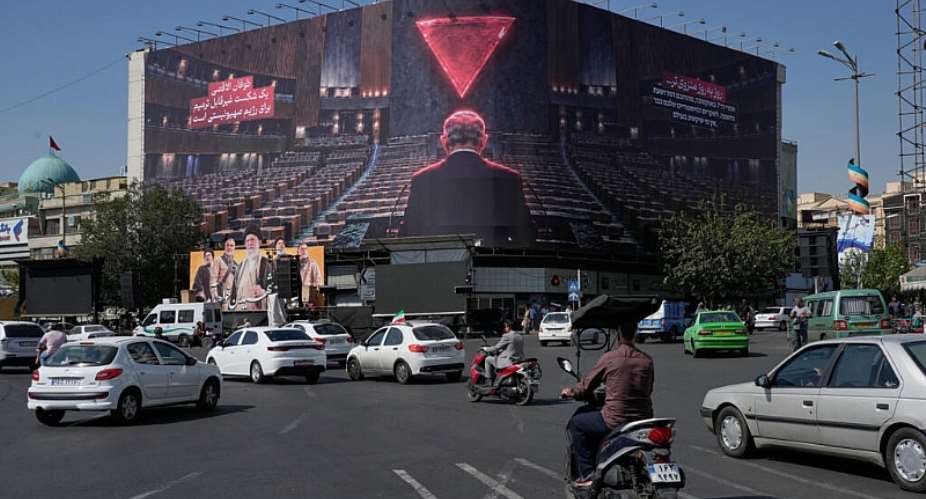
Iran's supreme leader on Saturday warned the United States and Israel against launching new attacks following their threats to resume strikes after crucial elections, as fears mount over a return to fighting.
The declaration came as the Islamic republic's top diplomat said there were no plans to hold talks with the United States, as indirect mediation via Qatar continues.
US President Donald Trump has warned of fresh military action after the US holds midterm elections early next week, saying last weekend that he was weighing whether to "finish them off".
In Israel, which is coming off fresh elections, Prime Minister Benjamin Netanyahu has spoken of a "historic, one-time opportunity" to topple the Iranian government.
US Secretary of State Marco Rubio said Saturday Trump had not yet made a decision about fresh strikes.
"We can achieve military objectives if we seek to. He hasn't made a decision. I have no announcement in that regard with you today, and nor do we take any of it lightly," Rubio said at a G20 press conference in Atlanta, Georgia.
Watch more Reports show US and Israel are planning new strikes on Iran
Polls in both countries could determine the direction of the conflict, with Israel having voted Tuesday but yet to form a new government.
"Any level or type of threat must be met with an immediate, impactful and geographically unrestricted response," Iran's Supreme Leader Mojtaba Khamenei told top military commanders in a meeting, according to a statement.
The encounter was the first reported meeting between Khamenei and military top brass, and included armed forces chief of staff Ali Abdollahi, army chief Amir Hatami and Revolutionary Guards commander Ahmad Vahidi.
The supreme leader has not been seen publicly since before he took the helm in March after the killing of his father Ayatollah Ali Khamenei in US-Israeli strikes.
Khamenei also ordered commanders to update Iran's target list to include "all types of tangible and intangible assets belonging to the American-Zionist enemy".
Iran has previously warned it would consider severing undersea cables in the Strait of Hormuz.
Petrol prices weigh on US vote
Since the initial US-Israeli strikes in February, ordinary Iranians "have been left in a state of limbo for the past year", Fariba, a Tehran housewife, told AFP.
But other residents in the Iranian capital brushed off the possible return to full-scale conflict.
"We do not fear another war. We have been at war for 48 years now," said Ebrahim, a salesman in his forties.
Since the outbreak of the war, Tehran has restricted shipping through the strategic waterway, which normally carries around one-fifth of global oil consumption.
Watch more Trump vs MAGA: Why his movement is splitting
The blockade has caused a spike in global energy prices, making the war unpopular among the US public ahead of midterm congressional elections Tuesday.
Gains for the opposition Democrats could restrict, to an extent, Trump's ability to enact policy.
Voting in Israel has left Netanyahu's political camp with the most seats in parliament but short of a majority, leaving the make-up of the next administration unclear.
Read more 'Atmosphere of fear': Trump moves to curtail voting rights ahead of the midterms
'Flames of war'
The war began on February 28 with US-Israeli strikes on Iran. The Islamic republic swiftly responded with attacks on American assets in countries around the region.
Fresh diplomatic efforts are underway to avert any resumption of fighting, with Qatari mediators landing in Tehran on Friday, and US Vice President JD Vance sending a letter to Iran's security chief Mohsen Rezaei.
But Iranian Foreign Minister Abbas Araghchi said on Saturday that "currently, there are no plans for meetings with American officials".
"Iran's conditions are clear, and consultations regarding them are ongoing among mediators," he said in an interview with Al Jazeera, according to the state news agency IRNA.
Read more Are fresh US-Israeli strikes on Iran in the pipeline?
Qatar and Pakistan have been mediating between the warring parties, but the talks have yet to produce a lasting agreement.
The Wall Street Journal reported on Wednesday that Vance had sent his letter to Iran's security chief at Trump's direction in a bid to revive negotiations and avert further US strikes.
Araghchi confirmed that Iran received the letter, saying, "The American side's effort to open a dialogue and reach a broader understanding is viewed as a positive step."
But the Iranian side kept firm its warnings against further attacks.
Earlier on Saturday, army spokesman Mohammad Akaraminia said that any resumption of hostilities would only expand the scope of the war.
"The flames of war will undoubtedly engulf a much wider geographical area," he said on social media, without elaborating.
Araghchi warned on X of an "Earth-shattering blow Iran's Powerful Armed Forces will deal against those who dare harm our people".
He said there would no longer be any "red lines".
(FRANCE 24 with AFP)


 'Gen Z' demonstrations across Germany demand more education funding
 Some 320,000 demonstrators take part in largely peaceful protests across France
 Iran's Khamenei warns US and Israel against new attacks
 GoldBod to formalise eligible small-scale miners within six months under new pro...
 Ghana explores local, reginal production of HIV medicines
 Ghana’s economy grows to GH¢1.4 trillion in 2025 but fails to create decent jobs...
 Student denies charges of stealing Bishop Obinim's GH¢1.5million
 There's no dumsor in Ghana, everybody has power — Mahama
 Govt pledges support for family, seek justice for Ghanaian teenager killed in Ne...
 9% pay increment means little if workers cannot afford basic goods – Kwasi Kwart...


