




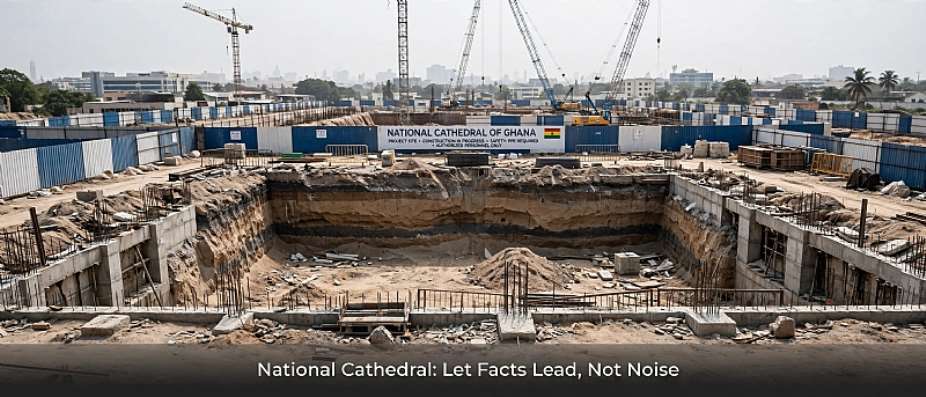
On 31 October 2026, the date the dissolved Board was told to hand over the National Cathedral site, the public debate remains deeply divided. One side already treats former President Nana Addo Dankwa Akufo-Addo as guilty. The other treats the matter as political persecution. I write for no party. My interest is the truth, and the truth on this matter is more careful than either side admits.
What has been established
President Mahama directed the immediate dissolution of the Board of Trustees of the National Cathedral project, and the trustees were told to hand over the site to the Ministry by 31 October 2026. On 5 October, the Minister for Local Government, Chieftaincy and Religious Affairs, Mahama Ayariga, said government will not put "one single cedi" into further construction. He added that the site was taken back because government considers the property to belong to the state, and that the next steps depend on the Attorney-General's review of the forensic audit.
The President has also explained his reasoning. He said the project began as a personal pledge by Nana Akufo-Addo to God and was not official state policy. He was careful to add that he has no quarrel with the idea itself. He said he is a Christian and has nothing against having a national cathedral. He has also raised concerns about the choice of site.
Clearing the misunderstanding
The first misunderstanding concerns what the President's statement means. Describing the cathedral as a personal pledge, not national policy, explains why his administration will not continue it with public funds. It is not a finding of theft, and it is not a finding of innocence. Reading it as either goes beyond what was said.
The second concerns the money. Figures have varied widely in public discussion. The President has since put the amount reportedly spent at about 90 million dollars, and said the forensic audit is with the Attorney-General.
The Board has long taken a different view. In a letter dated 24 September 2024, addressed to heads of churches and Christian leaders, Board Chairman Apostle Prof Opoku Onyinah wrote about the statutory audit for the period ended 31 December 2020. He reported that Deloitte's auditors had told church leaders there were no adverse findings. That is the Board's account of what the auditors said. At the time, Samuel Okudzeto Ablakwa, MP for North Tongu, called on the Secretariat to publish the full report, describing what had been released as the Secretariat's interpretation. An audit of a limited period, in any case, cannot answer every question about later spending.
The third concerns the word "misuse." It has been used loosely, as if a verdict had already been delivered. It has not.
What the official findings say
Fairness to all sides means stating the findings that are uncomfortable for the former President's defenders. CHRAJ found that the $312 million contract awarded to Ribade Company Limited was contrary to mandatory provisions of the Public Procurement Act. That is a serious finding about how the contract was awarded. A breach of procurement law is a failure of process, and it does not by itself prove that any person took public money for himself.
Government has also reported irregularities in the audit work done so far. Government communications said an audit uncovered multiple breaches and financial irregularities in dealings between the Secretariat and the Nehemiah Group. But the government itself acknowledged the limits of that work. It said the later Deloitte report did not cover the full scope of the Secretariat's operations and the project, which is why a forensic audit was ordered.
So the honest summary is this. Irregularities and procedural breaches have been reported. Who is personally responsible, and whether any crime was committed, has not been established.
The principle that should guide us
The forensic audit has been completed and submitted to the Attorney-General, who is studying it to decide on the next steps. Until that review concludes and its findings are made public, no one has a factual basis to declare the former President guilty of misusing state funds. By the same standard, no one has a factual basis to declare him innocent. The presumption of innocence protects every citizen, whatever his party, and it applies in both directions.
There is a hopeful sign of openness. The President said he would make a copy of the forensic audit available to the Christian Council so that it can examine how the money was spent. Meanwhile, the Christian Council announced on 11 September 2026 that it had formed a technical committee to identify a viable path forward for the project. Publishing the audit properly, and letting the Attorney-General's advice be known, would serve every Ghanaian better than speculation.
A word to both sides
To those certain of wrongdoing, I say wait for the evidence. A verdict declared early weakens a case that should stand on proof. To those defending the project, I say your strongest defence is transparency: welcome the audit and let the figures be examined openly. Both camps also owe the public a serious answer on the future of the site. The Minority Leader, Alexander Afenyo-Markin, has argued that a cathedral has value as a national symbol and for tourism, and he has criticised the lack of clarity from government about what the site will be used for. The government's concerns about cost and location are equally legitimate. A mature democracy can hold both views at once.
Conclusion
On this matter, the truth is unfinished. Ghana's task is to wait for the Attorney-General's review, to insist that its conclusions be made public, and to accept the outcome whichever way it falls. Clearing the misunderstanding means keeping three things apart that the debate has blurred: what has been proven, what has been alleged, and what is still unknown. Ghana needs its facts established in that order.


 'Gen Z' demonstrations across Germany demand more education funding
 Some 320,000 demonstrators take part in largely peaceful protests across France
 Iran's Khamenei warns US and Israel against new attacks
 GoldBod to formalise eligible small-scale miners within six months under new pro...
 Ghana explores local, reginal production of HIV medicines
 Ghana’s economy grows to GH¢1.4 trillion in 2025 but fails to create decent jobs...
 Student denies charges of stealing Bishop Obinim's GH¢1.5million
 There's no dumsor in Ghana, everybody has power — Mahama
 Govt pledges support for family, seek justice for Ghanaian teenager killed in Ne...
 9% pay increment means little if workers cannot afford basic goods – Kwasi Kwart...


